



A ‘Sine Die Seder’
What made the end of this year's General Assembly's session different was a Passover seder held in the state capitol.
Dave Schechter is a veteran journalist whose career includes writing and producing reports from Israel and elsewhere in the Middle East.
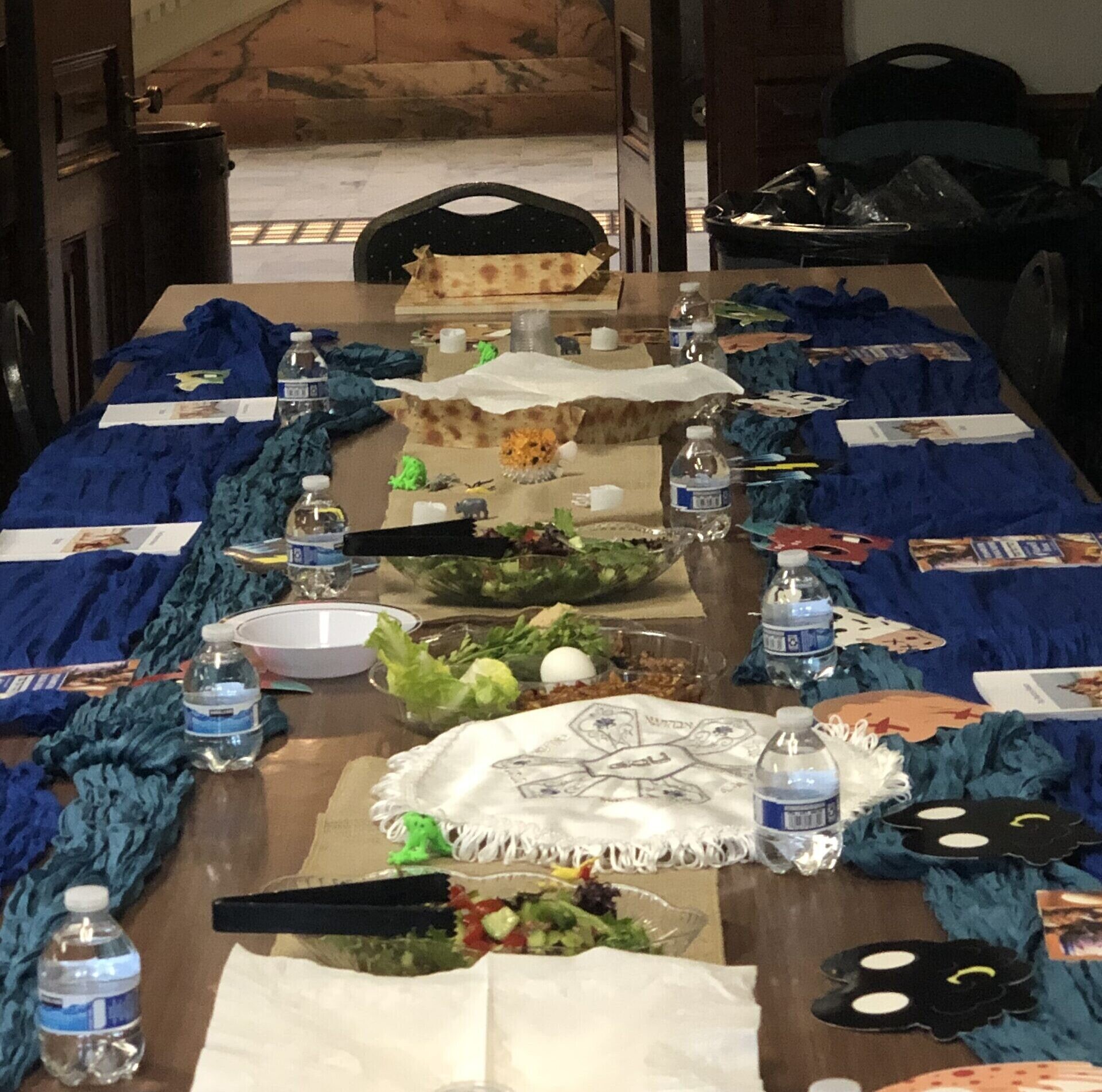
An unusual second-night Passover seder was held at the Georgia state capitol, on the last and usually most chaotic day of the legislative calendar.

Rep. Esther Panitch, the lone Jewish member of the General Assembly, organized the April 2 “Sine die Seder,” held in a second-floor conference room.
“Sine die” is a Latin term used to signal an indefinite adjournment. In the case of the General Assembly, it is signaled by the rap of gavels in the state House and Senate and members of those bodies flinging piles of paper into the air.
On this night, different from most other nights, the House and Senate often adjourn closer to midnight.
As the House conducted its business throughout the afternoon, Panitch ducked in and out of the chamber to check on preparations for the seder, work mostly in the hands of her chief of staff, Caroline Harper, and Alli Medoff, a friend and co-founder of the Georgia Solidarity Network, a bi-partisan political action committee that supports pro-Israel and pro-Jewish elected officials and legislation.
The unique seder began not at sunset but shortly after 6 p.m., when Republican House Speaker Jon Burns declared that the chamber would break for dinner.

The three dozen people seated at three long tables included a couple of Panitch’s House colleagues, along with legislative staffers, lobbyists, representatives of Jewish organizations, citizens with an interest in the legislation being debated, and journalists, among them an esteemed Jewish political reporter from the Atlanta Journal-Constitution.
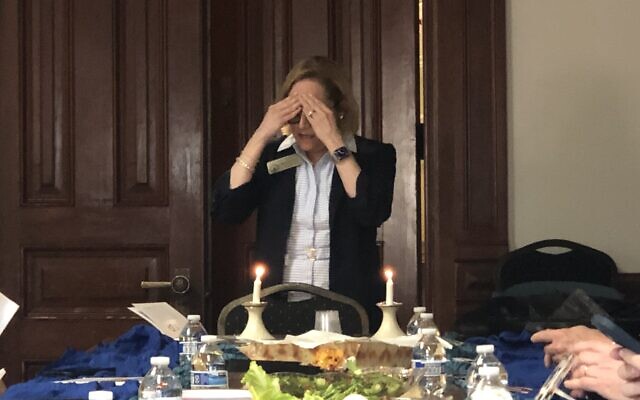
Panitch lit and recited the blessing over the holiday candles and the Shehecheyanu prayer. The proceedings were conducted by her husband, Roger Panitch, using a Haggadah created by their family.
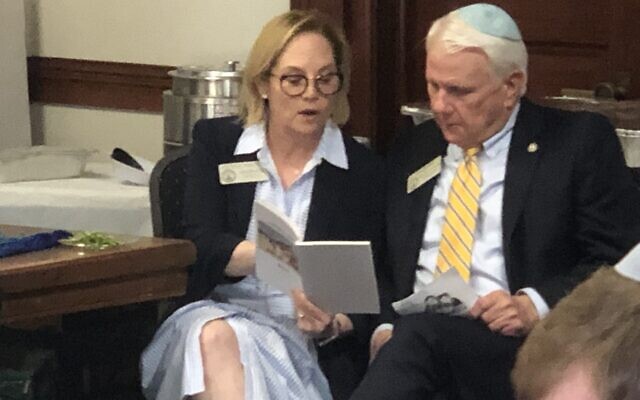
Panitch had invited Burns to attend and shortly after the white-haired House Speaker entered the room and donned a light blue kippah, there was discussion of the afikomen.
“We can hide it in the budget. No one will find it,” said a voice from the back of the room (which may or may not have been that of a legislator).
Burns sat next to Panitch as she explained the various Passover rituals.
In a deft piece of politics, when it came time to discuss the four sons in the Haggadah, Panitch assigned the role of the wise son to Burns, who read his portion in English.
Panitch, in turn, handled the words of the wicked son, in Hebrew and English.
A highlight — appropriate given when and where the seder took place — was a group recitation of “Sine die-yeinu” (From Election Night to Final Gavel), a play on the Passover song “Dayeinu,” written by Rabbi Michael Bernstein of Congregation Gesher L’Torah, tracing the progress of an elected legislator and legislation.
A meal — including matzoh balls in chicken soup, stuffed chicken, brisket, salad, potatoes, a blueberry cobbler — was served, after which most of those in attendance, Panitch included, departed, as the House gaveled back into session at 7.30 p.m.
Those who remained sang their way through Chad Gadya (“one little goat” in Aramaic) in English and Barrow County Commissioner Alex Ward delivered the entirety of Echad Mi Yodea (“one who know”) in Hebrew.
The seder is proscribed to end by midnight. So, too, is the final legislative session, but work in the House and Senate crept over the line from late Thursday to early Friday.
comments