



A Journey to Jibou
Cousins arrange for the repair of family graves and create a fitting memorial service.
Chana Shapiro is an educator, writer, editor and illustrator whose work has appeared in journals, newspapers and magazines. She is a regular contributor to the AJT.
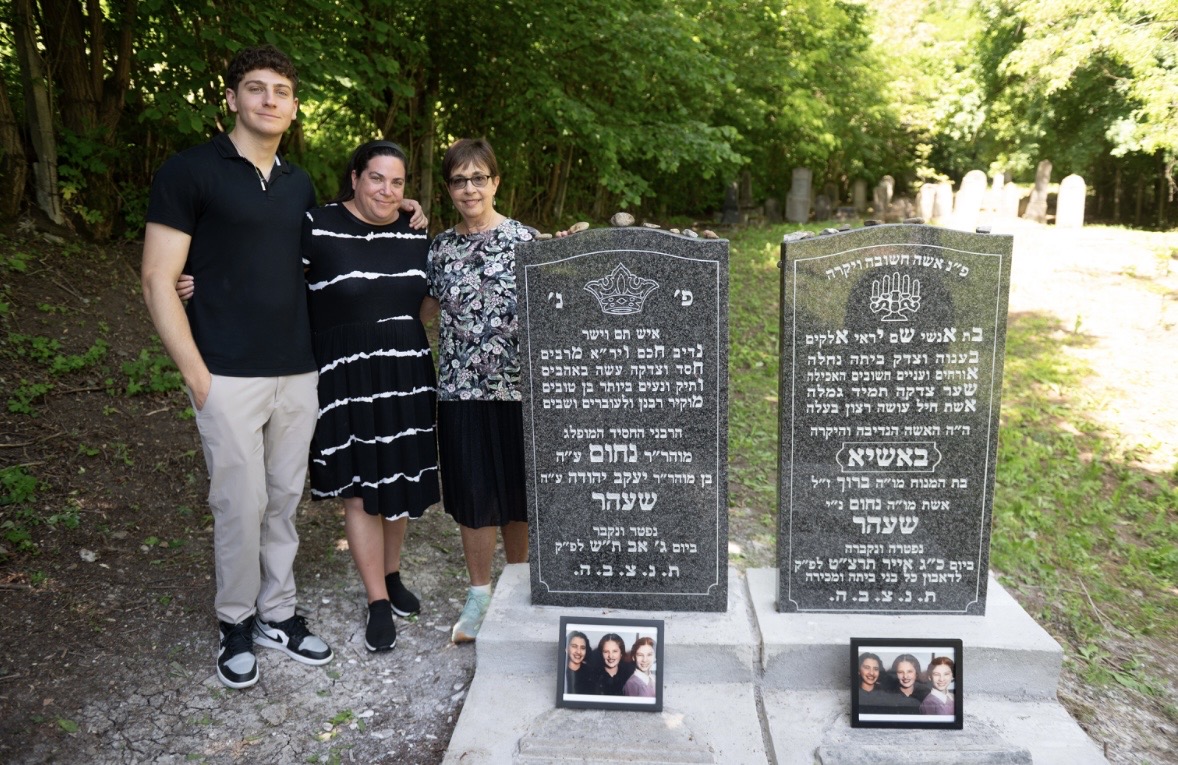
Jessica Wilson has always treasured feeling close to her third cousins and their families, even though they live far from her own family in Atlanta. The bonds deepened every summer when her sons attended Camp Stone in Pennsylvania with their fourth cousins. The strong family kinship is the generational result of the relationship between Jessica’s maternal grandmother, Hedwig Gross Weiss, and Hedwig’s first cousins, Esther Scher Steinberg and Hedy Israel Heller. The three cousins felt like sisters as the only family survivors of the Holocaust, and the women’s attachment is mirrored among subsequent generations.

One product of the enduring closeness was a multi-family, multi-generational trip back to the family’s roots in Jibou, Romania. The purpose of the journey was to take part in a family memorial service and to personally experience the full restoration of the desecrated graves of Nachum and Basya Scher, Jessica’s great-great grandparents. The family trip took shape following an aspirational idea that was proposed by Jessica’s third cousin, Zev Steinberg (Esther’s grandson), who lives in Boston. Jessica notes that a cousins’ group chat over the span of a full year was productive through discussions about the entire grave restoration process and resulted in planning a family trip to Jibou, where many cousins could stand at the gravesite together. The emotionally-laden event took place on May 27.
On a previous trip to Jibou in 2019, Jessica’s cousin, Zev, had been saddened and angered when he saw the desecration of the gravestones of his grandmother’s own grandparents who died and were buried in 1944, shortly before the Hungarian Nazis removed all the Jews from Jibou. Zev was determined to do something about the destroyed graves. He created a detailed family genealogy study, and he gained access to the Romanian government archives from Jibou, from which he gathered the names of every murdered family member. With his cousins, he shared his desire to replace the original, degraded headstones, which marked the graves in a gated Jewish cemetery. The process of restoring the graves was guided by Rabbi Yoseph Meissells, who lives in Brooklyn, N.Y. Rabbi Meissells is known for his wide experience in aiding Jewish families to restore gravesites throughout Europe, and he agreed to help.
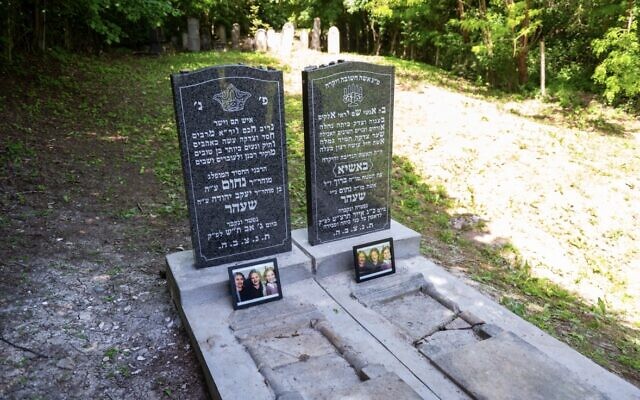
Consulting with his cousins, Zev ordered new headstones to be made in Jibou that would be replicas of the originals, and on which they could include a unique, impactful addition. On the backs of the new gravestones, the names of every family adult or child (31 names in all) who perished in the Holocaust, (and therefore for whom there are no graves), were permanently incised. All useful pieces of the original headstones had been carefully gathered, saved, and power washed, and the family was able to repurpose the largest pieces to create flat grave covers for both graves.
For 82 years, the family’s Holocaust victims had no permanent memorial and were not mourned or ever had Kaddish recited for them. The descendants standing together at Jibou created their own poignant ceremony, during which memories were shared, each reclaimed name was intoned, and they then recited a psalm and select prayers. At the feet of the graves, they positioned framed portraits of Hedwig, Hedy, and Esther, the women who survived and carried the family lore and traditions to America.
Jessica explains, “Traditionally, a Jewish funeral concludes with mourners helping to fill in a grave. Our memorial ceremony was not a funeral. Rather than burying our dead, we were reclaiming their memory and honoring their lives.”
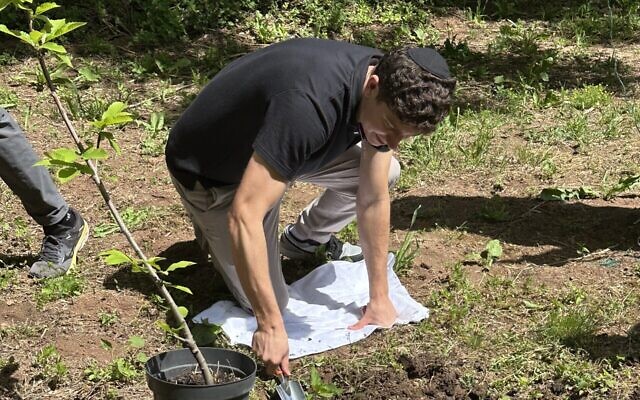
She continues, “It seemed fitting, then, that we decided to end the service not with Kaddush, an act associated with death, but by planting a tree, to renew and provide continuity with the past.”
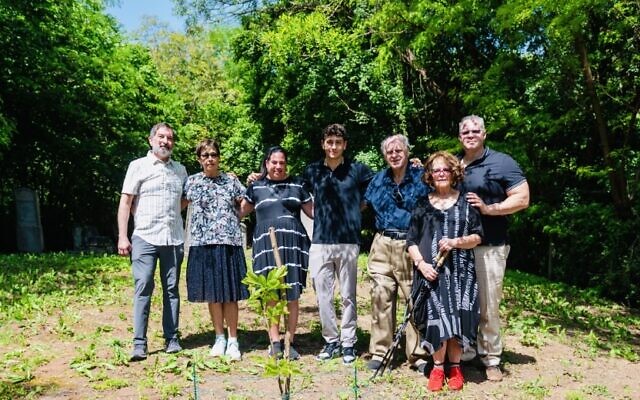
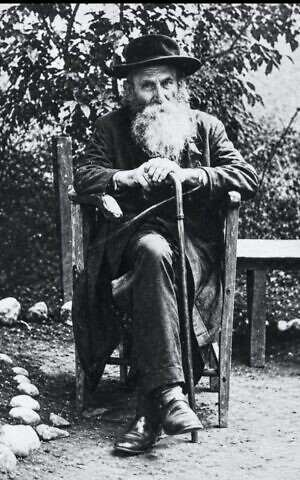
The group planted a young chestnut tree beside the restored graves, referencing a chestnut tree featured in a picture the family members have of Jessica’s great-great grandfather, Nachum Scher, sitting peacefully under the chestnut tree in his backyard. The new tree provides shade over the gravesite, which now includes the names of his murdered children and grandchildren.
Jessica lyrically muses, “In a sense, we gave our great-great grandfather the opportunity to sit beneath a chestnut tree once again, surrounded by a group of descendants, who — despite war, loss, and generations of geographical separation — had come together again in Jibou, the hometown he loved.”
Seven members of the three survivors’ descendants met in Jibou. After Jibou, they traveled to Bucharest, where they experienced the threads of family attributes. Jessica’s grandmother often spoke about her father who was a chazzan, and one of the descendants on the trip, Howard Steinberg is a chazzan who beautifully led the memorial prayers at the family service. Notably, the musical gift has continued into another generation: Michael, Jessica’s son, a great-great-great grandchild who was on the trip, spontaneously sat at the piano and serenaded everyone in the iconic bar of the Grand Corintha Hotel in Bucharest.
“Moments like these,” Jessica affirms, “make it clear that family traits and talents can endure across generations, connecting us in meaningful and personal ways.”
Jessica summarizes the historical importance and personal impact of the gravestone replacement trip. “As the grandchild of Holocaust survivors, I was raised with a deep sense of responsibility to bear witness and ensure that those who were lost are never forgotten. This journey allowed me to do both — not only by remembering the past, but by honoring our forbearers, alongside my mother and my son. Three generations standing together, in the place where our family’s story began, was a powerful reminder that memory is not only preserved through history, but through the people who carry it forward.”
Jessica Wilson, a social worker, is a geriatric case manager for Jewish Family & Career Services. Her husband, Joey, works in marketing. Their youngest son, Jonathan, attends Atlanta Jewish Academy (AJA); their oldest son, Simeon, is a University of Georgia grad and an AJA alum; and their middle son, Michael, also an AJA alum, is a student at Georgia Tech. Michael and Jonathan are working at Camp Stone this summer. The family are active members of Congregation Ohr HaTorah.
comments