



KSU’s Schwartz Wins Highest Undergrad Honor
Ari Schwartz received Kennesaw State University’s Fall 2025 President’s Award of Distinction.
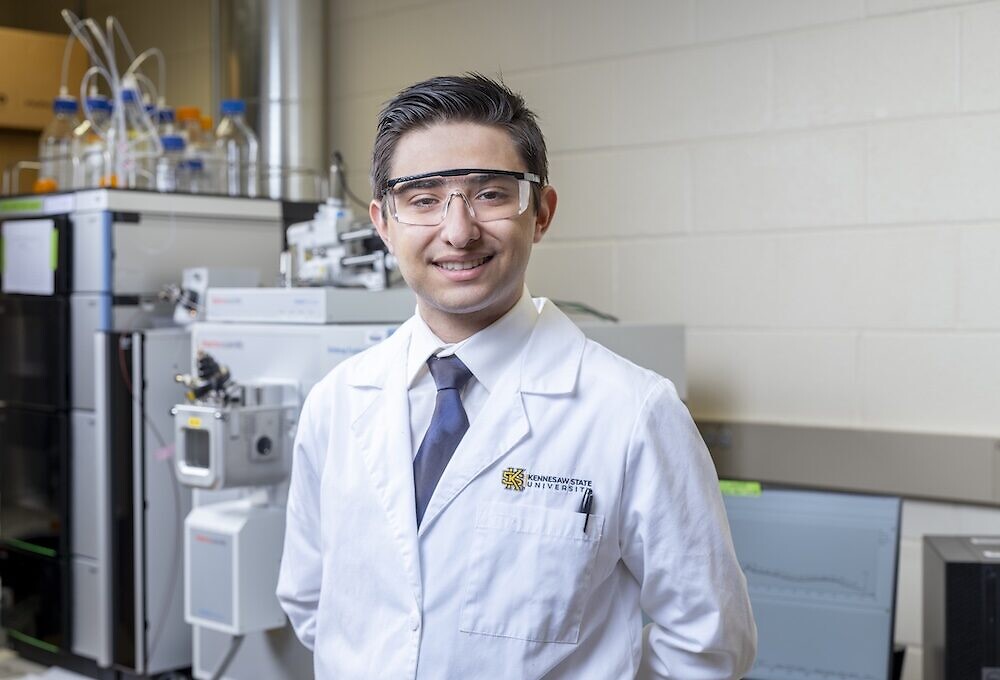
When Ari Schwartz went up on stage with the platform party at his graduation to receive the Fall 2025 President’s Award of Distinction, presented to only one Kennesaw State University (KSU) student in his 4,500-student graduating class, he’d already accrued a long list of accolades. These included a competitive national scholarship, a 4.0 GPA, teaching others through a NASA-sponsored program, and, as of the day, graduating a semester early – achievements made all the more impressive due to the fact that, just a few years earlier, he and his family weren’t sure he could even handle college.

Schwartz had been diagnosed with autoimmune encephalitis, which can cause a variety of symptoms, including short-term memory lapses, tics, brain fog, anxiety, and malignant OCD.
“At this time in my life, I wasn’t able to do the things most students take for granted, such as sports, social events, and even just keeping up with daily routines, said Schwartz. “So, I missed an entire year of school as I went through intense treatments, including plasmapheresis, immune-suppressing therapies, and surgeries to facilitate these treatments.”
But by going to school close to home, and with intense support from his family, Schwartz was able to succeed, turning some of his weaknesses into sources of personal strength.
“All in all, I would much rather not have OCD, but I was able to exploit its ‘desire for perfection,’ to do great academically. As a result, I got a 4.0 GPA that first semester and then every semester after that. I even took summer classes so I could make up for the time I lost when I dropped out of public high school.”
This success immediately began transferring into other areas. In 2023, with editing assistance from his brother David, Ari Schwartz submitted a video related to a topic of personal interest – genetic engineering and CRISPR – for the Joy Cappel Scholarship, a competitive $2,500 award given by Rockland Immunochemicals for students of the life sciences, in both undergraduate and graduate programs. He won.

“Whereas most of the other applicants for this scholarship focused on what scientific breakthroughs have allowed us to do, I focused on what CRISPR-Cas9 gene editing will allow us to do in the future,” said Schwartz.
This sort of scientific communication would be something of a repeating pattern through many other achievements.
“In order to facilitate research, you need to be able to tell others about what you know, and have others tell you about what they know,” Schwartz said.
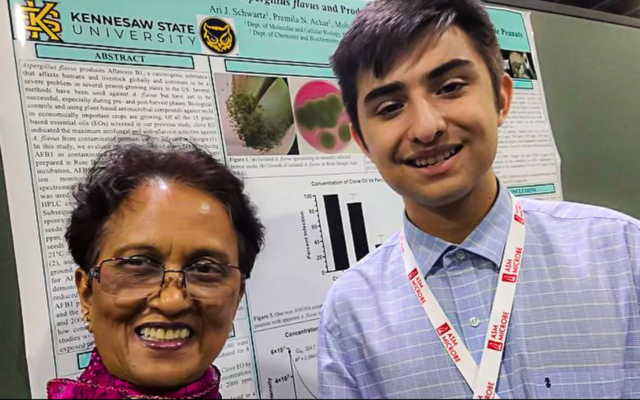
And he certainly has done so. After publishing research on the effects of castor oil as a natural fungicide for peanuts – a topic he began working on after a professor suggested he shift focus away from his original intention of genetically engineering the peanuts to resist fungus – Schwartz presented on the topic at several regional and national science conventions.
“When I first did a conference, I was very anxious, because I didn’t have any experience at first,” said Schwartz. “But I did have somebody who worked with me on the research, who had more experience with presentations. So, I practiced with him in order to get myself prepared to communicate. Eventually I became comfortable explaining my research.”
He used the same skills to communicate with and teach the next generation of scientists, through the NASA scholars program. While the program includes several opportunities to learn from other researchers, and visit places like the CDC; the part Schwartz enjoyed the most was teaching STEM subjects to underrepresented high school students. As part of this, he adapted college-level KSU labs and sat with the students, guiding them along the process in an engaging manner. He discussed one of these, a genetic engineering lab where they created fluorescent bacteria, with great zeal.
As for what’s next for this young scholar, he hopes to become a doctor, and recently received an opportunity to shadow world-renowned cardiologist, Dr. Howard Snapper, a leader in the treatment of POTS and syncope, and to assist him in his research.
Schwartz’ interest in the medical field is deeply inspired by his personal experiences, trying often with great difficulty to receive an accurate diagnosis.
“I’ve had to travel out of state a lot to go to different doctors, and sometimes not all doctors were the best for me,” said Schwartz. “My family has dealt with a lot, and I’ve dealt with a lot, in terms of finding a good doctor that can treat me. So that kind of makes me want to be someone that can actually treat people correctly.”
comments