


‘Lehman Trilogy’ is Not to be Missed
The local actors hold up over a century of powerful decisions.
After 37 years with the Atlanta Journal-Constitution and now with the AJT, , Jaffe’s focus is lifestyle, art, dining, fashion, and community events with emphasis on Jewish movers and shakers.

The term “epic” denotes tones of grandeur in terms of size, scope and ultimately length. “The Lehman Trilogy,” performed at the Theatrical Outlet, is epic because it does so much with so little fanfare.

Three actors and a modest stage craft legions with a fast-moving train of a script; although three hours and two intermissions qualify for length. How can riveting history from 1844 to 2008 cover it any less? Matters not, as Andrew Benator, Brian Kurlander, and Eric Mendenhall make such deft use of the set and dialogue, time is just a sweep of a feather, the changing of a store sign, the evolution of three generations.
Produced in conjunction with the Breman Museum, “The Lehman Trilogy” was introduced by director Matt Torney and Museum Executive Director Leslie Gordon, who shared the Breman’s role as “story seeker and story keeper.” She noted this story was rooted in the South, but “not only about the South.”
Delving into the rise and fall of the Lehman Brothers’ Bank, “Trilogy” fills in the back story to witness a saga where the end is already known.
In this writer’s career at Cox Enterprises, local mogul Jim Cox Kennedy often began his speaking engagements with a Chinese proverb: “The first generation makes the money, the second generation invests the money, and the third generation squanders the money.”
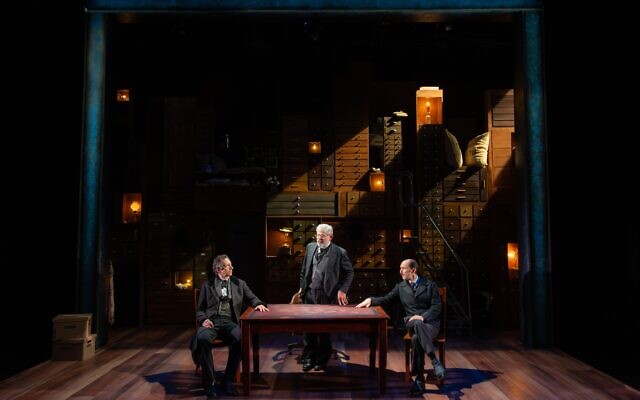
The “Trilogy” audience can decide if the fall of Lehman Brothers was timing, or the players themselves or both. Whatever happens at the end, the first act — with the three immigrant brothers settling in Montgomery, Ala., to sell fabric (recall 1998 book by Suberman, “Jew Store”) — morphs into the genius economic machinations of the brothers who steam-engined their ideas as businessmen before the Civil War to New York society with some assimilation.

No better cast could have been found in London (2018) than our local trio. Much has been made (since “Hamilton”) of using actors with “lived experiences.” Some other city “Trilogy” productions didn’t have an all-white, all-Jewish cast. These three Atlanta men are grounded in the way they say “baruch hashem,” recite the kaddish, light the hannukiah, and break into Southern society while the children are still in Hebrew school. Benator, Kurlander and Mendenhall use the stage as their tool utilizing nothing but a shawl, white flowers, and some wooden chairs. They walk a tightrope, hang street signs, and court their fiancés, never walking more than a few feet. But wait, they actually portray demure women, country folks and New Yorkers, changing accents on a dime.
Kurlander (the older Henry Lehman), whose character dies early in the production, comes back in several different forms, ricocheting accents and posture in seconds. Kurlander, who was recently glowingly reviewed in the City Springs production of the “Music Man,” told the AJT, “I hope audiences will walk away feeling like they experienced an epic story. One that they are hearing for the first time but also recognize as uniquely singular to the ‘American Dream.’”
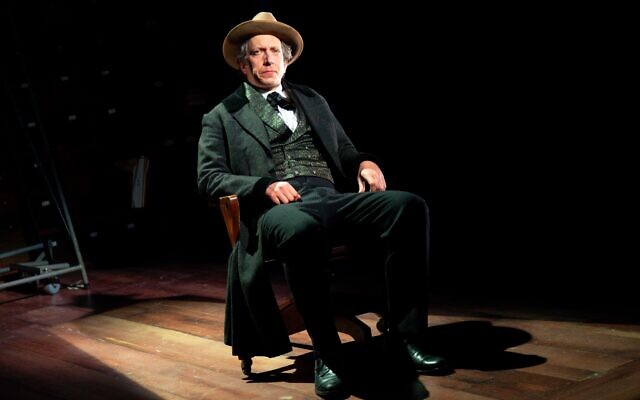
Benator (Mayer Lehman), a seasoned local actor who plays the “potato-looking, buffering” brother with a bucket of stage presence, also told the AJT, “After the overwhelmingly positive experience I had on ‘Remember This: The Lesson of Jan Karski,’ co-produced with The Breman, I knew that ‘The Lehman Trilogy’ would be a great opportunity to deepen that collaboration. The Jewish and Southern themes of the play overlap with The Breman’s mission, and the conversations we had in rehearsal with Leslie Gordon and Rabbi Joe from The Breman were extremely helpful in crafting the story.”
Mendenhall (Emmanuel Lehman), who holds up his 33.3 percent of the stage, said, “The Lehman Trilogy” has proven … in various productions around the country (and the world) that a profoundly human connection is created with an audience, no matter where this play is performed. It’s a play made for the theatre — full of soaring ideas, deeply poetic, and visually stunning. The script is wildly ambitious in what it asks of its actors, and I love that challenge.”
Audience member Linda Schear didn’t align with the play’s duration, and said, “I enjoyed the play and thought the three actors were wonderful and adjusted their roles well when needed. My only downside was that the play definitely could have been edited to keep it from ending near 11 p.m.”
“The Lehman Trilogy” runs through March 2.
comments