



Purim, Persia, and Iran
Iranian Jewish community closely monitors news, while women's group makes its way home from eventful Israel trip.
Dave Schechter is a veteran journalist whose career includes writing and producing reports from Israel and elsewhere in the Middle East.

The timing of U.S. and Israeli air strikes on political and military targets in Iran — beginning two days before the Jewish holiday of Purim — was hard to miss.

Purim commemorated the salvation of the Jews of ancient Persia in the fourth century before the Common Era, as told in the Biblical Book of Esther. The setting for that story is Susa, a city today known as Shush, a drive of more than 400 miles southwest from Tehran.
Persia was renamed Iran in March 1935, by the late Reza Shah Pahlavi. Tehran, the capital of Iran (and before that, Persia, since 1796), has been the locus of airstrikes that began on Feb. 28, at about 9.45 a.m., Tehran time (1:15 a.m. in Atlanta). Iran has retaliated with missile launches against Israel and other U.S. allies in the Persian Gulf region.
These events have been watched with particular interest by Atlanta’s Iranian Jewish community, said to number several thousand. Among them is Anna Nooromid, a 61-year-old native of the Iranian city of Isfahan who left that country in February 1979.
“A week before the Shah was exiled and Khomeini came into power my mother put me — all of 14 years old — on the last El Al flight ever out of Tehran to Tel Aviv,” Nooromid said. The Ayatollah Khomeini returned to Iran from exile in France on Feb. 1, 1979. The last El Al flight left Iran on Feb. 10. The Shah’s monarchy fell on Feb. 11.
“I lived in Israel for a year-and-a-half before moving to the United States. My mother and my two brothers were all in Atlanta, Ga., together. That was over 45 years ago,” she said.

At the time, a community of about 50 Iranian Jewish families was centered in the Toco Hills area, but as their numbers grew and children were born, they spread into the suburbs. “I remember my children going to Jewish private schools with a lot of these families . . . and we assimilated into their communities,” Nooromid said.
She has been following events “very closely,” supplementing reports by U.S.-based news media and online sites with Iranian podcasters “just to see different perspectives on how everything is being reported in the states vs. in the country of Iran itself,” she said.
“I’m happy for the people of Iran who have this amazing and historical opportunity to free themselves from this regime. I am glad that Iran is not going to be a threat to the U.S. and Israel and all the other countries in the region. I am hopeful that after 47 years, maybe one day, I will be able to go back for a visit.
“I feel like the Iranian Jewish community is a lot more assimilated and maybe have less of a desire to go back — but everyone would like to see Iran free and to be able to go visit and see where they once lived,” Nooromid said. “I don’t think anyone would go back to live there, because most of their families have left the country, too, but to have the opportunity to see our home and revel in the memories would be incredible.”
A delegation of 22 women from the Jewish Women’s Connection of Atlanta, on a “Voice of Courage Israel Trip,” found itself in harm’s way in Jerusalem when Iran launched missiles at Israel on Feb. 28.
Leslie Kulbersh Lipson posted on Facebook, on the evening of March 4, that the women “got on a bus in Jerusalem and headed south, crossing through the Sinai under the cover of darkness to evacuate Israel through Egypt to Italy then to Atlanta.
“Just three hours earlier, we had been sitting together listening to the Megillah for Purim. The Book of Esther, a story about a moment when the Jewish people once again faced destruction and survived. The past couple of days had already been surreal. Iranian missile sirens. Running to shelters. Playing mahjong in strengthened stairwells. Doing skincare routines in bomb shelters. A hotel employee helping someone in our group replace the glasses she lost in the Old City. Strangers becoming friends because we kept ending up in the same shelter together,” she wrote.
Writing from an Italian airport, in a list of what stood out on the trip, Kulbersh Lipson closed with the following: “This experience was a reminder of something Jews have always known. We are not the ones in control. We believe that God is. We do not always understand why things unfold the way they do, whether in our individual lives, in our group, or for the Jewish people. But we try to stay open to what we are meant to see along the way. And this week in Israel reminded me that the Jewish story is still unfolding, and we are all part of it.”
The war was on the mind of Rabbi Brad Levenberg, senior rabbi at Temple Sinai and president of the Atlanta Rabbinical Association, as he addressed the March 3 closing night audience at the Atlanta Jewish Film Festival.
“Many of us arrived with the Middle East on our minds, and not just because the holiday of Purim is ending with the setting of the sun, but because of the active military conflict involving Israel, the United States, and Iran. There is fear for loved ones, worry for soldiers, anguish for civilians, and a lingering uncertainty about what tomorrow will bring. Even tonight, as we assemble in celebration, that weight does not simply disappear at the door,” Levenberg said.
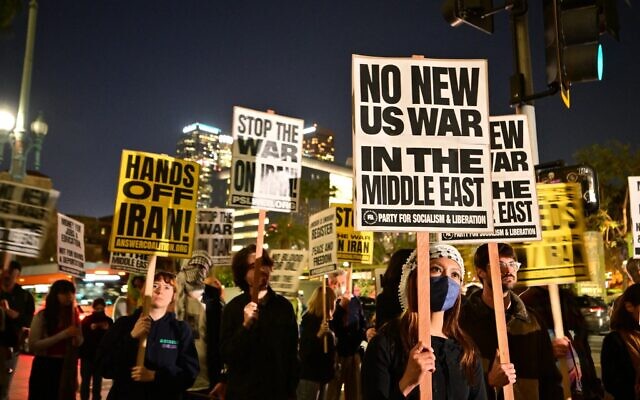
Georgia Democratic U.S. Sen. Jon Ossoff, who is Jewish, spoke about the war on March 2 outside the state capitol in Atlanta after qualifying for re-election.
“We’re here today in war time and so, on behalf of all Georgians, I express our grief at the news Americans have been killed and our deep sympathy for the spouses and children and loved ones of those who have made the ultimate sacrifice for our country. And with immense gratitude for all who serve, we pray for the survival and recovery of the wounded and for the safety and success of American service members engaged in combat,” he said. “Our commander-in-chief has no more somber responsibility than the stewardship of their lives. Sending Americans into combat should be a last resort in the pursuit of vital national interests.”
Ossoff repeated criticism of the decision of President Donald Trump to strike Iran.
“Eight months ago, President Trump lied to the country when he falsely claimed to have ‘obliterated’ Iran’s nuclear program. Now he says he’s taken the United States to war for regime change, without evidence of imminent threat, without having exhausted diplomacy, without clear objectives or a plan for the aftermath, and without the consent of Congress,” Ossoff said.
“The American people overwhelmingly oppose another open-ended regime change war in the Middle East. And the president owes Americans a real explanation for his decision to take this nation to war. Two a.m. posts on Truth Social are just not good enough when you’re sending Americans into combat,” he said.
Ossoff supported a failed War Powers Resolution that would have limited Trump’s ability to order military action without congressional approval. On March 4, the Senate rejected the resolution by a vote of 47 in favor and 53 opposed.
In a March 1 statement, the Jewish Federation of Greater Atlanta said the agency “prays for the success of the joint United States and Israeli actions in Iran and the safety of the brave fighters of the United States Armed Forces and the Israel Defense Forces carrying them out. We are closely monitoring events on the ground and communicating with our colleagues and partners in Israel.”
The lone Jewish member of the Georgia General Assembly, Democratic state Rep. Esther Panitch, posted Feb. 28 on the social media platform “X” a picture of two lions, one draped in an Israeli flag and the other with the Iranian “Lion and Sun” flag, which depicts a lion holding a sword. That emblem was replaced after the 1979 Islamic revolution that deposed the Pahlavi dynasty.
Above that image, Panitch wrote: “My prayers are with every American service member and IDF soldier standing together against the murderous IRGC. May God protect them and bring them home safely to their families. We also pray for the Iranian people, who deserve freedom from the regime that oppresses them. God Bless America. Am Yisrael Chai.”
On the business front, Delta Air Lines canceled flights to Tel Aviv from JFK International Airport in New York through March 8 and from Ben Gurion Airport near Tel Aviv to JFK through March 9.
comments