


Rabbi Roundtable: Dec. 31, 2025
The AJT has launched a new monthly feature bringing rabbis together from across all denominations and Jewish Atlanta.
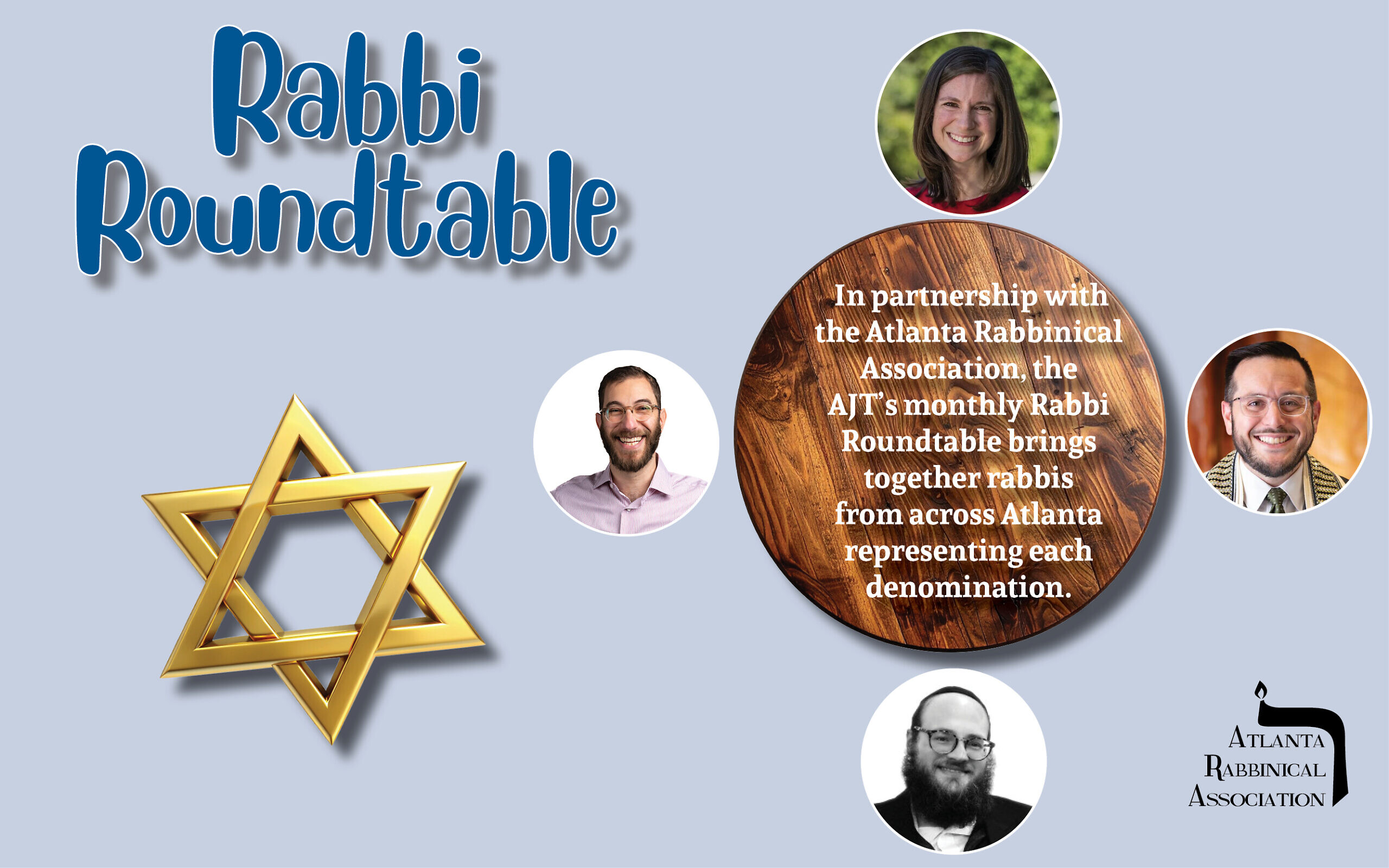
In Partnership with the Atlanta Rabbinical Association, The AJT’s monthly Rabbi Roundtable brings together rabbis from across Atlanta representing each denomination.

 For this month’s discussion, each rabbi was asked the following question:
If the Maccabees were alive today, would we even like them? What would their zealotry look like in our contemporary Jewish landscape?
Rabbi Ayal Robkin
Even the Rabbinic tradition offers no single judgment on the Maccabees. It was long assumed that the Sages held deep animosity toward the Hasmoneans. However, scholar Vered Noam (thank you Hadar faculty Jeremy Tabick for pointing this out) demonstrates that there is no evidence for this. In reality, the harsh critiques are found primarily in the Babylonian Talmud, relying on narratives from Josephus. Conversely, sources from the Land of Israel generally view the Hasmoneans favorably, celebrating them as the guardians of the last instance of Jewish sovereignty for two millennia.
So, how to judge the Maccabees! The answer may reveal more about the judge than the subject.
Ask a toddler why they dislike something, they will find a reason. Toddler: “I don’t like these pants.” “Why? They are soft and stretchy. You wore them last week.” Toddler: “They make my legs feel dizzy.” “Your legs can’t feel dizzy from pants; I think you just want to stay in your pajamas.” Toddler: “No, the dizziness is hiding inside the pockets.” As adults, we do the same thing; we’re just better at hiding it. We confabulate intellectual reasons to justify emotional instincts.
Rav Yisroel Salanter, the 19th century founder of the Mussar movement, insightfully notes that we rarely perceive the truth of our judgments because we are blinded by “inclination towards love and hate.” He describes the human mind tying “rope to rope, hair strand to hair strand,” weaving intellectual justifications for emotionally based conclusions, us rarely recognizing the true “first cause” of our beliefs.
Judging the Maccabees isn’t right or wrong. It’s just that the challenge, in the judgment, is intellectual humility. Can we work to transcend the instinctive, subconscious thought of ‘this-vibes with-MY-position-so-I’ll-stop-thinking-critically-about-it?’ Can we withhold judgment before we more or less understand them on their own terms?
Rabbi Chase Foster
Judah Maccabee, his family, and their followers fought those who sought to prevent our religious expression. This is an honorable endeavor, and one that I know many Jews appreciate and idolize. Especially given the evils of Jew-hatred and religious extremism that we encounter today, we should all work to ensure that Jews everywhere have the freedom of religious expression, regardless of denomination and adherence.
However, the extremism of Judah and family is something we must reject. We can be strong for our people without sacrificing our own humanity. We can be fierce advocates for ourselves without appeasing the evil inclination within us. We must not allow the bigotry of others to allow us to become callous.
Would we even like them? As humans and members of our community, possibly. As leaders we would want to elevate and emulate? No, thank you.
Rabbi Lauren Henderson
It’s quite easy and tempting to map the Maccabees of the 2nd century BCE onto today’s far-right or far-left Jewish extremists. They were zealots who were willing to take dramatic and sometimes violent action to work for the preservation of the Jewish religion and people, as they understood it, and they saw their zealotry as justified in the moment just as Pinchas’ zealotry in the book of Numbers was justified.
The problem is, they’re the heroes of the story of Hanukkah – so they can’t be both the heroes we revere and the extremists we reject! So, what are we to do?
I understand the Maccabees as a profoundly countercultural force in their time. In the Hellenistic period, the dominant culture was one of blending, mixing, and assimilation. The Maccabees were the ones who refused to bend to the dominant cultural pressures of assimilation, emphasizing their distinctive practice and way of life and willing to fight for Judaism in its particularity and uniqueness to endure.
Today’s dominant culture is one of hyper polarization – where extreme viewpoints on the poles have a powerful influence, and where the center is drowned out and stripped of its power. So, in our contemporary Jewish landscape, I want to (perhaps radically) suggest that the Maccabees would be fighting against the climate of polarization, offering instead a passionate moderate voice that argues for pluralism and humility. I hope today’s vibrant Jewish center can be inspired by the legacy of the Maccabees and lean into our counter-cultural leadership – our world certainly needs it.

Rabbi Chaim Markovits
The Maccabees forfeited everything they had, including their own lives, to enhance their Jewish identity.
Every person that joined a public menorah lighting this Chanukah season, behaved like a Maccabee.
Knowing full well that lives were lost at another lighting yet choosing to come out for this one is a Maccabean statement.
To say, “the only thing important to me, above everything, even my life, is to serve G-d with pride, confidence and conviction.”
The Maccabee will look at any given situation, and not stall or delay, rather immediately make the G-d focused choice.
If she isn’t sure what’s the right direction, she doesn’t check Instagram or Snapchat for popular opinion; she calls her rabbi or Torah teacher and discusses options until she’s confident she’s on the right path.
Some think they’ll transfer their child (or grandchild) to Jewish school when they’re older: the Maccabee doesn’t wait for later. She immediately takes action to ensure Jewish continuity.
Some think they’ll eat kosher at home, but at the restaurant they’ll suffice with the ‘vegan’ option. The Maccabee insists that everything he eats, no matter where or when is kosher.
It’s not popular to take the high road. Nor is it always safe or guaranteed. But it’s always the high road, it’s always the path of dedication and moral integrity.
You, my friend, are a Maccabee, guided by the Torah, inspired by its teachings. That’s why you’re reading a Jewish newspaper, that’s why you attend classes and prayer services. Are you too zealous for your circle?
About the Rabbis:

Rabbi Ayal Robkin, Orthodox
Rabbi Ayal Robkin is the incoming director of Hadar Atlanta. A native Atlantan and graduate of Atlanta Jewish Academy and The Weber School, Ayal has taught Talmud, Bible, Jewish thought, and mindfulness meditation at the Abraham Joshua Heschel High School in New York, N.Y., for the past 20 years. Ayal is a graduate of the Pardes Educators Program and holds rabbinic ordination from Yashrut. He is excited to move back to Atlanta this summer with his wife, Maddy Bloch, and children Neima and Menashe.

Rabbi Chase Foster, Reform
Rabbi Charles “Chase” W. Foster is honored to serve as the senior rabbi of Temple Kol Emeth, where he strives to cultivate a joyful, caring, and empowered Jewish community. Born and raised in Cincinnati, Ohio, Rabbi Foster is the proud product of an interfaith family. His love for Judaism was shaped by summers at the URJ’s Goldman Union Camp Institute and active involvement in youth groups. He earned his B.A. from Purdue University and later received his master’s in Hebrew literature and rabbinic ordination from Hebrew Union College in New York City. Before joining Temple Kol Emeth, Rabbi Foster spent five years as the rabbi for engagement and learning at jHUB in Cleveland, Ohio, supporting interfaith families and young adults on their Jewish journeys.

Rabbi Lauren Henderson, Conservative
Rabbi Lauren Henderson is spiritual leader of Congregation Or Hadash. Ordained by the Jewish Theological Seminary in New York in 2016, she is rooted in tradition and guided by a visionary spirit. During services, Rabbi Lauren regularly facilitates discussions, embraces diverse perspectives, and empowers members to connect Judaism’s ancient wisdom with the realities of their own lives. Lauren and her husband, Joel Dworkin, have two sons, Rafi and Amit. A southerner who originally hails from Spartanburg, S.C., she enjoys running even when it’s completely humid out, discussing her and your favorite books and podcasts, and baking (and eating) all the chocolate.

Rabbi Chaim Markovits, Chabad
Chaim Markovits founded Chabad Rural Georgia with his wife, Chayala, in 2020. Their organization is the only effort to enhance the Jewish experience of small-town rural Jews in Georgia. Growing up in Sydney, Australia, and Bel Air, Calif., respectively, they have dedicated their lives to the eternal service of the Jewish community.
comments