



Telling Lucille Selig Frank’s Story
Ann Hite finds inspiration working at Lucille's desk.
Dave Schechter is a veteran journalist whose career includes writing and producing reports from Israel and elsewhere in the Middle East.

Ann Hite is determined that Lucille Selig Frank be remembered as more than a footnote in the life and death of her husband, Leo Max Frank.

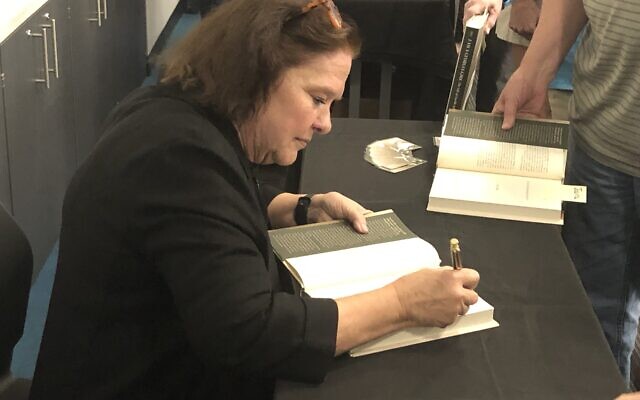
The acclaimed author’s new biography of Lucille Frank — “I Am A Georgia Girl,” published by Mercer University Press — was celebrated at a Sept. 8 talk and book signing for an audience of about 100 people at the Cobb County Public Library in Marietta.
Answering questions from the AJT prior to the event, Hite said, “My goal with writing this book is to tell Lucille’s truth that no one really seemed to care about when she was alive. Pretty much most wanted all that happened to Leo … 110 years ago, to go away, fade into the background, and be forgotten. I couldn’t let that happen.”
Hite’s fascination with the story began more than 50 years ago, as a 9-year-old, hearing her grandmother describe seeing Leo Frank’s body hanging from the tree in the Marietta woods where he was lynched at sunrise on Aug. 17, 1915. Hite’s grandmother, then just 6 years old, was brought by her father, from their home in Forsyth County, as some 3,000 people came to the site, many in a festive mood. Frank’s body was left hanging for hours before it was removed.
The book’s working title had been, “Lucille Selig Frank: The Wife Of Leo M. Frank and Echoes of The Mary Phagan Murder Case.” Hite acknowledged that, “I have never been good with titles, and the original title of this book was an effort to remind readers who Lucille was in history because so very little was written about her. It was very long and clunky.”

The new title was adopted after Mary Beth Kosowski, the Mercer University Press marketing director, reminded Hite of Lucille Frank’s last public statement, made to the Augusta Chronicle: “I am a Georgia girl, born and reared in this state, and educated in her schools. I am a Jewess.”

The full quote “gave me a window into who Lucille Selig Frank was,” Hite said. “In her own way, Lucille was reminding the public that the killing of Leo had wide-spreading repercussions for them and others.”
Hite devoted more than a decade to research and writing before submitting the manuscript in the summer of 2024. Her connection to Lucille Frank has deepened since in a way she could not have foreseen.
Early this year, Hite was introduced to Chuck Marcus, a great-nephew of Lucille Frank. Marcus’ grandmother, Sarah Selig Marcus, was Lucille’s oldest sister.
“Our phone conversation was a gift. Chuck was 13 when Lucille died in 1957, so he could remember what she was like. He filled in the gaps of her later years, who she had become,” Hite said. “Chuck told me he had a gift he wanted me to have, and I would need a truck to pick it up at his home. My time at Chuck’s home was amazing. He had many of Lucille’s possessions. One of them was Lucille’s writing desk. This was the gift he wanted me to take home.
“You can’t imagine how it felt for me to receive this desk. You see, when I began this book, I worried about doing Lucille justice. I knew how private she was and worried about exposing her story. When I received this beautiful desk, I couldn’t help but think somehow Lucille was giving her approval. A nod to my effort to tell her truth,” Hite said.
“The desk is a treasure to me, a full circle moment,” she said. “I did all the edits to ‘I Am A Georgia Girl’ at Lucille’s desk, and many times I felt sure she was looking over my shoulder. Today, with the book in print, I continue to write at this desk. I can only be inspired by someone as brave as Lucille.”
Marcus told the AJT that Hite was gifted the desk “as an appreciation token of her research and work that honored Lucille. It was such a pleasure doing this from myself and the family.”
The book is a change of pace for Hite, the author of more than a dozen works of fiction, most set in and around Black Mountain, N.C., and involving ghosts or spirits. Her debut novel, “Ghost on Black Mountain,” received a 2012 Georgia Author of the Year prize. She has been short-listed for other honors.
“Writing ‘I Am A Georgia Girl’ came from a deep need to tell Lucille’s story,” Hite explained. “I have four daughters and three granddaughters, and Lucille’s story serves as a mentorship to them and any young woman who knows it. What happened to Lucille and how she handled the circumstances are so relevant to 2025.
“The newspapers painted Lucille as a weak hysteric, like they did most women at the time. Yet, she wrote two letters to the newspapers at the time Leo was going to trial for Mary Phagan’s murder. The first letter addressed Hugh Dorsey, the prosecutor of Leo’s case, for his handling or mistreatment of Minola McKnight, the Seligs’ cook, while getting her statement. When Dorsey answered her back in the same papers, he played her concerns down, marginalizing her views. Lucille promptly wrote a second letter, firing back her thoughts. At the time, ladies were not to have opinions. Lucille did and voiced them. She went on to fight tirelessly to save her husband’s life and prove his innocence.”
In 1913, Frank, a 29-year-old, Cornell University-educated engineer — and a Texas-born Jewish transplant from New York City — was superintendent of the National Pencil Company factory in downtown Atlanta. On April 26, Phagan, a 13-year-old employee from Marietta, came to pick up $1.20 owed her for work done the previous week. Her body was discovered the next morning in the factory basement. Three days later, Frank was arrested and charged with murder.
The desk is a treasure to me, a full circle moment. I did all the edits to ‘I Am A Georgia Girl’ at Lucille’s desk, and many times I felt sure she was looking over my shoulder. Today, with the book in print, I continue to write at this desk. I can only be inspired by someone as brave as Lucille.
Following a trial that generated sensationalistic newspaper coverage, Frank was convicted on Aug. 25, 1913, sentenced to death, and sent to the state prison farm in Milledgeville. His appeals, including to the Supreme Court of the United States, were denied.
On June 21, the day before the scheduled execution, Gov. John Marshall Slaton commuted the sentence to life imprisonment. Late on the night of Aug. 16, Frank was kidnapped from the prison and driven to a Marietta farm belonging to former Cobb County Sheriff William Frey.
The kidnapping and lynching were carried out by a cabal calling itself the Knights of Mary Phagan, organized by prominent citizens of Marietta and Cobb County. No one was prosecuted for Frank’s murder.
Hite said that her grandmother told her: “I can only say that no person, no matter what, should ever be treated like he was treated that day.”
The Georgia Board of Pardons and Paroles granted a posthumous pardon in 1986 without judging Frank’s guilt or innocence, but “in recognition of the state’s failure to protect the person of Leo M. Frank and thereby preserve his opportunity for continued legal appeal of his conviction, and in recognition of the state’s failure to bring his killers to justice, and as an effort to heal old wounds.”
The Cobb County library is a short drive from both the site of the lynching and Phagan’s grave in the Marietta City Cemetery. Leo Frank was buried in the Mount Carmel Cemetery in the New York City borough of Queens. Lucille Selig Frank’s ashes were buried in the Oakland Cemetery in Atlanta, between the headstones of her parents.
- News
- Books
- Dave Schechter
- Ann Hite
- Lucille Selig Frank
- Leo Max Frank
- I Am A Georgia Girl
- Mercer University Press
- Cobb County Public Library
- Mary Beth Kosowski
- Chuck Marcus
- Sarah Selig Marcus
- Ghost on Black Mountain
- National Pencil Company
- Gov. John Marshall Slaton
- Cobb County Sheriff William Frey
- Knights of Mary Phagan
- Georgia Board of Pardons and Paroles
comments