



This Fiddler Plays a Modern Tune
The Atlanta Opera and Alliance Theatre’s “Fiddler On The Roof” explores a world coming apart at the seams.
When Jerome Robbins, the original director and choreographer of “Fiddler on the Roof” was casting about for a unifying theme for the 1964 production, he famously asked the creator of the show, what is it about? It took a while, but they finally came up with a description that impressed him. “Tradition” was the single word that stuck as shorthand for what this wide-ranging view of Jewish shtetl life around the turn of the century

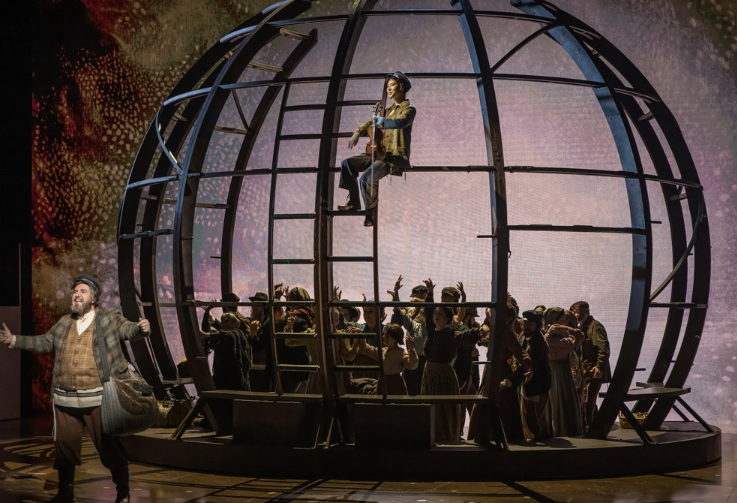
But that theme, that resonated so forcefully with audiences in an America that was still wrestling with the Holocaust over 60 years ago, has been re-cast in the Atlanta Opera’s new production with the Alliance Theatre. In this “Fiddler On The Roof,” the setting is not the comforting abode of a ramshackle turn of the century village that was Jerome Robbins’ scenic vision in the 1960s.
In his brilliant new staging, Tomer Zvulun, the Atlanta Opera’s artistic director, has imagined this vision of the past as a single dark and almost foreboding sphere. A hollowed-out globe is the dominant stage set. It seems to suggest, in a way, an old world that is being transformed by the press of modern life and modern ideas. It expands and contracts, splits open and separates, in the course of this two-and-a-half-hour production. It is as if to say, see, this can happen to a world that is not just losing its traditions, but as Zvulun points out, its very existence as a community.
“This story is one of people coming together and forming something beautiful, like a community, and then having to deal with the dangers of it being disintegrated. It’s a universal story that can happen, not just for Jewish people, our drama, in 1905 in Russia. It can happen in any time period, in many different countries and many different cultures, in many different ethnicities.”
The drama highlights the loss of community, of relationships built up over decades or centuries, that can been torn asunder by the actions of powerful tyrants. That they can act either in a Ukraine of the 1900s or the Ukraine of the present day, is an idea that is central to this “Fiddler On The Roof.”
The symbolic set design of a circle stands for more, in the director’s view, than just the circular sweep of history. It is, in Zvulun’s thinking, much more than just a story of a humble milkman and his often challenging relationship with his five daughters. It is about the circle of life itself.

“We think about it in our production as three concentric circles. The circle of the family that is being challenged. The bigger circle of the community of Anatevka in Russia, And there’s the third circle that is much bigger, and that’s a circle of the world.”
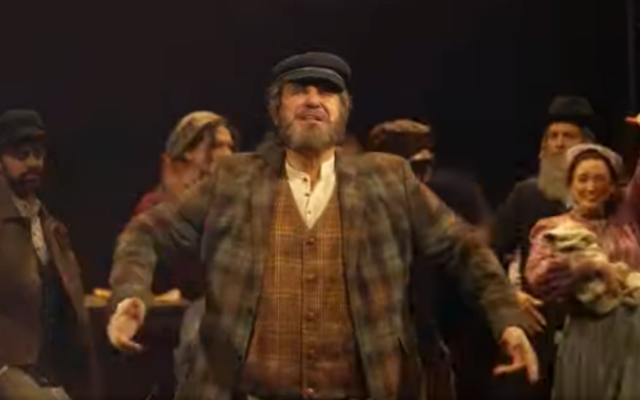
Dominating this world, both as an actor and towering presence on stage, is the veteran Israeli actor, Itzik Cohen. This is his first starring role in America, but he has long been a familiar face in Israel. He’s a leading member of the cast of the Israeli hit series on Netflix, “Fauda.” He wrapped its fifth season with the production just six hours before stepping on a flight to Atlanta.
He may be remembered here for his starring role in the critically acclaimed film, “A Matter of Size,” a comedy that was shown at the Atlanta Jewish Film Festival back in 2009.
Cohen leads a strong, talented cast that includes Debbie Gravitte, a Tony Award and Grammy Award winner as Tevya’s wife, Golda. and Jeremy Radin, as Lazar Wolf, the butcher. Radin was Tevya in last year’s 60th anniversary production of “Fiddler” at the well-regarded North Shore Music Theater in Massachusetts. There’s even a small but significant role for Rabbi Ron Segal, as the rabbi of Anatevka. In real life, he is a senior rabbi at Temple Sinai in Sandy Springs.
Just before the first performance, when Cohen spoke at The Breman Museum, he told the AJT what separates this production from hundreds of others is not just its theme but its impact.
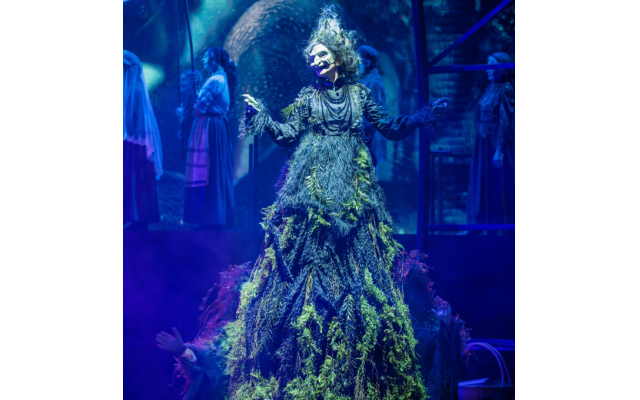
“It’s bigger than life:” Itzik said. “It’s not atomical, with the small houses of Anatevka that you’ve seen in other productions. No, no. It’s tremendous. And the costumes and the visual elements and the stage design. It’s very, very heroic and very epic in that way.”
Part of the reason the production seems to create such a powerful presence is the close collaboration between the key members of the creative team, several of which had their roots in The Pale of Settlement, the Eastern European region of the Russian Empire where “Fiddler On The Roof” is set.
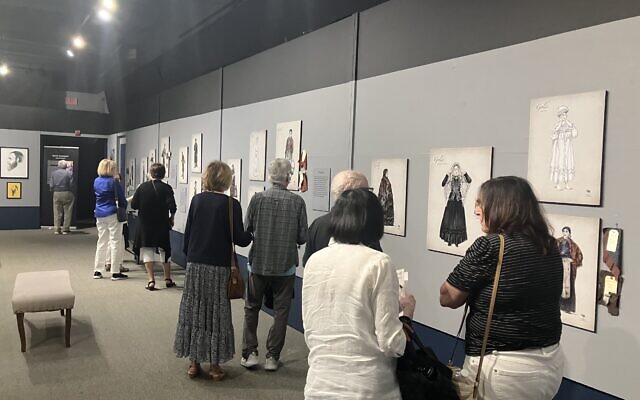
The designer of the monumental set is Alexander Lisiyansky, who has lived in Israel since the migration of Jews from Russia and Ukraine in the early 1990s. The costumes were created by Vita Tzykun, who was Lisiyansky’s student at Tel Aviv University after she immigrated to Israel from Ukraine. They’ve both infused the production with a radiant glow, with the able assistance of lighting designer Thomas Hase, of a world which reaches back to the past, without abandoning its sense of timelessness and community. Costume designer Tzykun believes that comes from a personal connection to the time and place of the production.
“I just speak that language of that place. It’s not something that I have to work hard on conjuring in my mind, it’s part of my DNA. That’s the visual world that I grew up with. So, I don’t have to work hard on analyzing it. It’s just part of my family’s history,”
An exhibit of her designs, called, “Fiddler On The Roof – An Exploration of Tradition and Identity,” opened earlier this month at The Breman Museum. It was created with her father, the celebrated Israeli artist Arkady Tzykun. They’ll be discussing the exhibit on Sept. 28 at the museum.
It’s fitting tribute to a production that knits together so many disparate strands of history to reemphasize the important lessons that community holds for us today. The lessons of “Fiddler On The Roof,” according to Zvulun, are timeless.
“This is a story about a community dealing with the dangers of disintegration. But it can happen at any time. anywhere. The danger is, always, hate. What changes everything is time and hate.”
“Fiddler On The Roof” has extended its run at the Alliance Theatre until Oct. 12.
comments