



Election Issues Motivate Jewish Candidate
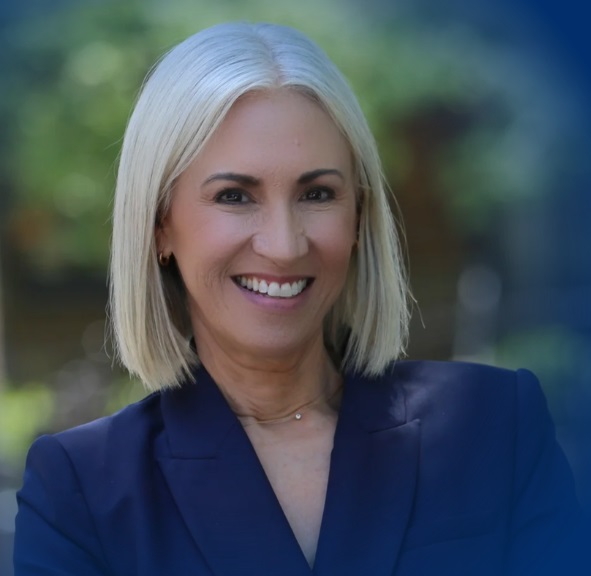
Dana Barrett hopes to emerge from May 19 primary as the Democratic nominee for Georgia secretary of state.
Dave Schechter is a veteran journalist whose career includes writing and producing reports from Israel and elsewhere in the Middle East.
[Editor’s note: This is one in a series of articles about Jewish candidates for federal and state offices in advance of the May 19 primary.]

The first Jewish woman to serve on the Fulton County Commission is looking to become Georgia’s first Jewish secretary of state.
Dana Barrett will appear on the May 19 primary ballot with three other Democratic hopefuls: Penny Brown Reynolds, a former Fulton County judge who served in the Department of Agriculture under President Joe Biden; Adrian Consonery, a voting rights activist; and Cam Ashling, a small business owner and immigrant rights advocate.
On the other side of the ballot, the Republican primary field is comprised of state Rep. Tim Fleming; former state Rep. Vernon Jones; Kelvin King, owner of a construction firm; Ted Metz, retired insurance executive, and Gabriel Sterling, former chief operating officer of the secretary of state’s office.
Any necessary runoffs will be held June 16.
The current secretary of state, Republican Brad Raffensperger, is seeking the Republican gubernatorial nomination.

If victorious in the primary and general elections, Barrett, as best can be determined, would be Georgia’s first Jewish secretary of state.
Barrett, who was elected to the Fulton County Commission in November 2022, will continue to serve as a country commissioner while running for secretary of state.
She cited voting rights and securing free and fair elections as priorities, telling the AJT, “Everything to do with elections is a key pillar of my campaign.”
She called it “the height of irresponsibility “that when the legislature two years ago approved a measure — set to take effect this July 1 — banning the use of QR codes to count votes, lawmakers did not provide funding or a road map of how to accomplish this goal.
Barrett said Republican Gov. Brian Kemp should call the General Assembly into special session to delay the effective date of the law, as the time available to implement such a change by November’s general election “is not doable this year.”
Fulton County has been embroiled in several election-related controversies.
In January, the Federal Bureau of Investigation, an arm of the federal Department of Justice, seized Fulton County records from the 2020 election. President Donald Trump has claimed — without evidence accepted by courts — that he won Georgia’s 2020 presidential vote. Democrat Joe Biden received 11,779 more votes than Trump, who told Raffensperger, in a Jan. 2, 2021, phone call “I just want to find 11,780 votes, which is one more than we have because we won the state.”
Earlier this year, Trump allies also sought to seat two conservative activists on the county election board. After Georgia’s Court of Appeals overturned a trial court order that the county seat the pair or face fines, Barrett posted on Facebook: “I never thought I’d face jail time for doing my job and protecting our elections . . . but I stood firm and we won. As Secretary of State, I’ll never stop fighting to protect our elections. Donald Trump and his MAGA cronies can come for our votes, but they’ll have to come through me first.”
Barrett said she the election controversies propelled her run for secretary of state. “I’ve been very invested in the work I’ve been doing in Fulton County,” she said. “The attacks on our elections have really been ramping up over the years. It kind of came to a fever pitch with the whole issue about putting election deniers on our election board.”
If elected, Barrett said she also wants to bring more attention to the “other” part of the secretary of state’s job, which involves business registrations and professional licensing, “protecting Georgians’ right to choose their own future, to build businesses, to have careers as licensed professionals and to be protected from frauds and scams.”
As to how her Jewish identity informs her candidacy, Barrett said, “I think certainly the core values of justice and fairness and making the world better have driven me into politics . . . [growing up] We were taught all the stories of history, of Biblical history and more recent history, which made clear that democracy and freedom were fragile.
“We know as Jewish people what happens when people stay silent in the face of extremism. That is a large part of what has driven my willingness to fight back with everything I have to protect voting rights and democracy,” Barrett said.
Barrett’s resume before becoming a Fulton County commissioner included stints as a talk-radio and television host. Her radio show’s tagline was “It’s salty, it’s got bite and it’s better than a two-martini lunch.”
Barrett was the Democratic nominee in 2020 from U.S. House District 11 but received just 39.5 percent of the vote and was defeated by incumbent Republican Rep. Barry Loudermilk (who this year opted not to seek a seventh term in Congress).
By coincidence, one of Barrett’s Cornell University classmates was Jewish Democrat Barry Wolfert, who is seeking the Democratic nomination in the 11th Congressional district.
According to the recently available state campaign finance reports, Barrett had raised $215,760, compared with $315,130 for Reynolds, $11,480 for Consonery, and $100 by Ashling.
Georgia’s secretary of state is paid $128,637.12 per year.
- Elections
- News
- Dave Schechter
- Fulton County Commission
- Secretary of State
- Dana Barrett
- Penny Brown Reynolds
- Adrian Consonery
- Cam Ashling
- Tim Fleming;
- Vernon Jones
- Kelvin King
- Ted Metz
- Gabriel Sterling
- Brad Raffensperger
- Brian Kemp
- General Assembly
- Barry Loudermilk
- Cornell University
- Barry Wolfert
- Jewish candidates for 2026 Primaries
comments