



The ‘Jewish Jet’ Soars into Beth Tefillah
Israel’s Jared Firestone, wore a Mogen Dovid on his helmet during the Winter Olympics.
After 37 years with the Atlanta Journal-Constitution and now with the AJT, , Jaffe’s focus is lifestyle, art, dining, fashion, and community events with emphasis on Jewish movers and shakers.

Just when you think you’ve heard the most amazing stories about industrious young Jews, Floridian Jared Firestone is “golden” in pursuing “the skeleton.”

On April 20 at Congregation Beth Tefillah, Firestone shared his journey of resilience as a high school track star, inspired by both Judaism and Israel, to leverage his physical prowess and spiritual acumen in representing Israel in the recent Milano Cortina Olympics.
Firestone also appeared on April 19 at Chabad of North Fulton.
Along his journey, Firestone graduated law school, had a stroke and a variety of bizarre ups-and-downs, ultimately finding his way to the Knesset to secure Israeli citizenship.
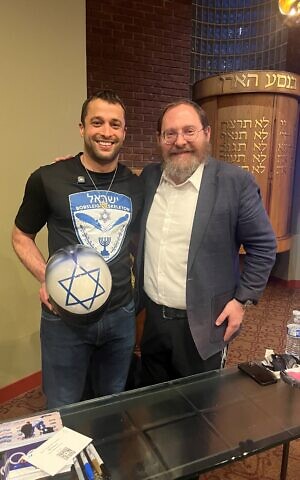
Firestone was introduced by Rabbi Ari Sollish, who framed the presentation with reflections on Yom HaZikaron honoring fallen soldiers and victims of terror. Then, he compared Firestone’s sport to the Bal Shem Tov’s commentary: how small moments can shape outcomes, how discipline must guide emotion (headfirst), and how each individual travels a unique path even when moving along the same track.
The sport at the center of Firestone’s Olympic dream — skeleton — is one of the most physically and mentally demanding events in the Winter Olympics. Athletes race headfirst down an icy track on a small sled, reaching speeds of up to 90 miles per hour. Unlike luge, where competitors lie on their backs, skeleton racers face forward, navigating sharp turns with only subtle shifts in body weight. Precision, reaction time, and fearlessness are essential. Even the smallest miscalculation can result in crashing into the track walls.
Firestone described how training his mind was just as important as training his body, as he needed to react instinctively while maintaining perfect positioning inches above the ice. His Olympic aspiration was influenced by a desire to honor Jewish coaches and athletes who were killed at the Munich Olympics.
Firestone said, “I want Jews to have a role on the global stage … I don’t feel that the Munich victims have been fully remembered.” He watched the Winter Olympics in Russia and noted that the skeleton “looked super easy.” Ha!
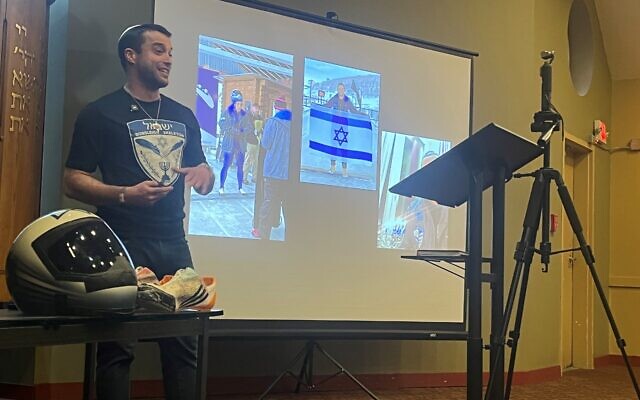
Firestone’s path was anything but straightforward. While attending college and, later, law school, he balanced academics with athletics. Just one month into law school, he experienced a stroke. Diagnosed quickly thanks to his doctor-father, he stepped away from sports for months. Later, with minimal equipment and little experience, he endured bruises, crashes, and frustration. Setbacks continued. A popped bicep required surgery and months of rehabilitation. Later, a crash during a World Cup event left him with broken ribs, forcing him to finish a race in visible pain. With an eye on the prize, he trained in the Miami heat with no air conditioning and wrapped tefillin to maintain spirituality.
His breakthrough came with strong performances that secured Olympic qualification. Still, another challenge emerged: obtaining Israeli citizenship in time to compete. Navigating bureaucracy proved demanding, but he ultimately succeeded, describing the moment he received his passport as a dream realized.
One of the highlights of his Olympic experience was carrying the Israeli flag during the opening ceremony. Overcome with pride, he admitted he forgot the instructions about maintaining formation down the center.
Firestone took questions from the audience. One fan suggested he do a movie for the Jewish Film Festival, in which case Firestone hinted that one was already in production for the San Francisco festival. Another guest asked if Firestone’s parents and siblings shared his similar intensity traits to which he recalled his father taking 3 a.m. phone calls to help patients. Another guest queried what it was like behind the scenes at the Olympics. Firestone said, “You don’t see it but there’s a truck that takes us up back to the top for each run. No one is walking.”
Recalling that some athletes (Ukraine) were disqualified for making political statements on helmets, Firestone safely painted his with the Mogen Dovid. He also had a kippah engraved with the names of the 11 coaches and athletes who perished in Munich.
He concluded, “This was all a dream come true.”
comments