



Peretz Weighs in on Latest Knee Treatments
Approaching 15 years at Resurgens, Dr. Jeff Peretz describes the variables and the future of robotic treatment.
After 37 years with the Atlanta Journal-Constitution and now with the AJT, , Jaffe’s focus is lifestyle, art, dining, fashion, and community events with emphasis on Jewish movers and shakers.
In varying sports circles, from pickleball to jogging, the convo swerves around hip and knee issues. Then, seniors further heap on complaints about “just getting old and wearing out like used car parts.”
Enter Dr. Jeff Peretz, who has been practicing at Resurgens since 2011, and puts a finer point on the conditions by stating, “Knee and hip issues are very prevalent in the U.S. population. I mainly deal with and treat arthritis which affects about 25 percent of the U.S. adult population. This is approximately 75 million adults. Nearly half of these patients report daily limitations in activity due to their arthritis. As our population ages and people live longer, the numbers of those affected will certainly continue to increase. Older adults are also maintaining active lifestyles for much longer which increases the demand for treatment.”
Peretz sees a variety of conditions that affect knees both from overuse/activity and degeneration. There are several tendons around the knee joint that can become inflamed from overuse. The patellar tendon, hamstring tendons, and quadriceps tendon are some of the more common ones. Peretz advises that appropriate stretching before activity and gradually ramping up activity can help prevent overuse issues.
Some common ailments are a meniscus tear or a ligament injury with the most common degenerative problem with knees as osteoarthritis which affects the cartilage or cushioning in the joint. Activity can sometimes aggravate a knee with underlying osteoarthritis. Typical treatments are anti-inflammatory medications, injections, bracing, and physical therapy.
In terms of knee procedures, Peretz’s most common are knee arthroscopy and replacement. The former is a procedure where structures inside the knee can be treated in a minimally invasive procedure using a camera and small incisions. Meniscus tears, some ligament injuries, and certain cartilage issues can be treated similarly.
Peretz explained, “This is usually an outpatient procedure and is the most common orthopedic procedure performed around the world. Knee replacement is a procedure where the cartilage surfaces of the knee are replaced with metal and plastic implants. This is also often an outpatient procedure. It’s a much longer recovery compared to arthroscopy. Knee replacement is the best surgical procedure for knees that have osteoarthritis and have failed conservative management with medications, injections, and therapy.”

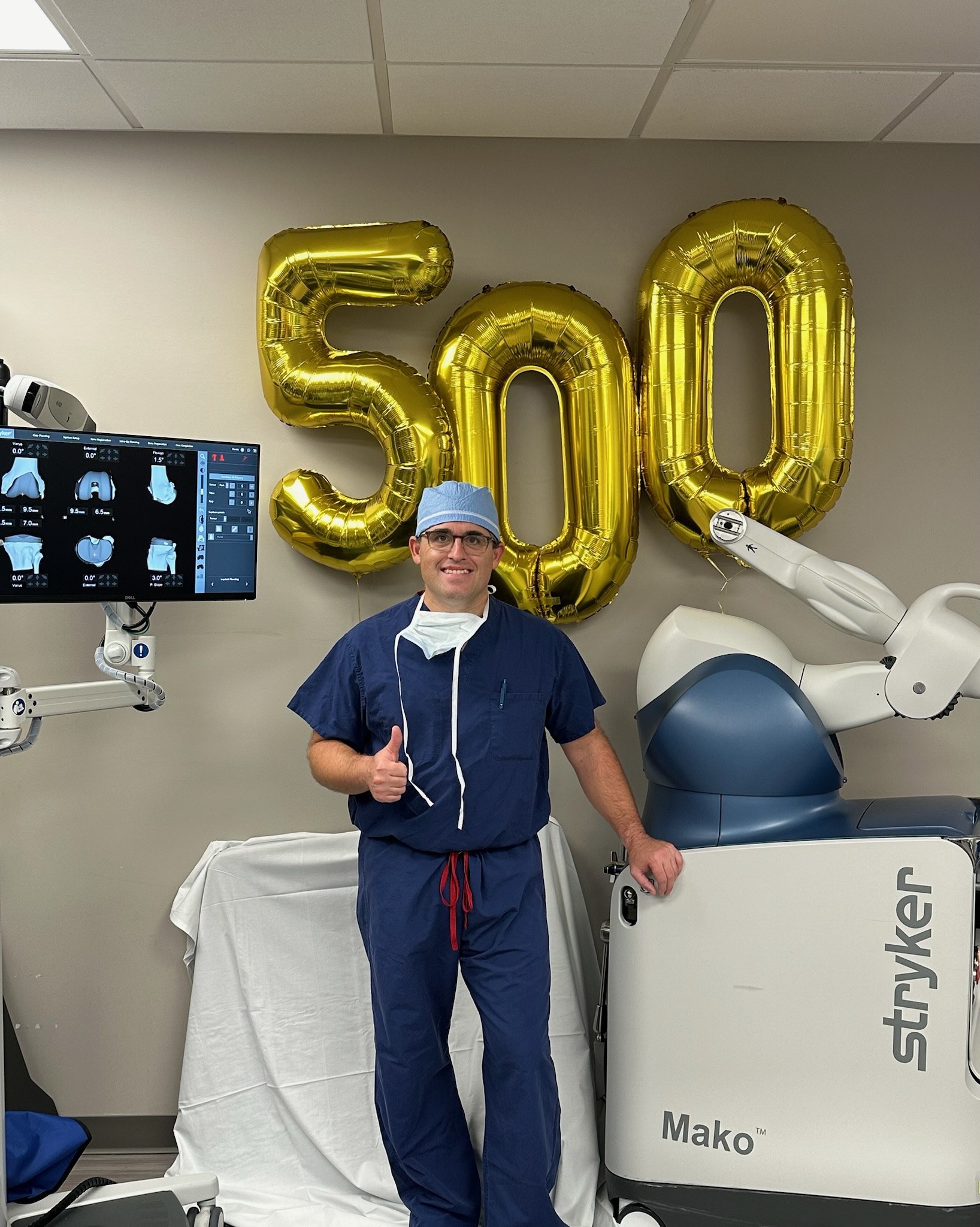
Some of Peretz’s emerging technology tools involve robotics which allow knee replacement to be performed with fewer instruments and utilize navigation to control implant sizing, position and allow for optimal ligament balancing. These factors may allow for a quicker recovery compared to traditional knee replacement. The precision of robotic surgery also lowers the risk of implant failure and revision surgery. Peretz stated, “I find the robotic technique very useful in all knee replacements, but I find it to be particularly helpful in the more challenging procedures with more severe deformities.”
Recovery after knee replacement varies and is usually performed as an outpatient with patients walking right after surgery and going home the same day. Typical recovery involves outpatient physical therapy and can take two to three months for patients to see significant functional improvement. He explained that quadriceps strength can take even longer and, many times, recovery can take longer than a few months. He usually performs from 10 to 20 knee replacements per month. Patients will often regain a normal level of function after they recover –they are often able to do activities they weren’t able to enjoy before surgery.
Some conservative treatments are anti-inflammatory medications, bracing, physical therapy and injections. Cortisone or steroid injections can help relieve symptoms. Hyaluronic acid injections are an alternative injection commonly used to treat knee osteoarthritis although results vary depending on the disease severity. Other types of injections such as PRP (platelet rich plasma) and stem cell injections may also provide some benefit.
Peretz and family live in Sandy Springs and belong to Temple Sinai. As for the “Peretz” name, his mother’s parents were Holocaust survivors from Greece, and his father was born in Israel. He laughed, “I enjoyed a Mediterranean diet growing up.”
Peretz went to Emory University, then the rest of his medical school, residency, and fellowship were in Philadelphia and Boston.
comments