



Tourette’s and the Magic of Music
David Feldstein parlayed his misunderstood childhood into teaching the joys of musical guitar.
After 37 years with the Atlanta Journal-Constitution and now with the AJT, , Jaffe’s focus is lifestyle, art, dining, fashion, and community events with emphasis on Jewish movers and shakers.
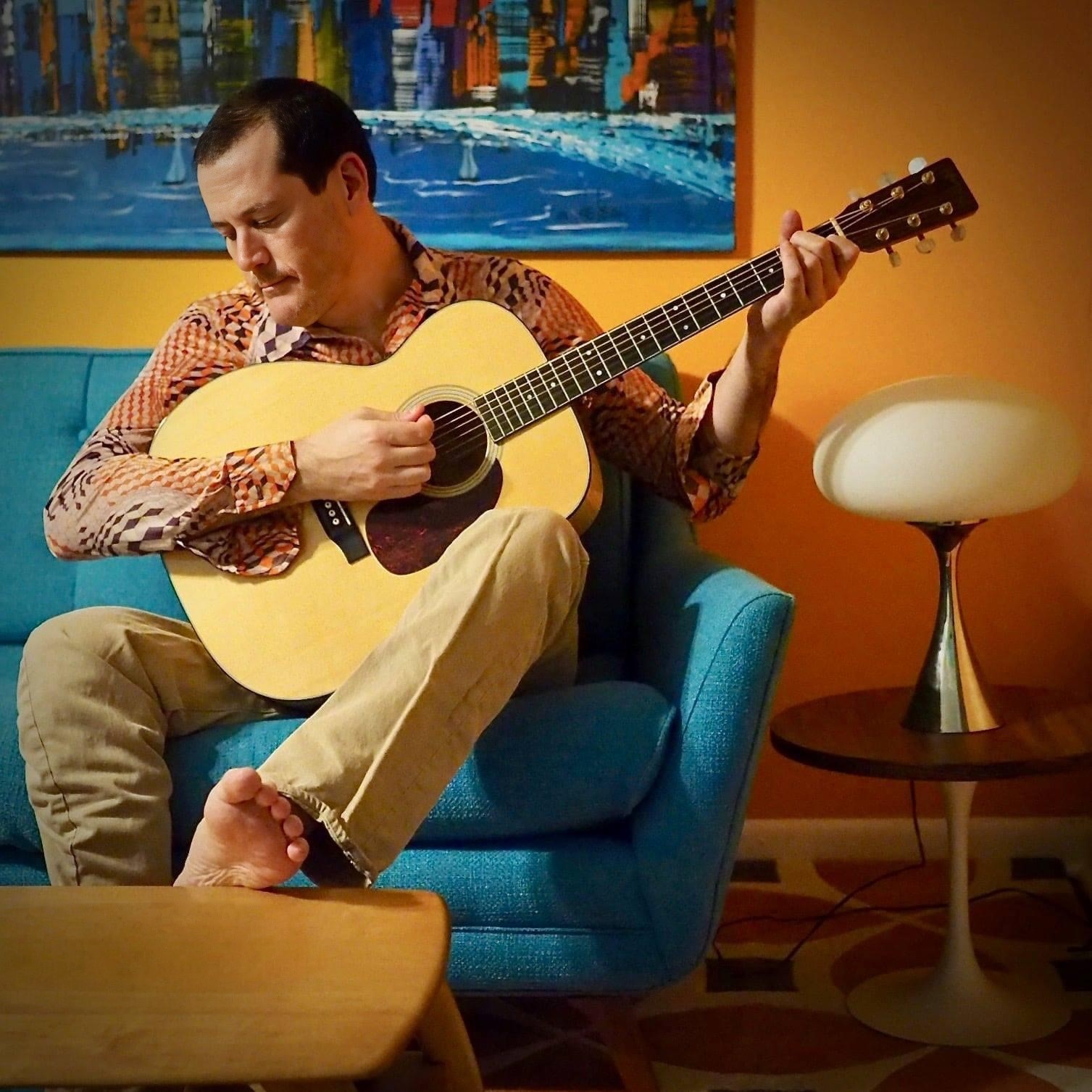
Guitar teacher David Feldstein found his voice playing and teaching guitar with twists along the way: his tortured childhood getting diagnosed and being misunderstood while navigating Tourette’s Syndrome.

Feldstein explained, “Having a diagnosis, unfortunately, didn’t mean everyone understood it. I had loud vocal tics and other involuntary movements that made remaining anonymous in a classroom impossible. My mother would visit school at the beginning of each year to explain Tourette’s to my new teachers, what they might see and hear and, most importantly, that I wasn’t doing these things intentionally.”
Sometimes that understanding came too late.
Growing up in the Chicago, at age 7 in 1978, his parents flew with him to New York to see one of the few doctors in the U.S. who knew enough about Tourette’s to diagnose it.
In third grade, teachers believed he had behavioral problems. One manifestation of his neurological and sensory issues was a compulsion to “even things out.” If someone bumped one side of him on the playground, he could feel compelled to make a corresponding movement. One day, he unintentionally bumped into a girl. That was the incident the school had been anticipating. Mom was called and David was suspended for three days.
He remembers walking out of school repeatedly telling her, “I couldn’t help it.”

Other children could be far crueler. He was mocked, beaten up, and received late-night prank calls. He related, “From the moment I boarded the school bus in the morning until I arrived home, I was frightened, anxious, and I would just stare at the second hand on the analog wall clock unable to focus.”
Guitar entered his life. He took a few lessons at the YMCA with yet another diagnosis. He added, “ADHD wasn’t part of the everyday vocabulary in the 1970s; I was simply the ‘hyper’ kid who couldn’t focus. Eventually, the instructor told my mother lessons weren’t working. So much for my promising musical career.”
In 1989, he heard R.E.M.’s, “Murmur.” Peter Buck’s guitar playing made him want to pick it up again. This time, it stuck.
“Today, I treat my tics just like traffic. It’s just another thing, as we all have those things to get through each day. Playing guitar gives my brain somewhere to go. Music can reflect whatever mood I’m in, and the concentration and fun involved in playing can reduce my tics,” he explained. Decades later, music has also provided him a way to help other kids whose brains don’t “necessarily cooperate with what the world expects of them.”
While he was working professionally in social services, he volunteered in his children’s school music class. Parents began asking him to teach their children privately. Word spread, and eventually, he left social work to teach guitar full time through Kids Guitar Atlanta. Today, he drives to students’ homes, teaching ages 7–18.
He summarized, “About 85 percent of my current students have some type of neurodivergent diagnosis, including ADHD, Autism and Dyslexia, although I work extensively with neurotypical children as well. I have nearly 40 years of experience working with children.”
Feldstein has two rules: Have fun, and neither of us plays while the other is talking. Beyond that, he meets children where they are with games, songs they actually want to learn, ridiculous voices, accents, fist bumps and humor. Music theory and the math can wait. First, he wants children playing music.
As a recording artist, his own album, “Surrender the Silence,” represents decades of riffs and melodies. Album No. 2 should be out in 2027.
His license plate reads “MENSCH.” He concluded, “I don’t always live up to it. Having the reminder follow me around helps. The simplest explanation for why I teach the way I do goes back to that anxious 10-year-old on the school bus. The teacher I needed then was someone who knew what it was like to go through what I was experiencing. I try to be that teacher now.”
David is fully present and not actively presenting with uncontrolled movements during lessons. For more information, please email kidsguitaratlanta@gmail.com or visit KidsGuitarAtlanta.com.
comments