



Barbeque Wizard Has Roots in His Jewish Past
Author Steven Raichlen credits his Jewish childhood experiences for much of his success as the cookbook king of barbecue.
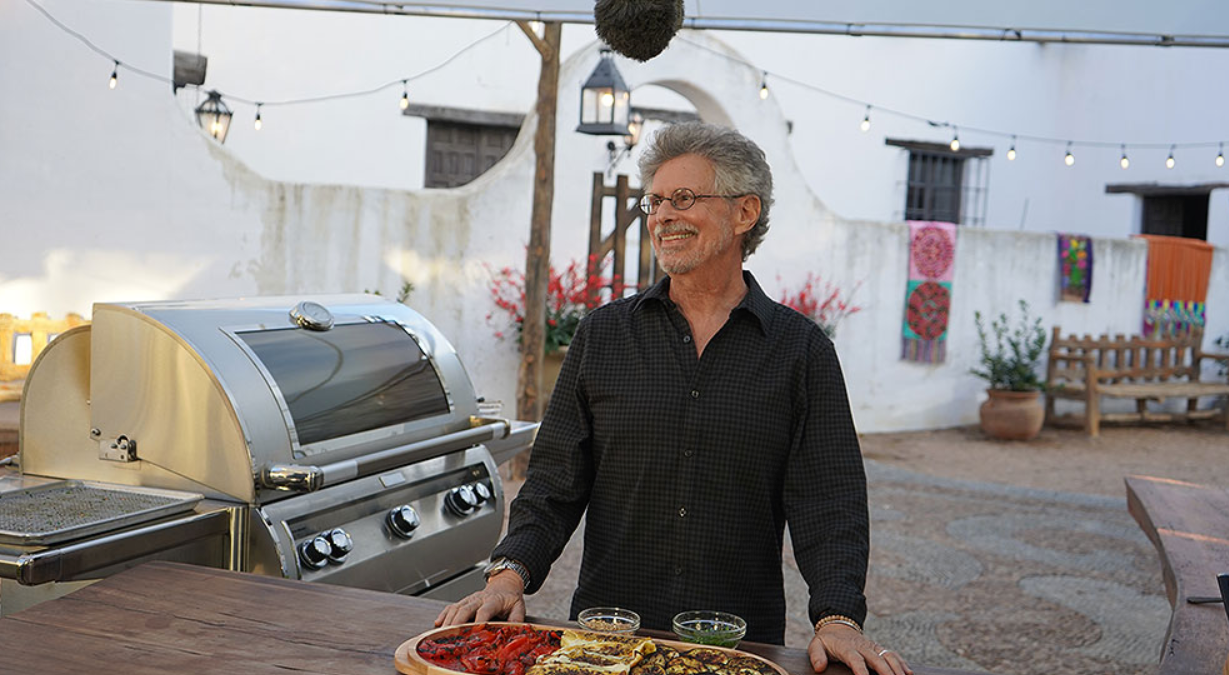
Steven Raichlen has been described as a leader in the global renaissance in barbeque. His 35 books, which have been translated into 17 languages, including his best-selling series of “Barbecue Bible” cookbooks, have made him a familiar ambassador from his smoke-filled world.

But his latest book, that he previewed at the recent Decatur Book Festival, is short on recipes and long on reminiscences about how a nice Jewish boy from Baltimore grew up to be a key figure in this modern international barbeque revolution.
It’s appropriately titled, “Man On Fire,” and it’s a candid memoir of how he was transformed from a budding young scholar of medieval French poetry to eventually becoming the winner of five prestigious James Beard Awards for his writing and a place in the Barbeque Hall of Fame.
His interest in good food, the craft of preparing it, and the important role that it plays in our social and cultural life today began not as an acolyte of some sweaty, musclebound high priest of pit smoked beef but at the Shabbat table of his paternal grandparents, Samuel Israel Raichlen, better known as Dear, and his wife, Grammie Ethel, as she was called. For most of Raichlen’s first two decades of life, these traditional weekly family dinners, presided over by first-generation descendants of Ashkenazic Jews, shaped his appreciation of how the bonds of love and family can be nurtured by a steaming bowl of chicken soup swimming with mandelech or soup nuts and a golden slice of a freshly braided and baked Sabbath loaf.
“Every Friday night was indescribably precious,” Raichlen said. “I didn’t realize it at the time, what a big impact it had on me. Out of that, I later developed the sense of food as community, food as tradition. My grandfather, Dear, would say, ‘a day in the life of a man is a hundred years in the life of a people.’ Food is a powerful way to connect us to our past. I feel my Jewish roots all the time.”
But not all of what he learned about food and how it shapes who we are was learned around that table. He’s quick to point out that if those Friday nights and the crowded and noisy holiday dinners that overflowed the dining room shaped his soul. But it was the corned beef sandwiches at the Attman’s Delicatessen on Lombard Street in Jewish Baltimore that shaped his belly. Those steaming sandwiches served on soft rye with a schmear of yellow mustard were a regular treat. It was his introduction to how a simple and inexpensive cut of meat, with care and devotion to craft, could be transcended.

He has travelled the world in search of how that kind of culinary perfection has been reproduced in the 75 countries he’s visited on six continents; and in the television shows about barbeque he has regularly hosted on PBS in America, in French in Canada, and in what he describes as a rough approximation of the Italian language in Italy. In recent years, he’s hosted a select group at his Barbeque University in California, where he passes all that he’s learned about the many ways to bring heat and meat together.
But he traces back this restless search for a new recipe here, a new technique there, a new way to bring perfection to his discoveries about food to something deeper in Jewish life than just the shared meals he enjoyed growing up.
“It is the study rather than the practice,” Raichlen said. “I mean, there are guys that can smoke a brisket 10 times better than I can. There are guys that can grill a steak 10 times better than I can. But it is the study. In all that I want to know the the how’s and the why’s and the background, and that is very Jewish. I mean, we are the people of the book.”
Ultimately, he traces all of his success to his mother, who was disdainful, for the most part, of how food was prepared or consumed. In Raichlen’s mother’s opinion, food was nothing she ever took very seriously. Instead, what she devoted herself to was dance, endless practice and the discipline of performance that aimed at balletic perfection.
That his mother never achieved the recognition that such devotion might bring, Raichlen believes, may have contributed to the tragic and premature end of her life. But the positive lesson he took away from her life was the importance of her devotion to craft and nuance. It is a lesson that has never left him and in “Man On Fire” he pays homage to not only all that he learned but all that he has become.
comments