



After Oct. 7, More Jews Turn to Torah Study for Meaning and Resilience
Established in 2019, Yashrut’s Classic Talmud Program brings the traditional approach of old-time yeshivas to its diverse group of students, while committing to aggressively building their Talmud skills and fostering their independence in approaching Jewish text.
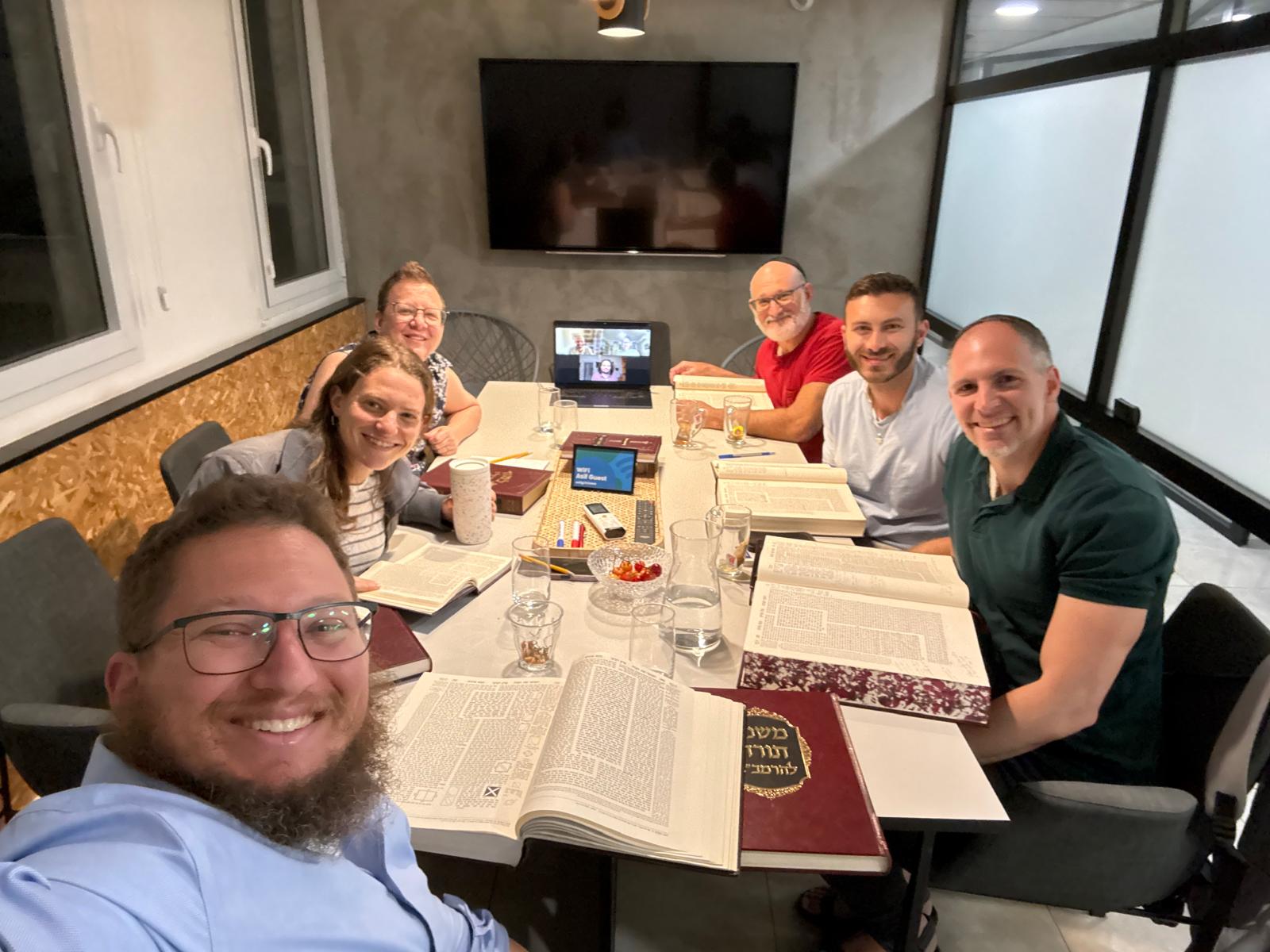
As for many Jews in America and across the world, for Elaina Marshalek, the Hamas-led attack against Israel on Oct. 7, 2023, the ensuing wars and the political upheaval in the United States, have marked a challenging time for her life and Jewish identity.

In this tumultuous period, she has found that one crucial element that has helped her cope is Jewish learning. In her mid 30s and the senior educator at Mem Global’s Base Bay Area (in Northern California), Marshalek came to the world of Jewish education as a UC Berkeley-educated industrial engineer who had previously served in management roles at McKinsey and Company.
“Since Oct. 7, a regular practice of learning has felt all the more important,” she said. “Learning is a spiritual practice that our tradition has given us. Especially in hard moments when some of the other things feel hard or meaningless, or not as profound, I find learning can be grounding, connective, and help me think expansively.”
Marshalek has been learning at Yashrut (www.yashrut.org), a Jerusalem-based Torah institution dedicated to rigorous study of Talmud and Halacha (Jewish law), and the pursuit of moral integrity.
“Today, we are faced with those who try to claim Judaism and Jewish texts for themselves using them as a tool to promote supremacy and corruption, while at the same time, Jewish life is under attack across the world as antisemitism surges,” said Yashrut founder and Rosh Yeshiva Rabbi Daniel Landes. “It is crucial that we fight back, preparing Jewish leaders and rabbis who demonstrate and promote the Torah’s call to moral excellence, equipping them with the indispensable tools to do so, living and teaching a Judaism of morality.”
“This is our mission at Yashrut,” he stressed.

Eight years after Yashrut was established offering shiurim (traditional classes on Jewish texts) to a small circle of students, today nearly 100 Jewish educators, rabbinical students, rabbis, professionals, and passionate learners from all walks of life, denominations, and backgrounds attend Yashrut’s programs each year, including the Classic Talmud Program (CTP) and the Semikha Initiative.
The 72 students who will make up the Classic Talmud Program’s 2026-27 student body were chosen from a pool of close to 150 applicants, making Yashrut one of the most competitive Jewish learning programs available to post-undergraduates.

Marshalek recently completed a year of study in the CTP and is currently preparing to kick off her second year in the program.
“I’ve been so grateful for my learning at Yashrut,” Marshalek said. “The format of learning is unique, and the level of individual attention to each learner is such a gift, and the fact that class size is not too big means that there’s like space for everyone to explore their learning and make meaning of the text.”
Established in 2019, Yashrut’s Classic Talmud Program brings the traditional approach of old-time yeshivas to its diverse group of students, while committing to aggressively building their Talmud skills and fostering their independence in approaching Jewish text. Men and women, LGBTQ people, old and young, Orthodox, Conservative, Reform, and non-denominational Jews, right-wing and left-wing, Americans, Europeans, and Israelis — they all gather together in pursuit of their love of Torah study.
“Every year, we study a different Talmud masechet (tractate) from amongst the six ‘classic yeshiva masechtot,’ studied in yeshivot all over the world,” said Yashrut President and Classic Talmud Program Director Rabbi Isaac Landes. “Classes are divided by skill level, with some sections focusing primarily on reading, parsing and translating the text, and more advanced classes examining commentators and Halachic literature.”
The unique pedagogical approach developed for the CTP offers flexibility to students who work or study full-time to attend the program, enabling them to combine high-level learning with a busy life. Participation requires a six to eight hour commitment per week. A weekly class – capped at 12 students per class divided into six sections – is the only fixed time when students are required to show up.
Leading up to the class each week, students are expected to first learn the material on their own, then meet with a chavruta (study partner, assigned by the teacher) to discuss it. Next they review their progress in a one hour individualized tutorial with a Yashrut teacher.
They can tailor their independent learning, chavruta meetings, and tutorials to their schedules.
“That’s a really special model that gives people seven or eight hours of Talmud study a week, offering a way to bridge our lives between a yeshiva setting and real-life working,” said Rabbi Risa Dunbar, a community educator and fellowship manager for the prestigious Bronfman Fellowship Program.
“I feel really privileged to live in a time and to live in a world where I have access to Torah in this way,” she added. “I feel like Torah and Talmud study specifically gives me a spiritual, emotional, intellectual access to the lives and fabric of my ancestors, and the questions that most fundamentally they were grappling with. At the same time, this learning also invites me to discover my own voice.”
Dunbar said that she especially appreciates the combination of rigor and warmth offered by Yashrut, and her experience in the Classic Talmud Program is also very meaningful for her as an educator, enabling her to bring what she learns to her students.
“I’ve gained a deeper sense of some of the thought patterns within religious communities, bringing myself into conversation with people with whom I may not share the exact practices, and I think that I bring that idea and perspective to my students,” the rabbi said.
“The ease with which I can open a Tractate and guide them through it is something very powerful, especially with my own story, because I didn’t grow up this way; I had no Talmud learning really until my like early 20s,” she added.
Rabbi Alex Goldfarb, a former social entrepreneur in agricultural and fishing ecosystems and currently embarking on a newly-created campus rabbi position at the University of Massachusetts, Amherst, also explained that learning at Yashrut has had a deep impact on his own teaching.
“Learning at Yashrut has been really helpful for me as I’m trying to grow as an educator,” he said.
“As somebody who spends a decent amount of my time learning and teaching rabbinic literature with college students, learning at the Classic Talmud Program, and especially in tutorial, means both learning the part of the Talmud we are studying and how to do Talmud mentorship and teaching,” he added. “I certainly get a ton of practical skills from seeing how Yashrut’s teachers do it.”
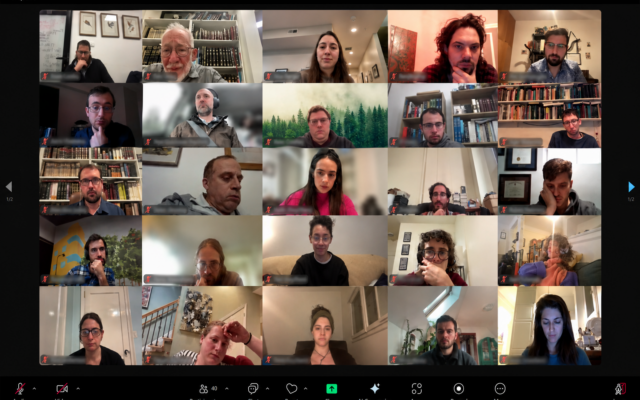
Goldfarb explained that the study of Talmud has also offered him solace in moments of personal crisis.
“For me, Talmud learning has been my go-to emotional sound,” he said. “In moments of difficulty in my life, I find that even when I don’t feel like getting up to spend time with friends or do something else to feel better, learning is the thing that I will always get to do, and is always there to provide me with a better understanding or solace.”
The rabbi said this has been even more significant after Oct. 7.
“I believe, and I think many of the students that I work with on college campuses also do, that there is a question of why we are so invested in Jewish communal life,” he said. “Some say it’s peoplehood, but there is more than that; there is the substance to this peoplehood that we’re all invested in. Learning is an important opportunity for us to pause and reflect on why all of this matters. All of us have different understandings of the world since Oct. 7, but I do find it really significant that we are coming together to do this learning, as if to say that this is the big reason for us being so invested in this project, building a community of learners, educators, thinkers, and people living meaningful lives in the world.”
Last year, Yashrut expanded its reach by piloting a program that brings together passionate Jewish students in their 30s and 40s with limited experience in Jewish learning. The Mishnah and Maimonides Program places students inside the great Jewish conversation that spans the centuries, combining the study of Mishnah, the foundational work of oral law, and Maimonides’ Code of Law, a crown jewel of the Jewish bookshelf.
The program introduces students to the language, themes, and concepts that form the basis of Rabbinic thought, while developing their reading and comprehension skills. The program offers rich Jewish substance for students to benefit from as they look to further invest in our Jewish story.
As the interviews to select the 2026-2027 Yashrut student body continue through the summer, Rabbi Isaac Landes believes that the upcoming year will be one of the strongest ever, thanks to a very high-level pool of candidates.
“With our programs kicking off in the first week of September, Yashrut and its students will charge into a new year immersed in learning and empowered to elevate Judaism and the Jewish people,” Rabbi Landes said. “As the world gets increasingly complicated and threatening, we are proud to inspire Jewish leaders as they master the texts and conversations that have shaped our people for two millennia. It is their commitment that will fuel the fight for a moral and vibrant Judaism across the world.”
Paid content by Yashrut.
comments