


Jewish Surrogacy Brings Jewish Joy
Surrogacy often provides last hope for those looking to start a family.

For six years, Rachel Villena attempted to have a child. When she and her husband, Daniel, failed to have a child naturally, they tried repeated rounds of in vitro fertilization (IVF), in which fertilized embryos are implanted in the uterus. The treatments are expensive and are often painful and they can fail. Villena estimates she and her husband spent more than $100,000 in their attempts to produce a viable pregnancy.

“We explored a lot of different options. We applied for grants and loans. We reworked our retirement plans. We revisited our savings plans, watched how we spent our money. We were frugal when we bought a car and our house. We watched every penny, anything and everything to be parents.”
It is a stressful and often lonely journey but in recent years that burden has been helped along by the Jewish Fertility Foundation (JFF), a national organization headquartered in Atlanta that has grown quickly in recent years. The organization provides numerous programs for those experiencing infertility, including in the Villenas’ case, cash grants for medical treatment. But nothing seemed to work for them. The reason, according to her doctors, was what they called unexplained infertility, meaning her physicians couldn’t find a specific reason why Villena wasn’t getting pregnant, just that she wasn’t.
And if the financial burden and the disappointment wasn’t enough, each time the fertility treatments failed there was the wrenching psychological consequences.
“Each time we failed it was like a death in the family or like being told you have cancer,” Villena recalls. “It has that deep of an impact, and there’s that much grief involved in the process. Over and over again. Most people can’t truly understand how it feels until they go through it.”
Eventually, their doctor suggested surrogacy, often a last resort for couples like the Villenas who were on the verge of giving up their dream of ever having a family.

According to the Society for Assisted Reproductive Technology, which represents clinics that work with couples using surrogates, the decision to use someone to carry your child to term is rapidly growing. Ten years ago, there were only about 5,500 of what are called assisted embryo transfers to a surrogate. Today, that figure is over twice that and about half of them result in successful deliveries.
But the cost can be as much as $200,000 with a payment of $50,000 or more for the woman who spends nine months of her life bearing a child. There are no federal laws governing surrogacy and at the state level there’s a patchwork of regulations covering the procedure. Louisiana and Nebraska outright forbid surrogacy payments.
To ease the financial burden of surrogacy, the Jewish Fertility Foundation last month announced a new financial support program.

Starting later this year, they will provide $20,000 each to couples beginning the surrogacy process in Atlanta and South Florida. The organization’s founder and CEO, Elana Frank, acknowledged that the grants are only a beginning.
“We recognize $20,000 is not everything,” Frank noted, “but our hope is that together with this additional support and wrap-around discounts, it’s going to feel like a big hug from the Jewish community at one of the most important moments in our life. So, this is a big, big moment for our organization.”
But two years ago, when the Villenas were searching for help, they were beginning to feel despair. Then, they learned through friends of someone living some distance from Atlanta who was open to voluntarily carrying their child. The woman had successfully gone through her own pregnancy five years before and passed through psychological and medical testing that usually precedes the procedure. And, to the Villenas’ delight, she was Jewish.
“She wanted to do this as a pure gift,” Villena explained. “We made sure that she was not out of pocket for anything. We covered her health insurance and medical expenses, and everything related to the procedure.”
Engaging a surrogate and working with them during the many months leading to a birth can be a complex process. Contracts for surrogacy usually spell the medical obligations of each party and the terms for payment to cover the many obligations that are incurred between the surrogate and the couple or individual they work with.

Rachel Loftspring is a partner in the Family Law and Fertility Law Group and a former board chair of the Jewish Fertility Foundation. For the past nine years, she’s worked on contracts that bind her clients and their surrogates in a strict set of legal agreements.
“Everyone needs to fully understand,” Loftspring cautions, “what it is that they are getting into, what it is that they are agreeing to, and what their rights and obligations are to each other. And they also have to agree to the child that will result. The surrogate has to understand what she can and can’t do in a pregnancy and follow what the doctor says. We have to lay this out clearly in a contract so that we understand everybody’s rights and obligations.”
For the Villenas, the bond they had with their surrogate was intense. They texted almost every day and spoke by phone every week. Even though they were separated by hundreds of miles, Rachel Villena developed a relationship that was enhanced by small gestures by her surrogate.
“My husband and I recorded our voices and sent them to the surrogate. She’d play them back though little speakers on her belly, so that our child could hear our voices. It was things like that that never made me feel the distance was a hindrance.”
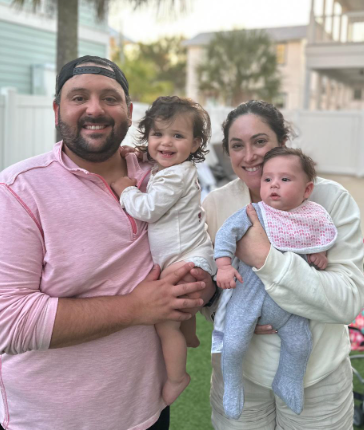
But for Villena, the most surprising and joyful news was yet to come. During the later stages of the surrogate’s pregnancy, she discovered that she also was pregnant. No fertility treatments were involved, no IVF, just a natural miracle, after all those years. It only added to the overwhelming sense of gratitude that she felt for the immense gift their surrogate had provided she and her husband.
“When our daughter was born, I felt just so overwhelmed,” Villena said. “I felt such happy joy, to see someone do that for you, it’s really kind of humbling. I get emotional even now thinking about that gift she gave us. She made us parents.”
Seven months later, the Villenas’ son was born without any complications. Two children, one family that seemed so long in coming.
“We truly do think we have two miracle babies. I mean, we know we have two miracle babies. Having our daughter, then, obviously getting pregnant on our own, naturally and spontaneously, is just the biggest blessing and the biggest miracle.”
comments