


Rabbi Roundtable: July 15, 2026
The AJT has launched a new monthly feature bringing spiritual leaders together from across all denominations and Jewish Atlanta.
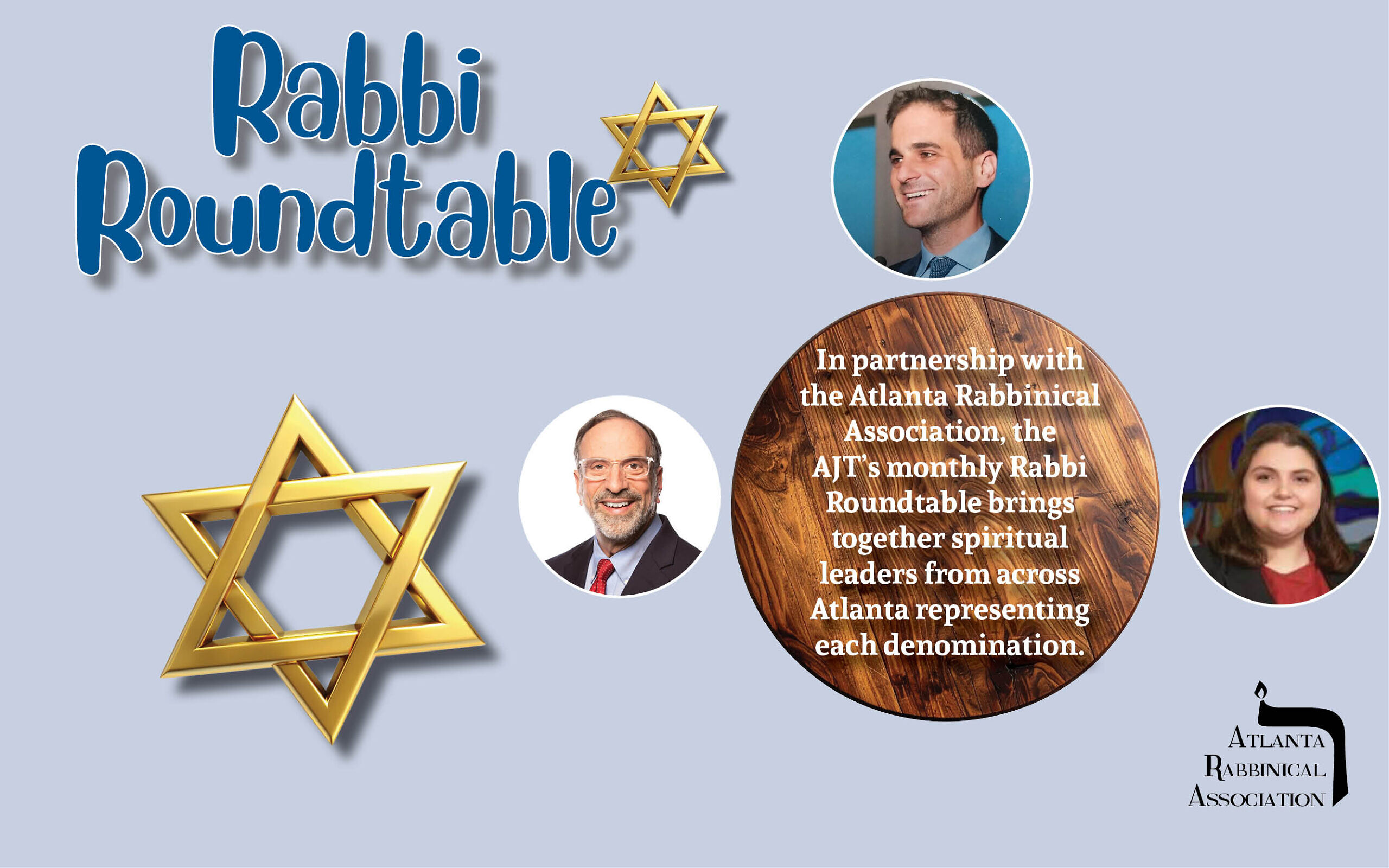
In partnership with the Atlanta Rabbinical Association, the AJT’s monthly Rabbi Roundtable brings together spiritual leaders from across Atlanta representing each denomination.

 For this month’s discussion, each spiritual leader was asked the following question:
When someone experiences the death of a beloved pet as the loss of family, how should rabbis honor that grief while also being honest about the boundaries of Jewish mourning practice?
Rabbi Natan Trief
My 9-year-old labradoodle, Huck, is a big part of our family. We got him a year before our son was born, and he has been with us every step of the way. I often stare at his big brown eyes feeling as though my gaze penetrates his soul. In Hebrew, we say that animals are ba’aley chayim, literally “possessors of life.” That life represents something sacred as does the soul attached to it. But Huck is not human. I notice it constantly as he acts almost entirely on instinct and craving rather than higher-order thinking. In Jewish philosophy, human beings are called ha’midaber (the one who speaks). Our capacity for speech differentiates us from other forms of life and places our neshama on a separate plane.
As my vet reminded me during his recent wellness visit, this was Huck’s first “geriatric” visit. Hopefully he has many good years left, but I am increasingly aware that our time together is finite. For now, I do not want to imagine, but I know his eventual loss will be deeply painful and leave a profound void.
And yet, I remind myself that his soul is not the same as a human soul. I will surely craft some type of mourning ritual, including psalms and personal prayers, but it will likely end there. No Mourner’s Kaddish, el maleh rachamim, or other traditional forms of mourning human beings.
I would not, however, judge someone else who chose a different path of mourning, one more aligned with human rituals. As one of my favorite people always reminds me, there’s something worth noticing when you spell “dog” backwards.
Rabbi Neil Sandler
Nearly 40 years ago circumstances converged to create one of the darkest and loneliest nights I had ever experienced. Our young family would soon move to a new community. We had learned that our “first – born,” as we referred to our dog Zahavit, was ill without clear diagnosis. We could not take Zahavit with us to our new home. I drove nearly two hours to a college campus where the School of Veterinary Medicine had agreed to welcome her. My tears flowed freely. The separation from Zahavit felt especially painful. The ride home was unbearable.
Susan and I were in denial about the loss of our dog. We were anxious to move on with our lives. Eventually, the university to which I brought Zahavit contacted us to tell us about poisonous elements she had ingested and the decision to euthanize her. The staff of that veterinary facility were more sensitive than us. They knew that reaching closure following Zahavit’s death was important.
People who suffer the loss of a beloved pet and find ways, including Jewish actions, to mourn the loss are so much wiser than we were. They understand these actions will bring them a measure of comfort and perspective.
The question being addressed to the rabbis here is a difficult one. I learned a long time ago not to be judgmental about the choices people make. Being judgmental when I feel differently about how to act in given circumstances can only force a wedge between me and people I am trying to support. I might encourage certain Jewish actions rather than others. But what does it mean to be “… honest about the boundaries of Jewish mourning practice?” What are those boundaries?
Jewish mourning practices for a pet should be supported if they encourage healthy closure. May the Holy One continue to bless us with sustaining memories of our beloved pets who enriched our lives and the lives of our families.
Rabbi Ashley Englander
Judaism has many rituals when it comes to mourning practices. An immediate mourner will render their clothes, abstain from enjoyable routines, and recite the Mourner’s Kaddish. However, Jewish tradition is not as clear about mourning the death of a pet.
In II Samuel, Nathan shared the following parable with David, “There were two men in a city – one rich and one poor. The rich man had lots of animals, and the poor man had one lamb. The poor man tended to the lamb as it grew up and allowed it to nestle on his chest. The lamb was like a daughter to him. A traveler came to the rich man and asked for food, but the rich man refused. Instead, the rich man took the poor man’s lamb and prepared it into a meal. When David heard this story, he became angry and said that the man who killed the lamb deserves to die and should pay for the lamb four times over.”
Our tradition can recognize the possibility of an animal being like a family member to us, while still realizing that animals of our household are seen as property.
A couple asked me how they could mourn the loss of their beloved dog, who in their eyes, was like their daughter. Some might say that pet loss is not equivalent to the loss of a person, therefore, mourning the animal through Jewish practice is not only inappropriate, but also offensive. I have experienced the Jewish mourning rituals found in tradition. However, the grief of losing a pet does not negate the experiences I have encountered. Instead, how can we make Jewish rituals accessible to those who need it in their vulnerable and painful moments?
We can identify rituals that honor both the loss and our tradition. The mourner can honor their deceased pet through a burial, read parashat Noah, or share memories of the pet.
A rabbi can provide the framework of how an individual can use Jewish tradition as they navigate suffering. May we continue to comfort those who are in pain, and let us be strengthened by our tradition as we support them.

Rabbi Bios:

Rabbi Natan Trief, Reform
Rabbi Natan Trief moved to Israel in 2006 and enlisted in the Israel Defense Forces as a combat soldier specializing in search and rescue. He received a Masters of Hebrew Literature and rabbinic ordination from Hebrew Union College-Institute of Religion in 2015. He currently heads adult education for Temple Sinai in Atlanta, where he lives with his wife Samantha, also a rabbi, and their son, Rafael.

Rabbi Neil Sandler, Conservative
Rabbi Neil Sandler, a Conservative rabbi, is the Rabbi Emeritus of Ahavath Achim Synagogue. In recent years he has served as spiritual leader of the Fitzgerald Hebrew Congregation in South Georgia and as a volunteer chaplain to the Jewish community at Emory St. Joseph’s Hospital.

Rabbi Ashley Englander, Reform
Rabbi Ashley Englander serves as the Rabbi Educator at Temple Kol Emeth in Marietta. After her ordination from HUC-JIR, she served a congregation in Jacksonville, Fla. During her time, she was a rabbinic fellow for Amplify Israel. She has a deep passion for creating immersive, educational experiences for her students through the lens of progressive Judaism. Her love and support of Israel is unwavering, and she works diligently to include Israel education and connection in her curriculum and programming. In addition to a love for Israel, Rabbi Englander has a passion for Jewish ecology. She is a mother to two sons, and has a devoted husband, who continues to support her every step of the way.
- Rabbis Natan Trief
- Neil Sandler
- and Ashley Englander
- rabbi roundtable
- Opinion
- Atlanta Rabbinical Association
- mourner’s kaddish
- Israel Defense Forces
- Hebrew Union College-Institute of Religion
- Temple Sinai
- Ahavath Achim Synagogue
- Fitzgerald Hebrew Congregation
- Emory St. Joseph's Hospital
- Temple Kol Emeth
- Amplify Israel
comments