



‘Silent Night’ is a Remarkable Study of War
Atlanta Opera’s production of the Pulitzer Prize-winning opera brings together soldiers who are enemies during World War I.
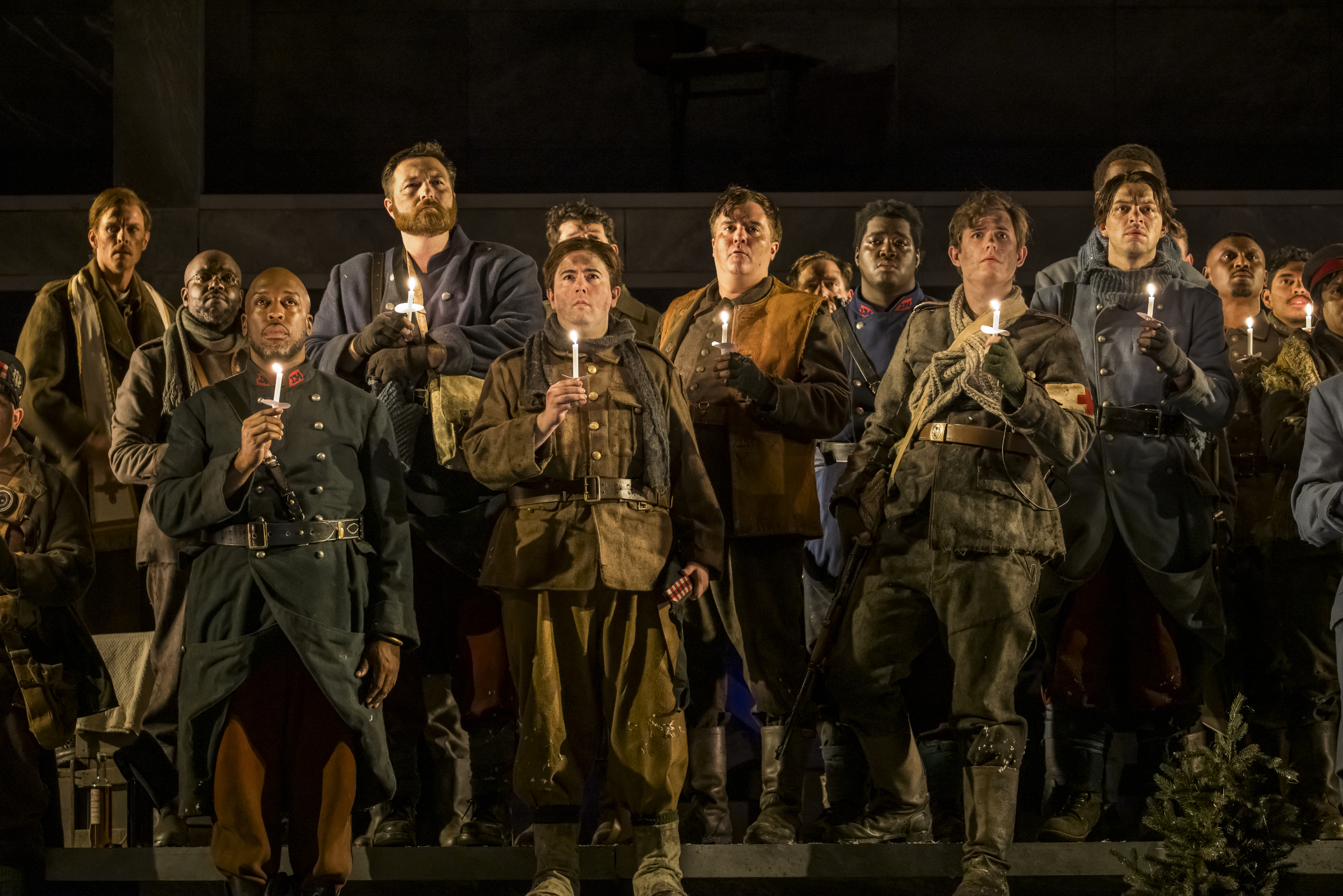
Before the curtain goes up on “Silent Night,” The Atlanta Opera’s first offering of its latest season, a memorial to those who died in World War I appears on a large projection screen.

In the background, the names of those who died scroll by in endless rows of type. The four-year war that began in 1914 is said to have claimed the lives of nearly 10 million soldiers and had an enormous impact on shaping the history of the century to come.
But at the outset of the opera, which opened just prior to Veterans Day, there is only is only an emotional high in the call to arms. In Scotland, Germany, and France young men go off to what they are certain will be only a brief interlude in their lives.
The Chief Rabbi of the British Empire, Joseph Hertz, who would later be noted for his commentary on “The Five Books of Moses,” was enthusiastic in his support for the war. Hertz became the first Jew to win Britain’s highest honor, the Victoria Cross, in 1914.
The history of the events leading to “Silent Night” was particularly important for the Jews of Germany. At the war’s outset, they flocked to enlist in the army of their Kaiser Wilhelm and before the war was over 100,000 Jews would go off to battle. Many took their participation in the war as an indication that after so many years of discrimination, they were finally being accepted, albeit somewhat grudgingly, as equals in the country of their birth.
And for the first time ever, rabbis were allowed to hold religious services for German Jews on the battlefield. Eventually, 40 rabbis would serve during the war and would be paid by the German government for their service.

In another first, a small number of Jews also served as officers in the German army. It is one of the ironies of what came to be known as The Great War that the Bavarian officer who recommended an Iron Cross for an Austrian corporal named Adolf Hitler was Lieutenant Hugo Gutmann, a Jewish army officer.
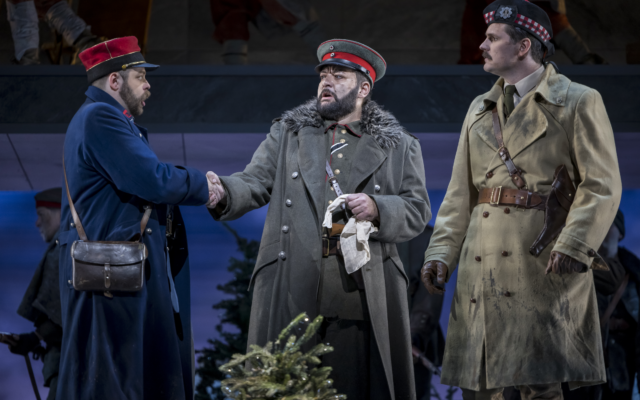
In “Silent Night,” the German soldiers are commanded by another Jewish lieutenant named Horstmayer. He’s chagrined, as we hear in the opera, that the first Christmas he is celebrating during the brief ceasefire may be his last. Still, according to the director, Tomer Zvulun, the Jewish Horstmayer is proudly serving Germany.
“World War I has a particular resonance in Jewish history,” Zvulun says. “Many European Jewish people were deeply assimilated and fiercely loyal to their countries. Watching him today, knowing what would happen to German Jewish people only two decades later, despite that loyalty and service, is deeply chilling.”
Horstmayer is portrayed by Aleksey Bogdanov, whose Ukrainian Jewish parents brought him to this country as child. He’s part of a talented cast headed by Susanna Burgess, who also starred in Zvulun’s production of “Silent Night” for the Florida Grand Opera and Kameron Lopreore, who, in the coming season, is making his Metropolitan Opera debut. Although the performance runs over two-and-a-half hours, time passes quickly in Zvulun’s absorbing staging.
All the early euphoria quickly dissipates the true horror of what seems like an endless nightmare of death and destruction that begins to take hold.
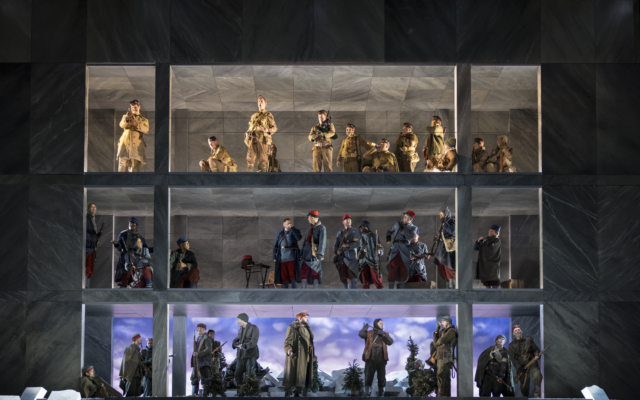
Then, suddenly and seemingly without much warning the soldiers from the three countries, who faced off against one another in the trenches along the Western Front of the war, agree to put down their weapons on Christmas Eve. They declare a short truce and celebrate the holiday together. But, to Zvulun, who grew up in Israel, this is much more than a story about a religious observance.
“For me, Christmas is the setting,” Zvulun pointed out. “The deeper story, about identity, belonging, dehumanization, and our ability to recognize ourselves in the person on the other side, belongs to everyone.”
While the Christmas truce that is so movingly portrayed in this work may be the opera’s high point, for the generals on both sides of the conflict it is taken as a sign of gross insubordination and they retaliate. What kind of a war can you have, after all, if soldiers on the front lines can declare their own cease fires?
For those who might not be able to attend the performances at the Cobb Energy Center, the Atlanta Opera is partnering with Theatrical Outfit at their theater downtown, for “All is Calm,” a stage version of the Christmas truce of 1914, which opens Dec. 2 for a month of performances. Next spring, the Metropolitan Opera in New York will mount their own production of “Silent Night.”
comments