



Rabbi Roundtable: Sept. 22, 2026
The AJT has launched a new monthly feature bringing spiritual leaders together from across all denominations and Jewish Atlanta.
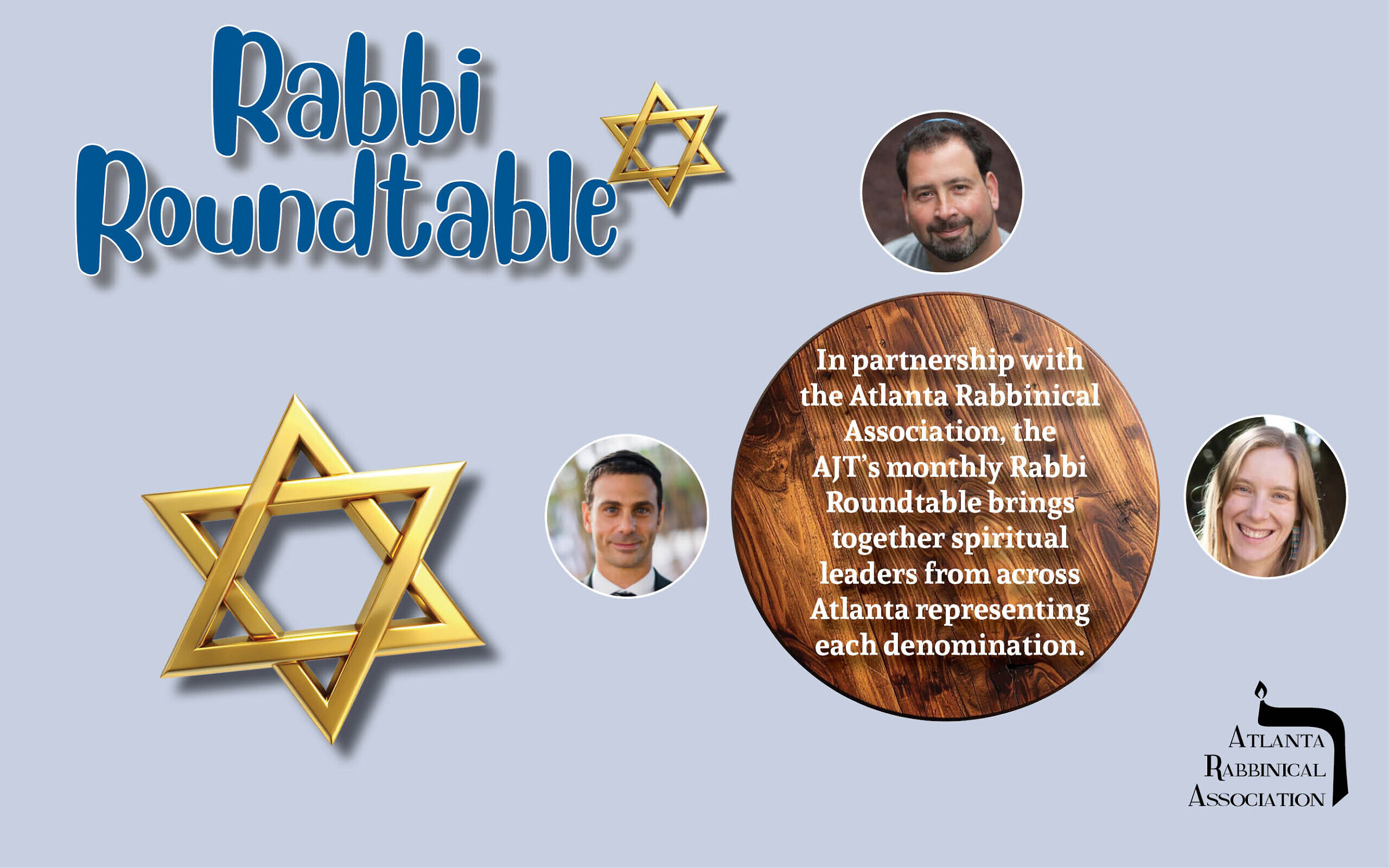
In partnership with the Atlanta Rabbinical Association, the AJT’s monthly Rabbi Roundtable brings together spiritual leaders from across Atlanta representing each denomination.

For this month’s discussion, each spiritual leader was asked the following question:
How does Judaism challenge us to define success in a culture that often measures it by income, title, or influence?
Rabbi Spike Anderson
In Torah, there is a brilliant image of our ancestors making their way through the desert wilderness, guided through the dark night by a blazing pillar of light.
There is a consistent theology in Judaism, which, whether you personally believe it or not, we Jews have been repeating from generation to generation for thousands of years. It declares that G-d has partnered with the Jewish people to take the world from where it is to where it needs to be — from darkness to light, from brokenness to wholeness, from injustice to justice.

The common term for this is Tikkun Olam, “healing the world,” and we personally prepare ourselves for this existential effort through Tikkun HaNefesh, “mending of the soul.”
This theological cornerstone literally lends itself to “meaning of life” conversations, along with subsequent orientations and convictions. More than a spiritual compass, they function as benchmarks for how we are living our lives: successfully … or not so much?
Is my time (at least some part of my free time) spent in ways that meaningfully move this proverbial needle forward?
Am I consciously building bridges and fostering human relationships that invite coveted human connection and goodwill?
Am I able to tap into my Judaism to both deepen my relationship with G-d and to raise up the Jewish civilization for myself, and for the generations to follow?
The Jewish lens regulates ordinary success markers of income, title, and influence solely as potential means to an end, but most definitely not ‘ends’ unto themselves. These are meant to be vehicles only, not destinations. (Imagine getting in your car, and that is where your journey ends). When we lose sight of this, according to our religious tradition, we miss the entire point of living, and the world (including those around us) is much poorer for it.
The good news is that usually small adjustments in our priorities can get us back on track.
Brass tacks: synagogues typically have a myriad of Tikkun Olam opportunities, chances to restart or deepen your worship, ways to meaningfully connect you to other Jews with similar priorities, and classes that help you access poignant Jewish wisdom.
A pillar of fire to illuminate our travels through the dark wilderness? We have it. We just have to open our eyes.
Rabbi Ariel Root Wolpe
My third child was born a week early, and for the first time in a decade, I stepped back from Ma’alot to focus on my newborn. For years, I had pursued success through a work life that, underneath, was not working.
Judaism has never measured a life by status. Pirkei Avot warns that envy, desire, and honor-seeking drive a person from the world. Instead, the rabbis measure two relationships: with the divine and with the souls around us. Both are shaped by how we care for our own self. If I am not for myself, Hillel asks, who will be for me?
Like many of us, I learned to push past my limits and perform excellence to feel worthy. But worth built on outside validation is ever fleeting. Judaism affirms our inherent worth and calls us toward relationship through ritual and deeds. We sit in our sukkah under branches that let the stars through and the neighbors in. On Yom Kippur, we examine every action that calls for repair; nowhere do we list our achievements. We visit the sick, tend the earth, and give thanks, not because these mitzvot build a resume, but because they build a self.
“Who is rich?” Ben Zoma asks. “The one who rejoices in their portion.” Success is not the title or influence one achieves. It is tending a whole self that channels gifts into the world.
My son arrived early, asking me to wholly receive him. I said yes. And we rejoiced.
Rabbi Ira Bedzow
While modern culture often defines success through income, title, and influence, chasing those markers can leave us pursuing a finish line that keeps moving. There is always another promotion, another milestone, or another person doing better. Also, when achievement becomes the goal, our motivation shifts away from the work itself, making it harder to find meaning in what we do.
The Jewish tradition offers a different way to think about success. In modern Hebrew, the common word for success is hatzlachah, and it generally means accomplishing a goal or having an endeavor turn out well. In the Bible, however, the word is not simply used to convey getting what we want. It describes a person under God’s guidance or walking wisely along the right path.
A more common biblical term that speaks to success is ashrei: fortunate, fulfilled, or happy — not as a momentary feeling, but as a way of living well. Psalm 1 begins, “Happy is the one who has not followed the counsel of the wicked … but rather delights in G-d’s teaching.” The successful person is not someone who has internalized society’s expectations of success, but one who takes pleasure in living based on the values and teachings of the Jewish tradition. Even here, however, the goal is not achieving a level of religiosity or frumkeit. It is enjoying the path and what one learns along the way.
In Pirkei Avot, Ben Zoma provides a strong psychological lesson on how to achieve this type of success: “Who is rich? One who rejoices in his portion.”
Rabbi Bios

Rabbi Spike Anderson, Reform
Rabbi Spike Anderson is the spiritual leader of Temple Emanu-El. Born and raised in Boston, he entered the rabbinate after a successful career as a Silicon Valley entrepreneur. Rabbi Anderson was ordained at Hebrew Union College-Jewish Institute of Religion (HUC-JIR) in New York City, and began his rabbinic service at Stephen S. Wise Temple in Los Angeles in 2008. The opportunity to lead Temple Emanu-El spurred Rabbi Anderson to move his family across the country to join a new congregation and a new community. Rabbi Anderson shares his journey with his wife, Marita, and their three young children.

Rabbi Ariel Root Wolpe, Conservative
Rabbi Ariel Root Wolpe is a mother, musician, spiritual educator, and the founder of Ma’alot. Originally from Philadelphia, she studied religion and music at Emory University before receiving rabbinic ordination from the Ziegler School of Rabbinic Studies, where her learning centered on Hasidic thought, feminist interpretations of Jewish history and ritual, and the spiritual possibilities of Jewish communal life. After ordination, Ariel deepened her study of Jewish music as a Rising Song Resident in Philadelphia. She founded Ma’alot in 2021 to create a Jewish community rooted in music, nature, spiritual practice, and meaningful human connection. Through her teaching and leadership, she helps people encounter Jewish wisdom as a living resource for healing, belonging, and becoming more fully themselves.

Rabbi Ira Bedzow, Orthodox
Rabbi Ira Bedzow, Ph.D. (Emory University) is the executive director of the Emory Purpose Project, one of the signature elements of its Student Flourishing Initiative, whose mission is to unite diverse partners across the Emory community in providing opportunities for students to develop a muscle for reflection on purpose and meaning. Rabbi Bedzow is an associate professor in the Department of Medicine, a core faculty member of Emory’s Center for Ethics, a senior fellow in the Center for the Study of Law and Religion, and the unit head of the International Chair in Bioethics at Emory University. He is also senior scholar of the Aspen Center for Social Values, and co-director of the Maimonides Institute for Medicine, Ethics and the Holocaust (MIMEH).
comments