



A Place at the Table
Embark Atlanta welcomes interfaith couples.
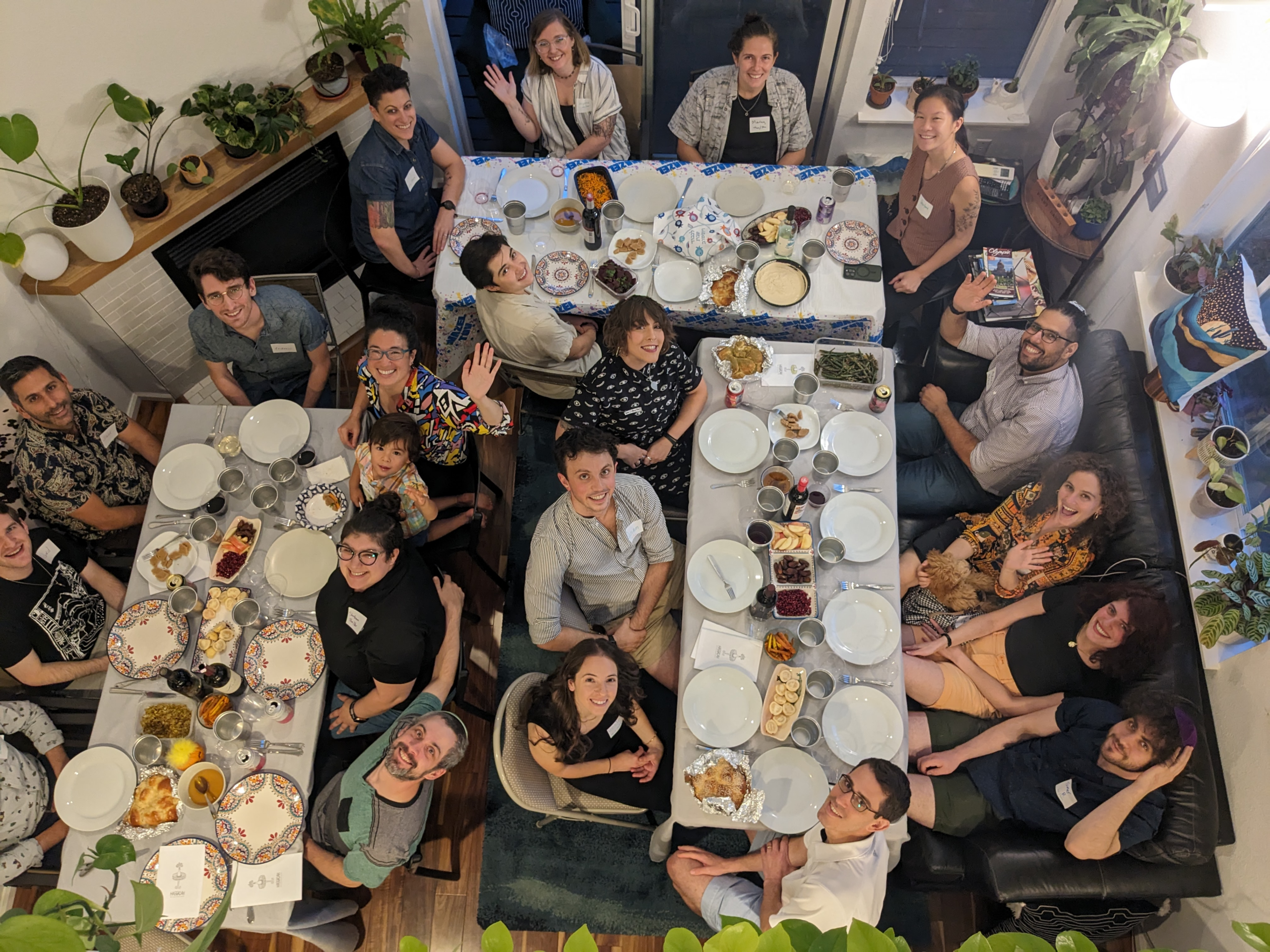
For Rabbi Daniel Dorsch, the goal of Atlanta’s newest Embark cohort goes well beyond six sessions, a retreat or a Shabbat dinner.

Success might look like a text message months later with a question about Jewish practice. It might be an invitation to grab coffee. Or it might mean being asked to officiate at a baby naming for a couple whose relationship with Jewish life began to deepen through the program.
Those continuing relationships are at the heart of Embark Atlanta, a program for young couples exploring what Judaism and Jewish life might look like within their relationships.
“I hope participants will walk away knowing that they have a relationship with a rabbi who values and respects them,” said Dorsch, who will lead the upcoming Atlanta cohort. “I continue to connect with most of the participants from my first cohort. I am proud that they continue to feel that point of connection with me.”
Embark, a program of Mem Global, is designed primarily for interfaith couples in their 20s and 30s who want to explore Jewish traditions, identity, and community without an expectation of conversion. The upcoming Atlanta cohort runs from Dec. 7 through Feb. 22 and will bring together a small group of couples for six cohort sessions, an immersive retreat and a Shabbat dinner. Couples also have an opportunity to meet individually with their cohort rabbi.
Rabbi Dorsch said his decision to partner with Mem Global grew from what he sees as a significant need within Atlanta’s Jewish community. Years ago, he attended a Jewish Federation of Greater Atlanta meeting where survey data indicated that Atlanta had the second-largest population of interfaith families of any city in North America.

“Provided this data point remains accurate, we have a tremendous amount of ground to cover when it comes to targeting families for meaningful Jewish engagement,” Rabbi Dorsch said.
Embark approaches that engagement without pushing couples toward a predetermined outcome. Instead, couples are encouraged to talk honestly about their religious and spiritual identities and what they want those identities to look like as they build a life together.
“Obviously, there’s no bait and switch here,” Rabbi Dorsch said. “They are joining a program guided by a rabbi. That said, I approach this work in a non-judgmental and supportive way.”
Conversations can include everything from holidays and Shabbat to family traditions, values, belonging and the rituals couples may eventually want to create in their own homes.
This Atlanta cohort will also broaden that conversation beyond traditional definitions of interfaith relationships. Rabbi Dorsch plans to welcome Jewish couples who grew up with different religious backgrounds or practices and are now thinking more intentionally about what their shared Jewish life should look like. That could also include couples in which one partner has converted to Judaism.
The idea grew partly from Rabbi Dorsch’s experience leading his first cohort.
“I found myself thinking just how many of these discussions could be relevant to different varieties of couples who may realize they may seek to be on a closer path with respect to their religious identity,” he said.
The conversations that followed, both within the group and individually, proved important.
“Both the group dialogue and 1-1 conversations in that first cohort were deep and quite impactful,” he said.
For Dorsch, those conversations are just the beginning. Since his first cohort, he has remained part of the lives of many participating couples. He has officiated at baby namings for two couples who did not yet have children when they joined the group. He also joined another family long-distance by Zoom for a bris.
“I personally find this work gratifying because I love building relationships with these couples,” he said. “Like all rabbis, it’s the honor of a lifetime to enter into the lives of these families and be there for them when they are making these critical Jewish choices together.”
Rabbi Dorsch is the rabbi of Congregation Etz Chaim in Marietta.
While he said he cannot speak for Atlanta’s Jewish community as a whole, the response within his own congregation has been overwhelmingly positive. There is also a generational element to that response. Some Embark participants are the adult children of synagogue members.
“They are happy to see their children reengaged in Jewish life as adults and welcomed by a rabbi into the fold,” Rabbi Dorsch said.
That sense of welcome may ultimately be the most important measure of the program.
For some couples, participation may lead to incorporating more Jewish traditions into their homes. For others, it may mean feeling comfortable asking a rabbi a question they once would not have known whom to call. Rabbi Dorsch does not define success by synagogue membership or by a particular level of observance.
“Success looks like a continued, engaged, meaningful relationship,” he said. “Maybe, a text message about a religious or spiritual question? An invitation to grab coffee at the synagogue for continued connection.”
Ultimately, Rabbi Dorsch hopes Embark sends a straightforward message to couples who may have wondered whether there is a place for their families within organized Jewish life.
“I hope that the program teaches interfaith couples that there is a space for them in organized Jewish life,” he said, “not only in a synagogue, but also that there is a rabbi who cares about them and welcomes them into the fold with open arms.”
More information and registration are available through Mem Global at https://memglobal.org/embark/.
comments