



Temple Sinai Hosts Israel Expert, Oct. 7 Memorial
Temple Sinai hears prominent Israel psychologist assess the progress that has been made in healing the nation and, along with Federation, hosts "Together We Remember, Together We Sing."
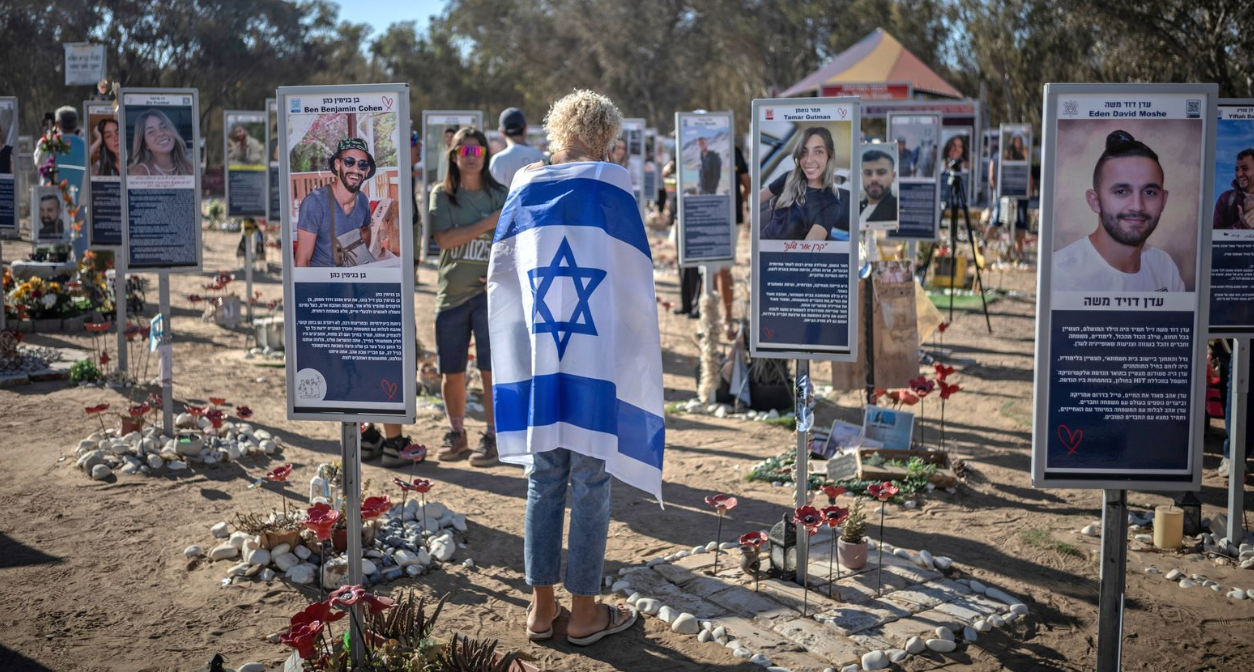
Three years after the tragic events in Israel of Oct. 7, members of Temple Sinai received a professional appraisal of the psychological damage the events of that day caused. They spent their noon hour virtually with Professor Ofrit Shapira Berman, one of Israel’s leading psychotherapists, an expert on psychological trauma who has been deeply involved in the complex and often lengthy treatment of the survivors of Oct. 7.

Because Israel’s national health service provides very limited care to those directly impacted by the trauma of the Hamas attack, she founded First Line Med. The nonprofit organization provides professional, long-term mental health counseling, free of charge, to Israelis affected by the events of Oct. 7.
So far, the organization’s 450 professionals have provided more than 30,000 hours of treatment for 750 families. But the need, she says, has been difficult to manage. To give her audience some idea of how Israel was impacted by the attacks, she once calculated that in an America of 350 million residents, it was as if 5,600 had been kidnapped and 40,000 had been killed in a single day.
And she told her Temple Sinai audience that shocks to the national psyche still keep coming. Ongoing trauma caused by war, political tensions, and the stress of continuing military service has meant, according to Dr. Berman, that sometimes the numbers seeking help are greater than when the war in Gaza was at its peak.
“What we see over the last year is that every time, like there are certain days or events in the social and political life of Israel, that … we have a rush of patients or of survivors or family members who reach out and ask for help,” she said. “And, of course those that, for example, that I see in my office, absolutely break down.”
She resists the analogy that that single day in Israel’s history equaled the terrible destruction of European Jewry over the 12 years of Nazi terror. But one cannot discount the impact of the 12 hours of unrelenting violence and human depravity unleashed by Hamas that was captured in audio and video recordings that are still fresh memories.

In a presentation she made in Switzerland for Israel’s Hebrew University, she recalled her own shock in the early hours of Oct. 7 as she began receiving word that some had heard of the death of a loved over or an entire family on a muffled cell phone call. Or that women had endured unimaginable sexual violence recorded by Hamas terrorists. The sound of laughter by sadistic Palestinians as Israelis were doused with gasoline and set ablaze still resounds in Israel.
“It was clear to us that the most long-term effect of what happened on Oct. 7 is going to be the psychological trauma,” Dr. Berman pointed out. “The physical wounds can be treated, and the medical care in Israel is wonderful. People will be healed physically, but mentally it’s going to be very, very difficult,” she said. “That they will need a long time of someone to be with them for them to be able to even begin to tell us what they were through.”
According to Dr. Berman, the closely knit social structure of many of the communities that were in the direct line of fire on that day often worked against the healing process.
“Many of them belong to a kibbutz, which is a very unique community,” she said. “Everybody knows everybody from the day they were born. So, even if none of your direct family has been murdered, the fact that the kibbutzim have lost so many of their members makes you a part of a very big, bereaved family. So, everything needs to get help.”
But she told her Temple Sinai audience that not all those who may need help seek an appointment with a therapist. For those young people who were caught, unaware, in the early hours of Oct. 7 at the Nova music festival near the Gaza border, help has come by telling the story of what they experienced to others in the United State and in Europe. The response by others, who are often contemporaries, the sense they are loved and respected and honored is very important and may play an important role, according to Dr. Berman, in the healing process.
“As more stories from survivors and more pre-Oct. 7 warnings come to light,” Rabbi Natan Trief said, “this year feels like we are right back in that terrible morning.”
Temple Sinai and Jewish Federation of Greater Atlanta hosted a ceremony on the evening of Oct. 7 to memorialize the third anniversary of the attacks. Several hundred community members gathered for the somber ceremony, seated in circles surrounding a raised, pristine white stage.
The memorial, “Together We Remember, Together We Sing,” featured a personal story from a local Lone Soldier currently serving in Israel, speeches from Consul General of Israel to the Southeastern U.S. Eitan Weiss and Federation CEO and President Renee Kutner, and prayers led by a collection of Atlanta Rabbinical Association rabbis.
The memorial also featured a series of inspirational posters that detailed the recovery efforts that hostages and their loved ones have made since the attacks.
comments