



Blank Gives $4M to Boost HBCU Graduation Rates
This year’s commitment is part of a $50 million, 10-year effort to help Black college students in Atlanta to graduate.

For several hundred students who are returning to classes this fall at Atlanta’s historically Black colleges and universities (HBCU’s), the financial burden of completing their education has become much easier.

The Arthur Blank Family Foundation announced earlier this year that it has made more than $4.2 million in scholarships available to nearly 600 students enrolled at Clark Atlanta University, and Spelman and Morehouse Colleges. That’s important because, according to recent statistics, Black students have a college graduation rate of only about 40 percent, which is significantly lower than the rates for white students at 64 percent and Asian students at 74 percent.
In recent years, Arthur Blank and his foundation has offered significant grants to the development of the social and economic structure in the largely Black neighborhoods that lie just west of his Mercedes-Benz Stadium. Clark Atlanta University, Morehouse College, and Spelman College are all less than three miles from the large sports arena.
Over the next 10 years, the Blank Foundation expects to support nearly 10,000 of these Atlanta students at Black colleges. The effort to boost Black college student graduation rates can serve as a model for other foundations according to Blank, who has made a personal commitment to the program’s success. He is hopeful that other philanthropic institutions follow his lead and expand their investment in helping these students succeed in graduating.
“We are deeply committed to supporting the students who will carry that legacy forward. We recognize that these campuses, like many across the country, are home to generations of students whose promise inspires us,” Blank said. “Our hope is that by helping more students earn their degrees, launch successful careers and become alumni who give back, we are investing in a cycle of opportunity that benefits young people and their families in Atlanta and communities across the nation for years to come.”
The Blank Foundation views the funding as particularly critical for students who are struggling to meet the financial burdens of higher education.

“We’ve seen what’s possible when students get the support they need to cross the finish line,” said Margaret Connelly, managing director of founder initiatives for the Arthur M. Blank Family Foundation. “That’s what drives this work, and why we hope this initiative encourages others to invest in closing these gaps and helping more students achieve the futures they’ve worked so hard to reach.”
This year’s grants are part of a 10-year commitment of $50 million that the Blank Foundation announced last year to keep hard-working students in school and to graduate. Studies have shown that the median income of Black students who graduate with a bachelor’s degree is twice as great as those Black students with only a high school diploma.
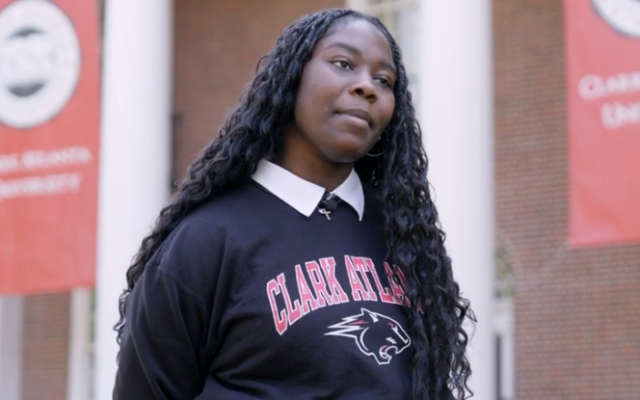
Clark Atlanta University student Kayla Drummond was among those students who were able to graduate this year because of the Blank Foundation’s financial aid. Like so many of her peers at the university, she had exhausted all her financial options before she entered her senior year. The failure to graduate, she feels, would not only have made a difference in her future, but it would have affected so many others who had encouraged her.
“From my first time stepping on Clark Atlanta’s campus, I felt a sense of family and this is where I belong,” Drummond said. “This diploma isn’t just for me, it’s for my family, it’s for my friends, the love, the prayers, the support.”
The scholarship aid is particularly aimed at students from low-income families who have exhausted their eligibility for Pell Grants, a need-based form of higher education aid from the Federal government. Unlike traditional college loans, it does not have to be repaid. But that doesn’t mean that Pell-eligible students don’t take out more loans, work longer hours at outside employment, and a face higher degree of food and housing insecurity.
Students who are in good academic standing and have fully exhausted other financial options, including scholarships, Federal grants, state assistance, and loan programs will be eligible to receive funding at the discretion of their respective institution. The funding will largely support students in their junior and senior years, when financial stress can be most acute as family resources may be spread thin or other family members begin college.
“Even a small financial gap can be the difference between walking across the graduation stage or walking away,” said Fay Twersky, president, Arthur M. Blank Family Foundation. “We are proud to stand with Atlanta’s HBCU’s and help more students achieve their dreams. These grants are a material investment in hope.”
comments