



‘Eleanor The Great’ is an Impressive Film
With a strong cast and a capable script, Scarlett Johansson makes her directorial debut.

Scarlett Johansson is nowhere to be seen in her directorial debut, “Eleanor The Great,” but her presence is felt in every frame of this beautiful, heartfelt psychological study of aging, intergenerational angst, Holocaust survivor guilt, and the contemporary ease we have of making up falsehoods for our own purposes.

Johansson, one of the most self-consciously Jewish of recent Hollywood stars, has chosen a neatly plotted and even occasionally profound script by Torey Kamen, who, along with Johansson is making a creative debut behind the cameras.
She guides an ensemble of four talented performers who run the full range of ages and on-screen personal problems, starting with Rita Zohar who, as Bessie Stern, a Holocaust survivor, dies early in the film. She lives on in flashbacks, not a few of which have such power that she almost steals the film from the rest of the capable, strong cast.
When we first meet her, early in the film, she is in a local Southern California supermarket, unable to find her favorite kosher pickles. She’s accompanied by her friend, Eleanor, played by June Squibb, with whom she has been sharing a nondescript apartment in Florida for 11 years.
It takes only a few minutes into the film for Squibb, around whom this film is constructed, to take charge. She sweetly but firmly lets a hapless young supermarket stock clerk know where he can find the under stock for her friend’s pickles.
Squibb, at the age of 94, is one of the true miracles of contemporary Hollywood acting. The Oscar-nominated actress had her breakthrough role 12 years ago in “Nebraska.”

She starred in “Thelma” last year, lifting the quirky, independently produced film higher simply by her appealing portrayal of a spunky senior. She dominates this film, too, but here she’s a much more complex character who struggles with the sudden loss of her close friend and her own personal moral compass.
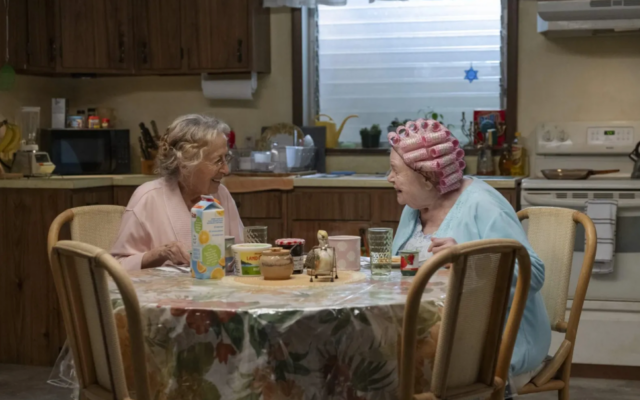
To help cope with her loss, she leaves sunny South Florida to move in with her daughter, a single and childless big city career woman in Manhattan played by June Hecht. The daughter quickly tries to relieve herself of too much responsibility for her mother’s move north. It’s the first of a number of scenes the two women share in the film that makes it clear that trouble is brewing.
And trouble it is, that appears in the most unlikely of places, a Holocaust survivors’ support group that meets regularly at the local Jewish community center. She immediately and unpredictably settles into the group as a survivor from Poland.
She relates her wartime experiences so convincingly and dramatically that she attracts the attention of a young biracial woman, Nina, convincingly portrayed by Erin Kellyman, who is also struggling with grief and the recent loss of her mother.
What complicates the seemingly perfect relationship that quickly spirals out of control is the life she has invented for herself in her new surroundings. She isn’t a Holocaust survivor, and she came to her Judaism only after she married a Jewish husband. In real life, Squibb is a Jew by choice who converted in the 1950s. In the film, she has contrived such a good story that she achieves a kind of minor celebrity in a city like New York that loves celebrities and is eager to accept any good story without too many questions.
But her story ultimately unravels and as it does, lands its strongest punch late in the film. Although the story falls into place a little too neatly and has been greeted by mixed reviews by critics, Johansson handles the tricky subject matter with a deft touch. For her success in bringing this not always easy story to the screen, she has been hailed as an A-list star who can comfortably add director to her resume. The film debuted at the Cannes Film Festival and was greeted by an extended round of standing applause.
It is praise that is well deserved. In bringing this story to the screen, with its attention to thoughtful pacing and a powerful finish, the Hollywood star turned director has shown she has a bright future ahead of her. It also confirms the recent string of films that have successfully dealt with Jewish identity. “Eleanor The Great” joins such films as, “The Brutalist,” and “A Real Pain,” as a trifecta of deeply affecting winners in the past two years that explore modern Jewish life with insight and deeply affecting character development.
This is a film that would have easily made the lineup of our local Jewish film festival. Don’t wait for this to stream in the first months of 2026, see it now and bring a friend.
comments