



I’m Happy & Relieved for My Extended Family
But the return of several dozen hostages (more than half of whom are believed dead) has yet to be finalized.
Dave Schechter is a veteran journalist whose career includes writing and producing reports from Israel and elsewhere in the Middle East.

This column was always going to break in one of two ways.

Which way was uncertain until Feb. 22, when Tal Shoham came home.
After 505 days as a hostage in Gaza, Tal returned to Israel, to his wife and two young children, and to an extended family whose lives have been on hold since Oct. 7, 2023.
Over the past 16 months, I have written two dozen “From Where I Sit” columns about the 1,200 men, women, and children slaughtered that day and the 250 kidnapped in the Hamas-led pogroms against kibbutzim, towns, and an outdoor music festival in Israel’s “Gaza envelope.» I have allowed myself an emotional investment in this story, contrary to my usual practice.
The reason lies in history that began in the mid-1800s, in Foscani, a town in Moldova, now part of Romania, with Isaac and Chaya Schechter, my paternal great-great grandparents. Their children included twin boys, Solomon, my great-grandfather, and Yisrael, my great-grand uncle.
Yisrael emigrated in 1882 to what then was part of the Ottoman Empire, where he was a founder of the town of Zichron Yaakov. Yisrael married twice and had 11 children. I can trace six generations of first, second, and third cousins, some once or twice removed, some connected by marriage, on the Israeli side of the family.
I met about 150 Schechter relations (and was told that another 300 were absent) in autumn 1985 when Audrey and I, who had arrived in Israel two weeks earlier on a study program, attended a family gathering.

An elderly woman was brought to me. Without saying a word, she placed one hand over my mouth and the other on my forehead. Looking into my eyes, she declared, in the guttural Hebrew pronunciation, “Schechter.”
Early on the morning of Oct. 7, as I followed the horrors being reported from Israel, I assumed that, given their numbers, Schechter descendants lived in areas suffering rocket fire, or worse, the terrorist attacks.
A couple of days later a nephew received a text from an Israeli cousin informing him that, in the immediate aftermath, family members were missing.
A mother and her teenage daughter, visiting from the United States, were abducted from Kibbutz Nahal Oz, and freed on Oct. 20 for what Hamas called “humanitarian reasons.”
The situation was more dire at Kibbutz Be’eri, where two couples, long-time residents, were joined by six other family members for the holiday weekend as Sukkot ended and Simchat Torah began.
Ten days after the attacks, the bodies of two men and a woman, people close to my age, were identified. Funerals were held for Avshalom Haran, z”l; Lilach Kipnis, z”l, and her husband, Eviatar Kipnis, z”l.
Seven family members were hostages: Shoshan Haran (Avshalom’s wife and Lilach’s sister); her daughter, Adi, and son-in-law, Tal; their children, 8-year-old Naveh and 3-year-old Yahel; along with Sharon Avigdori (Avshalom’s sister) and her 12-year-old daughter, Noam.
Posters with their faces were prominently displayed at a vigil for the hostages on Oct. 30, 2023, at Ahavath Achim Synagogue.
I had received a shock that morning — meeting two Israeli cousins at the Atlanta Press Club, where they and representatives of two other hostage families spoke, as part of a tour to raise awareness in the United States. I wrote in my column: “This extraordinary coincidence was an unexpected ray of sunshine amid the gloom of the circumstances that brought them here.”
At the vigil, Or Sella, whose late father hosted the gathering that we attended those many years ago, said: “Sooner than later, I’ll come back to being a musician and a music producer. All of us — and a lot of families in Israel . . . this is who we are, families of hostages.”
There was good news on Nov. 25, when, after 50 days in captivity, the women and children were freed as part of a wider exchange of hostages for a larger number of Palestinians jailed in Israel.
Tal remained a captive.
Throughout this ordeal, the Israeli cousins have campaigned on behalf of Tal and the other hostages, utilizing public forums, social media posts, and interviews. The efforts of the extended Haran-Havron-Korngold-Kipnis-Avigdori-Sella-Nishry family have been admirable.
Before Oct. 7, I did not know their names and knew nothing of their lives. Now my daily routine includes checking for their posts and messages. I have added numerous leaves to the family tree in my computer. One of them said: “We’re Ashkenaz, so every person up to the third or fourth branch is considered a closely related cousin.”
The hostage families have been living a “Groundhog Day” hell in which every day is Oct. 7.
More than once, hopes for a ceasefire and hostage release were raised, only to be dashed. Then came the Jan. 19 agreement, in which 33 Israeli hostages — including eight dead — would be returned in exchanges for jailed Palestinians, in the first phase of a three-phase agreement. Tal, who turned 40 as a hostage on Jan. 30, was on the list.
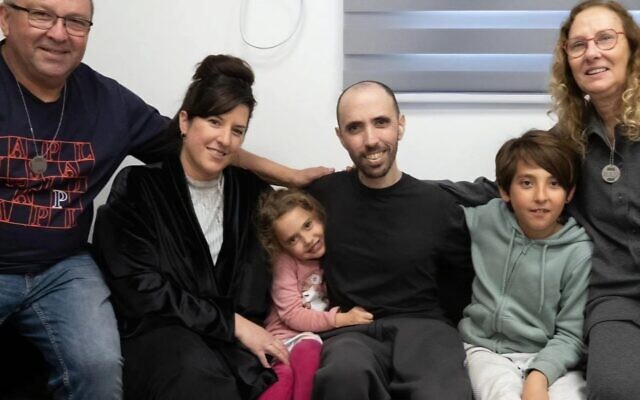
My favorite picture from Feb. 22 was of Tal seated on a couch, with Naveh on his left and Yahel on his right, along with Adi and his parents, Gilad and Nitza Korngold.
I am happy and relieved for the entire family.
The bodies of four hostages, the last on the phase one list, were returned the evening of Feb. 26. That leaves 59 hostages (more than half of whom are believed dead), but arrangements for their return have yet to be finalized.
“This is not a moment of joy or gratitude. It is a moment of relief—one that, for the first time in a year and a half, allows us to breathe,” Or Sella wrote on Facebook after Tal was freed. “We must continue demanding the immediate release of all the hostages. And only then can we begin to rebuild.”
comments