



Israel Expropriates Tomb of the Prophet Samuel
A-Nabi Samwil is a village trapped in a national park.
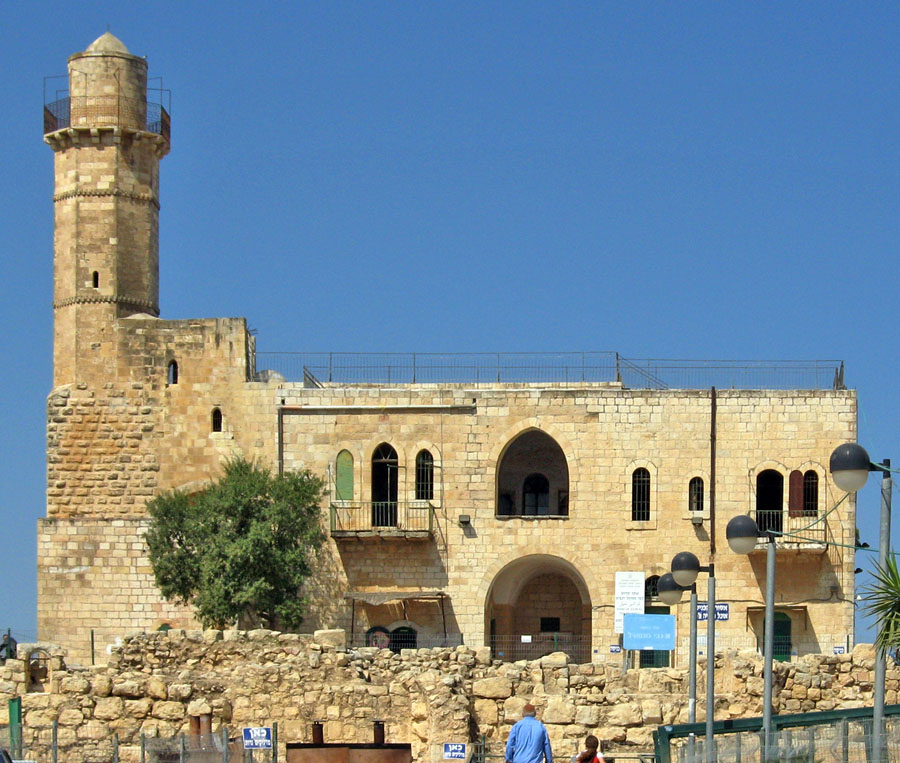
While the Prophet Samuel figures large in the Hebrew Bible, his tomb literally and figuratively looms over the landscape here. Known as Kever Shmuel ha-Navi in Hebrew and Qabr Nabi Samwil in Arabic, the site, located five miles northwest of Jerusalem, is the most notable feature on the horizon seen from Hwy. 1 as one ascends to the Holy City.
Perched on a scenic hill 2,979 feet above sea level, the 865-acre Israeli national park includes the site of a Biblical town, a Crusader fortress and church, and a 14th-century Mamluk mosque crowned with a minaret erected 100 years ago in the British Mandate era.
Most residents of the Arab Palestinian village that existed on the hilltop around the shrine fled following the 1967 Six-Day War. Their abandoned town, once home to more than 1,000 people, was demolished by the IDF in 1971 to facilitate the archaeological excavation. The remaining families were forcibly relocated a few hundred meters downhill to a site also called a-Nebi Samwil.
Now, Israel has further tightened its control of the holy site/national park, designated according to the Oslo Agreements as part of Area C. The Israeli Civil Administration recently issued expropriation order H/02/26 “for public utility purposes” for the tomb and the 28 acres surrounding the tourist and religious center which had hitherto been managed by the Islamic Waqf.
The Israeli anti-occupation activist group Peace Now decried the annexation, saying for “the first time”, the Jewish state’s Civil Administration is expropriating “a Waqf holy site in the occupied West Bank.”
The justification given by the Civil Administration – a main operational arm of the Ministry of Defense’s Coordinator of Government Activities in the Territories (COGAT) that controls the territory Israel captured in 1967 from the Kingdom of Jordan – is that a development project will be launched “to preserve the archaeological site of the tomb of the Prophet Samuel.” However, Palestinian analysts and scholars speak of Israel’s “use of archaeology and religion” to “undermine Palestinian land and identity.”

“Once again,” stated Peace Now in a press release, “we are faced with decisions by a Civil Administration, operating under Finance Minister [of Finance Bezalel] Smotrich, which are aimed at expanding and deepening the annexation. From plans to expand settlements and unprecedented declarations of ‘state land,’ the Civil Administration has moved on to taking control of heritage sites and is now appropriating religious sites, creating tension in some of the most peaceful and sensitive places in the West Bank. The Israeli government’s messianic agenda should have been halted long ago. Instead, every day seems to put us further at risk and create the conditions for turning a political conflict into a religious war.”
The Nebi Samwil National Park, established in 1995 and operated by Israel’s Nature and Parks Authority, symbolizes the complex character of Judea and Samaria, known by most of the world by its Jordanian-era name, the West Bank. Not only is the site revered by Jews, Christians, Muslims and Bahá’ís, but their overlapping traditions have led to twin tombs for the prophet – one in the crypt of the 900-year-old Crusader church which Jews pray at, and a second on the ground level of the mosque where Muslims worship.
Jews observe Iyar 28, this year celebrated on May 15, as the hilula (yahrzeit) of the Prophet Samuel. The Shmuel Ha-Navi Yeshiva is housed in a trailer at the entrance to the national park. An IDF outpost, protected by a concrete anti-sniper wall, a military antenna and cameras, stands between the entrance to the Palestinian village and the antiquities site.
Rounding out this history, in the 11th century, the Crusaders first viewed Jerusalem from Nabi Samuel on their way to conquer the city. They called the ridge the Mount of Joy (Mons Gaudi). Here in 1192, during the Third Crusade, Richard the Lionheart wept at the site of the distant holy city before turning back. During World War I, decisive battles were fought here between the Turkish and British armies, and on the night of April 22, 1948, during the War of Independence, the Palmach tried (and failed) to conquer the strategic hill.
Controversially, Kever Shmuel ha-Navi in Hebrew and Nabi Samwil is key to both Israeli and Palestinian identity.
Emek Shaveh, an Israeli NGO working to prevent the politicization of archaeology in the context of the Israeli-Palestinian conflict, notes: “The area of the antiquities site is approximately 7.5 acres. Despite this, the Nature and Parks Authority declared an area 100 times this size as a national park, based on its unique flora and Mediterranean landscape. A visit to the national park clearly attests that there is almost no flora on these lands – certainly no unique Mediterranean flora. As far as we understand, with the exception of the archaeological site, there is no justification for declaring the site a national park. For the sake of comparison: the area of the national park surrounding the walls of Jerusalem’s Old City is some 250 acres; the area of Sebastia National Park in the West Bank is approximately 60 acres; in Ein Gedi, to protect the ruins of the ancient synagogue unearthed there, only two acres were declared a national park.”
What would be the best usage for the holy site and recreational area? “Although, ostensibly, freedom of religion is not impinged, an unbalanced picture of Jewish-Arab coexistence is created,” noted an Emek Shaveh report.
“This lack of balance manifests in the fact that the Muslims were forcibly evicted from their homes, they are not allowed to build and develop their village, their legal status is unequal to the status of the Israelis, their part in the history of the site is barely mentioned, and their presence is confined almost solely to the prayer that takes place at the mosque. In the situation created, the antiquities and the archaeological excavations, which constitute a significant portion of the erasure of the Palestinian identity of the village, promote the site as a tourist and religious center, without exposing the visitor to the complex story of the place. Ironically, those advocating for development of the archaeological site at the expense of the Palestinian villagers are preserving Palestinian historical memory unwittingly, since the archaeological ruins that they insist on leaving intact include many remnants from the destroyed village.
“Nabi Samuel is a place of Jewish prayer and tradition, as well as Muslim tradition. Both sides have stated that there is almost no religiously based friction, due to the respect for belief and religion. Strengthening the status quo by emphasizing the religious importance of the site can lower the tension between the sides and enable them to live in respect until a political agreement is made between Israel and the Palestinians regarding the site.
“The area declared as a national park must be reassessed and reduced to the minimum extent.”
Gil Zohar is a journalist and licensed tour guide in Jerusalem.
- Gil Zohar
- Israel
- the Prophet Samuel
- Kever Shmuel ha-Navi
- Qabr Nabi Samwil
- Six-Day War
- Oslo Agreements
- The Israeli Civil Administration
- Peace Now
- Kingdom of Jordan
- Smotrich
- Shmuel Ha-Navi Yeshiva
- Mount of Joy (Mons Gaudi)
- Third Crusade
- Richard the Lionheart
- WWI
- Palmach
- Emek Shaveh
- Sebastia National Park
- West Bank
- Ein Gedi
comments