


The Temple Goes Solar
The installation is expected to save the congregation as much as 11 percent on its power bills over time, potentially as much as $800,000 over 25 years.
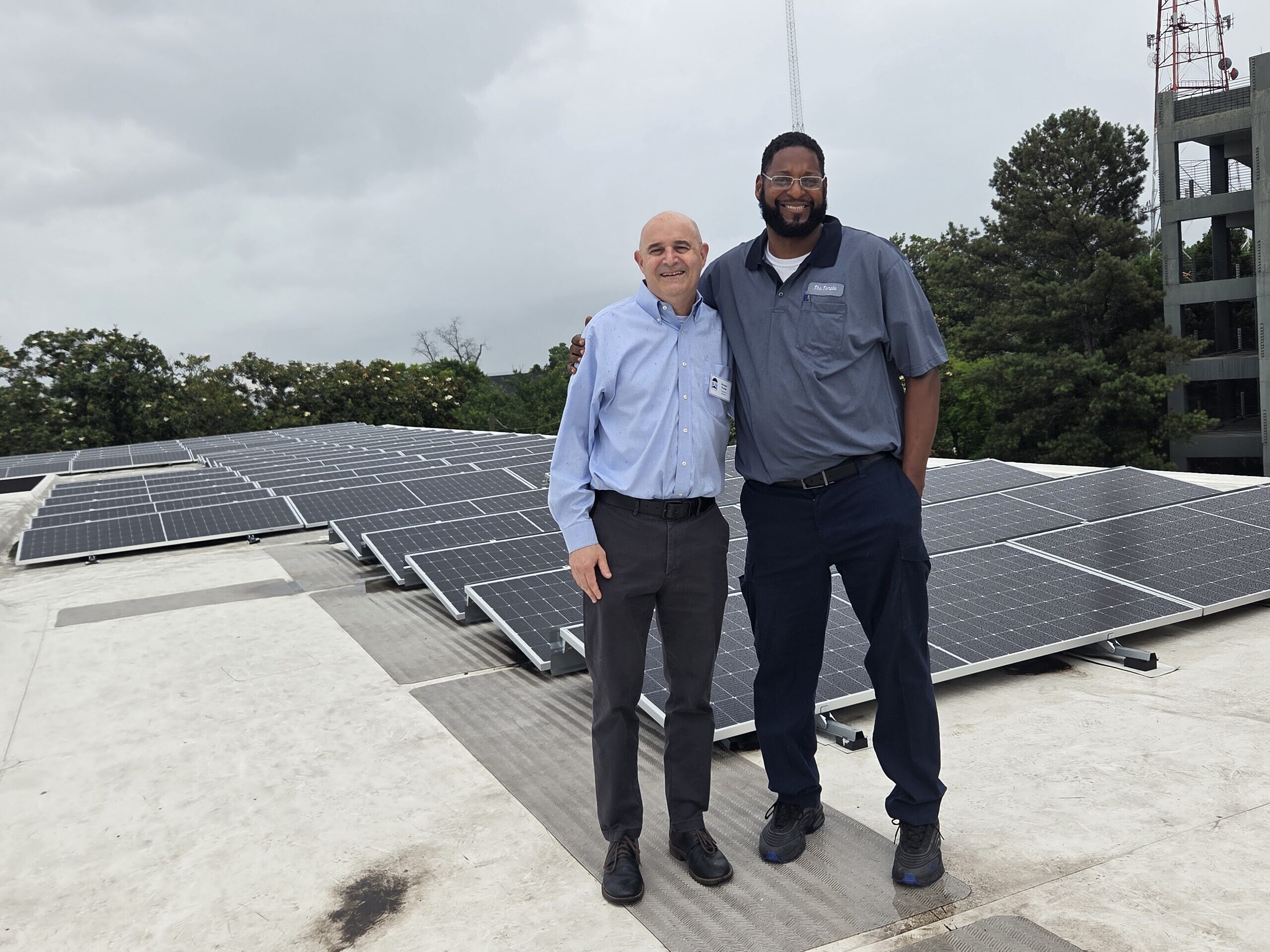
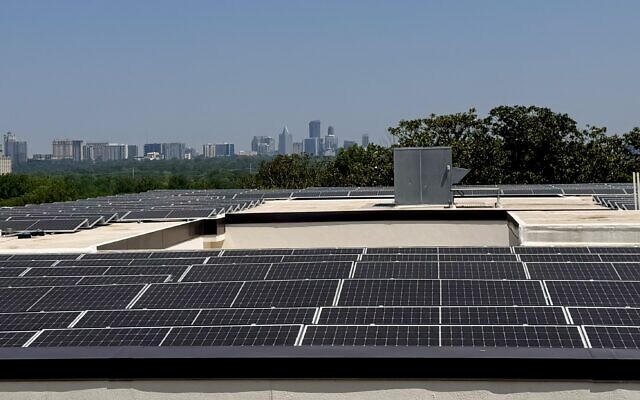
In keeping with The Temple’s commitment to environmental sustainability, Atlanta’s largest Reform congregation has installed 192 solar panels atop its main building that will enable the Midtown synagogue to receive a substantial portion of its electrical power from a renewable source. Not only will the solar power be environmentally friendly, but the installation is expected to save the congregation as much as 11 percent on its power bills over time, potentially as much as $800,000 over 25 years.

The idea began within The Temple’s Environmental Protection and Sustainability group, co-chaired by Ruth Menter and Jessica Landisman Williams. The group often partners with like-focused nonprofits such as Adamah, a Jewish environmental organization, and Georgia Interfaith Power and Light, and had already helped implement smaller acts of environmental initiatives into the synagogue infrastructure and congregational life. According to Menter, the project accelerated after The Temple’s new executive director, Jeremy Perlin, came onboard in 2023 and when The Temple signed on with Adamah’s Jewish Climate Leadership Coalition. She explained, “With the continuing increase in energy costs and the embracing of other sustainability projects such as recycling, LED bulbs, installation of water bottle refilling station, it felt like the right time to explore solar.”
For her part, Williams, who has an engineering background, described the philosophical thinking behind such a large effort: “So, we are stewards of our planet, and our goal, I believe, is to leave the world a better place than how we found it. And one of the ways we can do that is from an environmental perspective.” She added, “It’s been clear for a long time that one of the ways that we can be good stewards of our planet is to find other ways to provide electricity to The Temple, and solar is a very clean way to do that.”
The decision was made to purchase the panels outright, rather than lease, and to place them atop one of the oldest parts of The Temple’s campus, the Marx Building, which had recently been re-roofed. This made good sense because the lifespan of the solar panels is roughly equal to that of a new roof. The original bottom floor of the Marx Building and the synagogue’s historic sanctuary were built in 1931.
The project required considerable expertise and coordination from both The Temple administration and a group of committed volunteers who studied the options and the overall impact and benefits that would be gained. Eric Vayle, for example, served as the chair of the Building and Grounds Committee at that time, and according to Menter, was “absolutely critical in helping manage the process that led us to be able to make our proposal to the Board for approval.”
Likewise, Brian Banner, an engineer with prior solar experience, assisted in analyzing the various proposals from installers prior to the presentation to The Temple Board of Trustees last September. After the contract was signed, Banner became the project manager on the ground, working with the installer through final technical design, permitting, installation, and activation while coordinating with Temple staff.

The initial investment was primarily self funded by The Temple’s Endowment Fund. Additionally, the synagogue was one of nine 2026 organizations selected for grants from the Jewish Solar Challenge, which awarded The Temple $30,000 for its solar power project.
“We are honored to help such an incredible group of organizations across America make the transition to solar power,” said Jewish Solar Challenge (JSC) Founder Mitchell Schwartz. Schwartz founded JSC four years ago to encourage Jewish organizations to go forward with solar power projects by helping to shorten the payback period. The Temple also will receive a federal tax credit, a process being spearheaded by Temple Board of Trustees member Larry Sommerfeld.
As Perlin explained: “One of the practical aspects is that if we’re not spending more and more every year with Georgia Power, or if we’re able to limit the future increases that are passed on to us by Georgia Power, then that means we can have resources to do more programming. We can invest in our community.” Williams added: “What we have discussed doing is that once we pay off what we owe to the Endowment, then we will put the savings into a special account in the Endowment for future environmental sustainability projects.”
And while The Temple’s new WELC preschool building currently under construction won’t be solar powered, the team says the intent is to incorporate as many environmentally-friendly products and features as possible into the plan.
May 6 was the first day the monitoring app began showing how much solar was being generated. Reflecting on seeing this project come to fruition, Menter said: “After working on sustainability initiatives at The Temple for 10 years, I am extremely proud of what we have accomplished with this initial phase of solar. It establishes our congregation as a leader among Jewish institutions for embracing sustainability and also sets an example for other Jewish congregations and our members.”
comments