



A Man ‘Driven’ to Succeed
How a boy from Macon, Ga., reached positions of power and influence in the White House and CNN.
Dave Schechter is a veteran journalist whose career includes writing and producing reports from Israel and elsewhere in the Middle East.

On June 5, 1967, at 2.38 a.m., a phone rang in an Alexandria, Va., apartment.

A 25-year-old aide to President Lyndon Johnson, serving as the overnight duty officer for the White Home press office, was awakened. The caller was Helen Thomas, a White House correspondent for United Press International.
“Tom, war is breaking out in the Middle East between Israel, Syria, Egypt, and Jordan. Can you confirm that and secure a comment from President Johnson?” she asked.
The young man picked up a second phone in his apartment and, using a secure line installed by the White House, spoke to the duty officer in the Situation Room, who told him, “Mr. Johnson, we have absolutely nothing on that.”
Tom Johnson — no relation to the president — was surprised, but before he could respond to Helen Thomas, the Situation Room duty officer said, “No . . . hold it. We’re now receiving flashes from our embassies.”
The White House aide told the reporter: “Helen, UPI is ahead of us on this. It’s unclear exactly what is happening. I’ll try to provide a White House comment as quickly as we become better informed.”

The Situation Room log showed a flash message from the U.S. embassy in Tel Aviv at 2.55 a.m.
By 5 a.m., the log read: “ALL HELL BROKE LOOSE.”
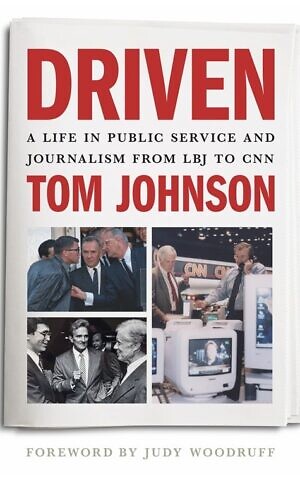
This is just one of the stories that Wyatt Thomas Johnson tells in “Driven,” a memoir published Oct. 1 by the University of Georgia Press. The title is an apt description of the diligence and dedication that Johnson brought to every task and objective put before him.
“Driven” follows Johnson, an ambitious boy from Macon, Ga., on his journey to the University of Georgia and Harvard University, then into the first class of White House Fellows (working with press secretary Bill Moyers) and a post as special assistant to President Lyndon Baines Johnson. In the White House, he often served as notetaker during the president’s otherwise private or classified discussions.
Post-presidency, Tom Johnson — again, no relation — followed Lyndon Johnson back to Texas, where he managed the Johnson family’s media properties, before becoming publisher of the Dallas Times Herald and then the Los Angeles Times.
At age 48, he came home to Georgia as president of CNN. Johnson’s first day on the job was Aug. 1, 1990. The next day, Iraq invaded Kuwait. CNN’s coverage of the Gulf War brought the network global recognition.
Now 84 years old, Tom Johnson possesses a “golden Rolodex” and a wealth of stories covering a span of American history.
[Full disclosure: My years at CNN included Johnson’s tenure (August 1990 to June 2001). For all of the stories I have heard him tell, there was much in “Driven” that was new to me.]
“Driven” takes readers inside the White House during the Vietnam War, anti-war protests, racial tensions, the “Great Society” programs, and into major news organizations, particularly CNN, then owned by Ted Turner, with its headquarters in Atlanta.
Johnson writes in a straightforward manner about his career. If he wasn’t smarter than others, he was determined to succeed by outworking them.
He is candid about the toll that this commitment took on his family and his mental health, and the debt that he owes his wife and two children for their support.
It’s unclear exactly what is happening. I’ll try to provide a White House comment as quickly as we become better informed.
Johnson went public (along with Atlanta business leader J.B. Fuqua) about his battles with depression in a January 2002 interview in the Atlanta Journal-Constitution. “The most important message that I want to convey is this: Depression is a treatable illness,” he writes in “Driven.” The interview “lifted a tremendous weight off my shoulders, and inspired others to share their own stories. More important, it inspired me to become more deeply involved with other major mental health projects.”
Johnson has been a major backer, through philanthropy and public advocacy, of treatment facilities and initiatives, notably Skyland Trail in Atlanta.
In the book’s foreword, journalist Judy Woodruff, whose career began in Atlanta, wrote: “He acknowledges there were times when he considered suicide, and credits his wife, Edwina, with being there, always, as a pillar of support and, literally, a life saver.”
Leading an organization such as CNN or the Los Angeles Times comes with an inherent degree of stress.
Johnson writes that in 1988, as publisher of the Times, he “was being disparaged as antisemitic because of our very independent coverage of Israeli-Palestinian issues. The Times confronted a boycott by many Jewish-led advertisers and temporarily lost thousands of subscribers.”
The vitriol prompted his son, Wyatt, to write a letter to a Jewish newspaper in Los Angeles.
The son wrote that “my father is a wonderful, enlightened man — though perhaps not radical. I know of no prejudices he holds towards any man due to one’s creed, color or faith. He’s not going to slant anything to make any group happy. He will do anything he can to stop antisemitism, but there is also a lot of concern about racism towards other groups, Palestinian included.”
The Times confronted a boycott by many Jewish-led advertisers and temporarily lost thousands of subscribers.
In his memoir, Johnson writes: “It is Wyatt’s letter that reminds me to this day that we did our best to provide accurate, fair, and comprehensive coverage, no matter who it angered or pleased. A quality newspaper doesn’t cater to any one group; a quality newspaper reports the news.”
Was everything at CNN always done to that standard? Johnson is forthright about the challenges and instances where he believes the network came up short and which pain him to this day.
Johnson also writes of being influenced “by some incredible people through different religious communities.” He names three, one being the late Rabbi Alvin Sugarman of The Temple. [In conversations, Johnson called Sugarman “my rabbi” and Sugarman spoke warmly of their friendship.]
- Dave Schechter
- Books
- Alexandria VA
- President Lyndon Johnson
- Helen Thomas
- United Press International
- Tom Johnson
- Wyatt Thomas Johnson
- “Driven”
- University of Georgia Press
- Macon GA
- University of Georgia
- Harvard University
- White House Fellows
- Bill Moyers
- Texas
- Dallas Times Herald
- Los Angeles Times
- CNN
- Iraq
- Kuwait
- Gulf War
- Vietnam War
- Ted Turner
- J.B. Fuqua
- depression
- Atlanta Journal Constitution
- Skyland Trail
- Judy Woodruff
- Rabbi Alvin Sugarman
- The Temple
comments