


From Khan al-Ahmar to Oblivion
For millennia, Bedouin tribes have lived in the Arabian deserts, moving seasonally with their herds of camels, donkeys, cattle, sheep, and goats between the Hijaz to the south, Alexandria to the west, and Damascus to the north.
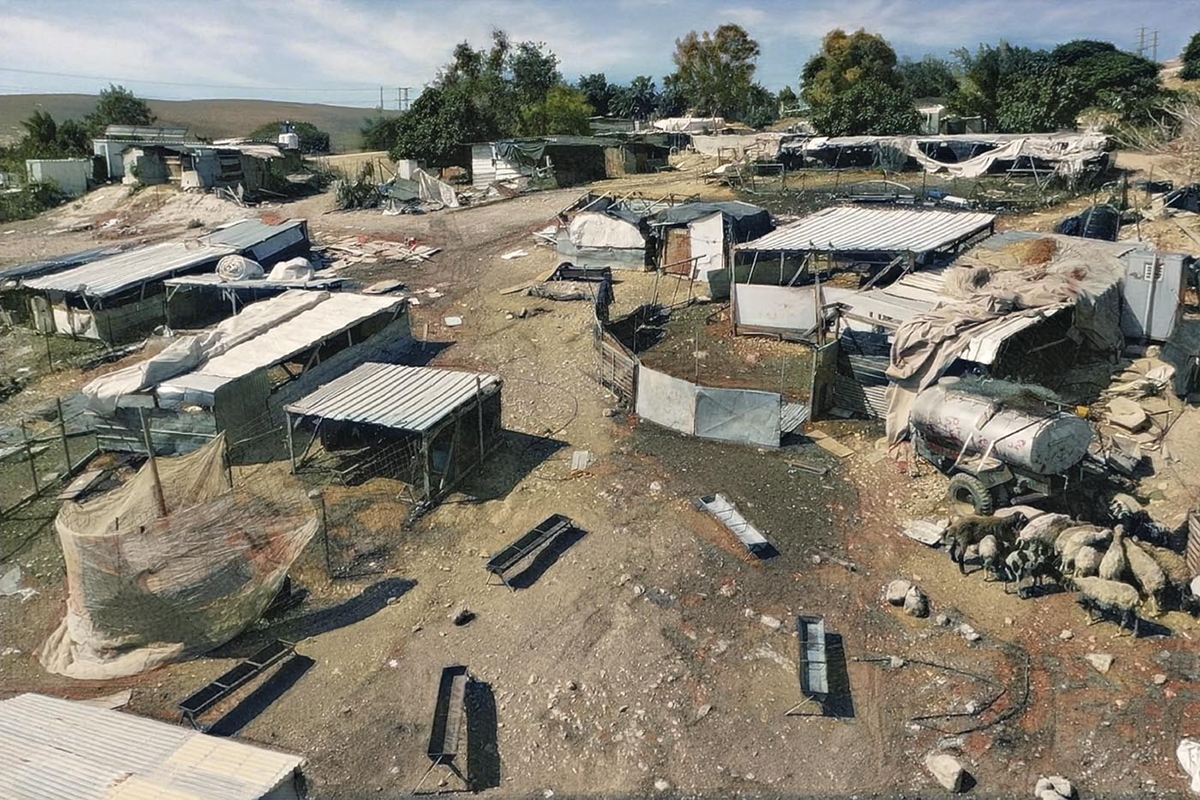
The 2,000 members of the Jahalin Bedouin tribe are living on borrowed time on the desert scrublands east of Jerusalem.

Once nomadic princes of the desert, the today sedentary goat and sheep herders live in Khan al-Ahmar – a series of shanty towns clustered along Highway 1 stretching from Jerusalem down toward Jericho and the Dead Sea. They face the imminent destruction of their homes – none of which have running water or electricity. The Israeli government considers them to be the illegal residence of squatters on state land. The mature trees the Bedouin planted when they settled there in 1973 attest to their decades-long residence in the Judean Desert. In their place, the Israeli government is planning to expand the city of Ma’ale Adumim into the adjacent hills to the north known as the E1 corridor.
Caught in a legal limbo between the Palestinian Authority and Israel under the 1992 Oslo Accords, the Jahalin – all of whom share their tribal name as their surname – are slated to be relocated to a site near a garbage dump in Abu Dis in Area A.
For millennia, Bedouin tribes have lived in the Arabian deserts, moving seasonally with their herds of camels, donkeys, cattle, sheep, and goats between the Hijaz to the south, Alexandria to the west, and Damascus to the north.
In the 19th century, Jahalin tribesmen gradually settled around Tel Arad in the Naqab Desert (now the Negev), and by their residency claimed the wasteland as their home. In 1858, the Ottoman Turks, who had occupied Palestine since 1517, introduced a land registration law for the purpose of collecting taxes. The region’s Bedouin, as with most landowners in Palestine, minimized the extent of the registration of their landholdings to ease the tax burden; a ploy they would later regret.
The collapse of the Ottoman Empire in 1918, and the British and French creation of mandates in the Middle East, forced the Bedouin to submit to new laws where their traditional lands lay. During the British mandate over Palestine (1922- 48), the Naqab’s Jahalin and other Bedouin, who numbered approximately 85,000, turned to farming. Wheat, oats, olives, and oranges were cultivated and sold in the markets of Beersheba, together with the livestock.

Although their way of life changed, the Jahalin nevertheless maintained the patriarchal order of their society, their own legal system, and their own dialect of Arabic. Today, the community’s traditional culture and clan-based lifestyle is under threat.
The Arab-Israeli conflict in 1948 devastated the Naqab’s Bedouin. With the founding of the State of Israel, the majority of the Bedouin fled to neighboring Arab countries – except for the Jahalin, who had no intention of leaving.
As hundreds of thousands of Jewish refugees from the Holocaust and the Middle East arrived, the nascent Jewish State rushed to build settlements and towns to house them. To make room for the creation of the city of Arad, the Jahalin were pushed into the Jordanian-controlled West Bank. Crossing the Green Line, as the 1949 armistice line was called, they migrated northward, settling near Jerusalem on land owned by the West Bank villagers of Abu Dis and Azzariya.
The decade-long peace enjoyed by the Jahalin ended following the 1967 Six Day War when Israel crushed the combined forces of Egypt, Jordan, and Syria, and occupied the West Bank, as well as the Gaza Strip, the Sinai Peninsula, and the Golan Heights.
Throughout the 1970s, portions of land on which the Jahalin tended their sheep and goats were appropriated by the Israeli authorities for military zones and nature reserves.
After a blood feud broke out within the tribe, some of the families were forced out from near Tel Arad. Migrating north through the Judean desert, they settled in their present location in 1973. A turning point came in 1981; the land the Jahalin occupied was seized from its legal owners in Abu Dis and Azzariya and confirmed as state or government land for the settlement of Ma’ale Adumim.
Today, the satellite suburb of Jerusalem houses more than 40,000 people in glittering towers – and is slated to expand to nearly double that size. Some 750,000 Israelis live among 3 million Palestinians in the disputed area Israel captured in 1967 – known as either Judea and Samaria, or the West Bank.
To make room for those newcomers, the government needs land in the West Bank to expand settlements such as Ma’ale Adumim. However, under Jordanian law, which remains in use in the West Bank, selling land to a Jew is a capital offense because private land purchases could serve as springboards toward claims of sovereignty. The Israeli government bypassed this impasse in the early 1980s by issuing a military decree for use in the West Bank: if the military commander confirmed land to be state land, then it was state land. The military authorities had to take into account, however, that most of the property was legally owned and occupied by private Palestinians. Therefore, an objection could be submitted to a military committee and proof submitted that the land in question was cultivated.
Israel’s High Court, which has no jurisdiction over the occupied West Bank, defined cultivated land as soil plowed for 10 consecutive years. According to this definition, the cultivation of olive and orange trees did not count; the soil under the trees had to be tilled. In addition, in some years, drought plagued the region, rendering the plowing of soil impossible and precluding fulfillment of the criteria set by the High Court.
Objections to the Israeli appropriation of property leased to the Jahalin were submitted by residents of Abu Dis and Azzariya, who tried to prove their ownership. But they could not afford the legal expenses incurred by this procedure, which entailed hiring land surveyors and lawyers. The Jahalin themselves did not file an objection – they were tenants.

Jerusalem fine arts photographer Jay Garfinkel has documented the tribesmen who are facing eviction.
“Last year, after the Supreme Court revoked the expulsion order of the Dead Sea Bedouin from the Jahalin, I asked Sheikh Eid Jahalin for permission to take a series of portraits of members of his community,” said Garfinkel.
“He asked me why portraits and not documentary-style photography about the living conditions of his community. That’s a fair question. Among other things, I am an art photographer rather than a documentary photographer. But there is a more significant reason. Thousands of Israelis travel on Highway 1 from Jerusalem to the Dead Sea [daily]. The only thing visible from the comfort of their speeding car is the dozens of scattered huts and shepherd pens that dot the mountains along the route. Most people pass the shepherds’ encampment but never stop to see the faces of those who live there. I chose portraits rather than documentary-style photographs because I didn’t want distance between myself and the person in front of me. I want to avoid the clichés of the noble nomadic shepherd. I want you to see the faces of real people up close.
“I want to tell their story from the perspective of a non-political artist; just a regular Israeli Jew whose motivation to tell this story is informed by his religious values; ‘One law alone is there to be for you, for the sojourner and the native of the land’ (Number 9:14).
“I don’t have to agree with the Bedouin’s lifestyle or their residency quest. I think the Supreme Court decision in May 2023 got it right. What is required of me is to treat them with decency and fairness. It means asking my government not to withhold water and electricity from their camp. It means asking my government to allow work permits so they do not have to live in the squalor of poverty. It does not make me a ‘leftie.’ It makes me a Jew who takes Biblical scripture as binding.”
- Gil Zohar
- Israel
- Jahalin Bedouin
- Khan al-Ahmar
- Jerusalem
- Jericho
- the Dead Sea.
- the Judean Desert
- Ma’ale Adumim
- Palestinian authority
- 1992 Oslo Accords
- Hijaz
- Alexandria
- Damascus
- Tel Arad
- Naqab Desert
- the Negev
- Ottoman Turks
- Beersheba
- Arad
- the West Bank Abu Dis
- Azzariya
- Egypt
- Jordan
- Syria
- the Gaza Strip
- the Sinai Peninsula
- the Golan Heights
- Jay Garfinkel
- Sheikh Eid Jahalin
comments