


Amar’e Stoudemire Inducted into NBA Hall of Fame
For the first time in over a half-century, the Naismith Basketball Hall of Fame has opened its doors to a Jewish former NBA player.
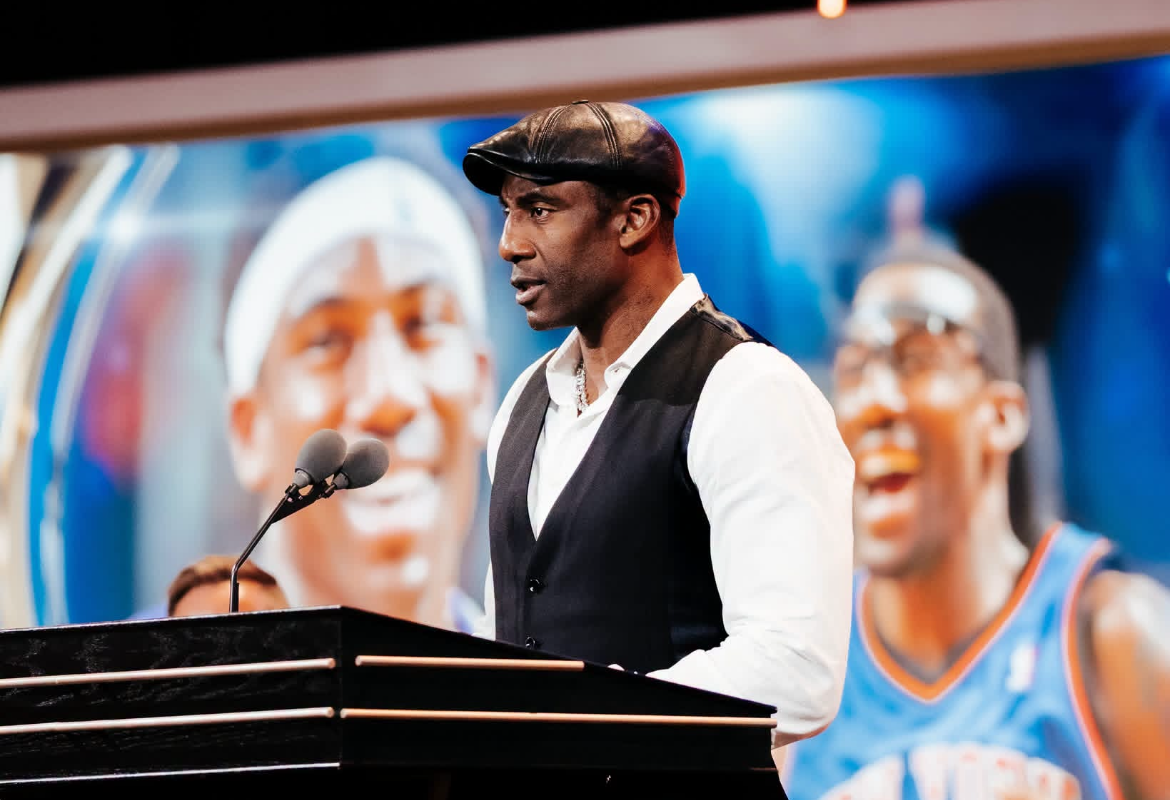
On Sunday, Aug. 16, retired American-Israeli basketball star Amar’e Stoudemire, a six-time NBA All-Star, 2003 NBA Rookie of the Year, and one-time Olympian highlighted the nine-inductee class of 2026. Stoudemire, who completed his formal conversion to Judaism in 2020 after finishing his pro basketball career in the Israeli Basketball Premier League and becoming an Israeli citizen, joins the late Dolph Schayes of the Syracuse Nationals/Philadelphia 76ers as the only two Jewish NBA alums to be enshrined in Springfield, Mass.

In addition to starring for both Hapoel Jerusalem and Maccabi Tel Aviv, Stoudemire served as an assistant coach for the Canadian men’s basketball team in the Maccabiah Games in Israel during summer 2013.
In the decade-plus since his final NBA game for the Miami Heat in 2016, Stoudemire has spoken openly about the impetus for his conversion — his close affiliation with Black Hebrew Israelites, a movement whose core belief is that African Americans are the genealogical descendants of the ancient Israelites. And at the tail end of his nearly 15-minute Hall of Fame enshrinement speech, Stoudemire made sure to touch on his Judaic and Israeli background.
“At the end of it all, I wanted to go back to a place where I had a special connection to,” said Stoudemire, who electrified NBA stadiums throughout the early 2000s as a freakishly athletic power forward for the Phoenix Suns and New York Knicks, and recently launched a Kosher wine brand. “I was learning for 20 years prior, secretly, I was learning Torah. I was learning the Bible, the Biblical understanding of history, and I wanted to go to a place where I can live and also play.
“I took my talents overseas to Israel, and I played in Israel, and I played in Jerusalem. So, I’m there with my family, and now I go from flying on private planes to five-star hotels to now taking a bus. Now we were playing in smaller arenas, but I was there for a deeper purpose and a reason. And my family and I truly enjoyed our time there.”
After exploding onto the NBA scene straight out of high school and edging Yao Ming for 2003 Rookie of the Year (today, American high school players are barred from entering the NBA as they must be at least 19 years old and have aged at least a year beyond their high school graduation) Stoudemire, oozing with raw but undeniable talent, appeared destined to guide the Phoenix Suns to their first-ever NBA title. But several months after averaging a whopping 37 points per game in the 2005 NBA Western Conference Finals, during which his Suns fell to the San Antonio Spurs, Stoudemire, only 22 at the time, underwent microfracture surgery on his left knee that threatened to jeopardize his NBA career.

Though Stoudemire resumed his All-Star and All-NBA caliber play while posting lofty scoring and rebounding numbers for the balance of the decade, a championship proved elusive until he captured the Israeli Basketball Premier League title in 2017 with Hapoel Jerusalem. Three years later, Stoudemire punctuated his nearly two-decade pro basketball career by being named the Israeli Basketball Premier League Finals MVP for the league champ Maccabi Tel Aviv squad.
“I was able to win my first championship in Jerusalem. And then I was able to now go back for my last game as a player to Maccabi Tel Aviv and live in Tel Aviv on the Mediterranean Sea, living the dream. It was great, it was beautiful,” the 43-year-old Stoudemire continued during his enshrinement speech remarks.
“I finished my career with a championship and a Finals MVP. The journey takes you on paths; it takes you down lanes that you don’t quite see in your early years. But I’m very blessed to have been able to persevere throughout my career and really be able to finish my career with a championship.”
Stoudemire’s journey to basketball immortality in Springfield, Mass. may have started in central Florida and finished in Israel, but at one point wound its way through Atlanta. During his fraught and nomadic upbringing, which involved poverty, the tragic passing of his father when he was 12, and five different high schools, Stoudemire briefly lived in Atlanta. And on Feb. 25, 2007, when Stoudemire was enjoying NBA riches as an established veteran in the league, Atlanta was the backdrop to one of the signature evenings of his career when he poured in a season-high 43 points and 16 rebounds.
Four years later, in 2011, Stoudemire, as a first-year Knick, scored a team-high 27 points against the Hawks on Jan. 28 before pacing all scorers with 26 points in the Hawks-Knicks game on March 6. Stoudemire outmuscled former Hawks greats Al Horford, Joe Johnson, and Josh Smith in front of packed Philips Arena crowds during both of the 2011 matchups.
And yet, while he soared to great heights as a celebrity NBA standout who appeared on billboards, frequented Met galas, and sat across from David Letterman and Jimmy Kimmel, Stoudemire always felt that itch to connect with Judaism. Indeed, it was after his first trip to Israel in 2010 that Stoudemire made it his life’s mission to invest himself in Judaism. He eventually became so invested, in fact, that he stepped aside from his assistant coaching role with the Brooklyn Nets in 2022 after claiming it interfered with his Shabbat observance.
“I was always intrigued with the prophets, I was always intrigued by how these guys carried themselves. How they lived their life, how they were so on point with everything, from a righteous standpoint. And so, my mindset was like, ‘How do I get to that level?’ It’s a heavy lift, it’s not easy, I’m not sure it’s possible,”
Stoudemire said back in 2020 while rationalizing his decision to convert. “And so that is what somewhat gave me my love to continue my search, continue to try to clean myself up, clean my character, understand how to carry myself, how to speak properly, how to not use profanity, how to not say certain words, not speak lashon hara [saying negative things about someone].”
Thanks to Stoudemire’s journey, the Jewish community now has a more prominent representation in the basketball one.
comments