



Beth Schafer’s New Music Revisits Old Prayers
Her “Sinai,” released this month on several streaming sites, reflects her thinking about contemporary Jewish liturgy.
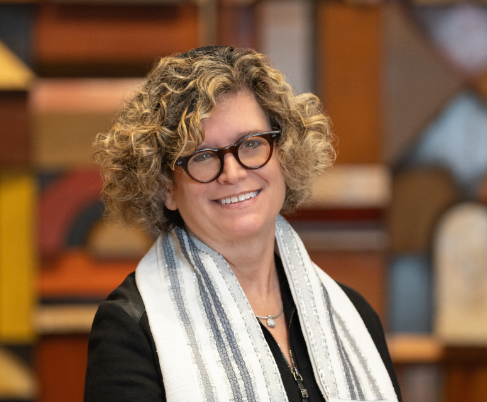
Temple Sinai’s Cantorial Soloist Beth Schafer, who holds the Bunzl Family Cantorial Chair there, used her sabbatical from the Sandy Springs congregation to put the finishing touches on a new selection of her recent reworking of Hebrew liturgical melodies entitled, “Sinai.”

The nine songs include new arrangements of such traditional Shabbat favorites as “V’shamru” and “Shalom Aleichem,” and features a rethinking of the familiar High Holidays prayer, “Avinu Malkeinu,” which means, “Our Father, Our King.”
Schafer’s new arrangement, which retains most of the words of this plea for Divine mercy, is entitled “M’kor Hachayim,” which can be translated as a more gender-neutral title, “Source of Life.” The AJT spoke with Schafer recently about her music, about the introduction of more Hebrew in Reform worship, and her concern about gender bias in Jewish prayer.
Beth Schafer’s new EP, “Sinai” is available on Apple Music, You Tube Music, and Spotify.
Schafer: I think we have a generation of people who are wedded to the music more than they’re wedded to the Hebrew, and so they don’t want their music to change, “Avinu Malkeinu” is the perfect example of that. A lot of people are not ready to let go of the music of “Avinu Malkeinu” that they grew up with or that has defined their holy day experience.
There are others who are curious and open to new ideas, and who, while they wouldn’t have pursued a change when it is offered to them, they embrace it.

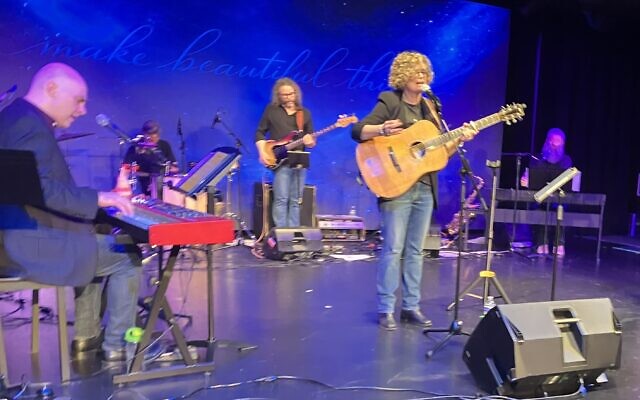
And then there are Reform clergy coming out of school now who have emerged in the last five years from Hebrew Union College, who transcend gender altogether in their liturgy. I think that is going to take a little longer to take root, but I applaud the efforts of the people who are trying to do that. That excites me. It excites me to be able to take an ancient language and reexamine it for our times and how it shows up in our liturgy.
AJT: And do you think that congregations today are more comfortable with the Hebrew as a part of the Reform service?
Schafer: I think we have swung back toward Hebrew in the Reform movement. Yes, in the last 10 to 20 years, I’m thinking of my contemporaries, who are composers. I think they’re still writing in both Hebrew and English with some combination. I don’t know that we’ve swung all the way back; but for this album, it really was a joy to sit in that space of composing with Hebrew.
AJT: And how resistant do you think congregations are to introducing new melodies into the service?
Schafer: Well, this is an age-old question. It’s not new to me or my generation. Each generation has their “Adon Olam,” each generation has their “Oseh Shalom.” Each generation has their “Shema.” They are not set in stone. And so, every time a new generation of composers comes into their own, they are faced with the exact same situation, which is, how do I honor the music and the musical composers on whose shoulders I stand, while also bringing the sound of Judaism into the present and making sure that I attract the next generation into our sacred space? So, I would say every generation has both rejected and embraced at the same time, new music. And I’m no different.
AJT: What kind of a responsibility does that place on you?
Schafer: I believe my job is to provide the best musical experience possible, that is engaging and polished and current and connective. I do try to curate music that comes from a lot of different places.
Some of it comes from the old Reform répertoire or a new Reform repertoire influenced by Eastern European or Ashkenazi styles. Some are Sephardic styles that come from Israel or Middle Eastern. I think it is my responsibility to have a people-friendly sound.
I like music that is accessible and engaging and that people can sing. I love people to clap along, stomp along. I want people to be in sacred conversation with our rabbis and myself on the bimah, and to access a greater power that sometimes we can only tap into through music.
AJT: And when that happens, where does it leave you?
Schafer: It is a joy. It is what fills my tank. To be able to make that music in a congregational setting, to live at the intersection of music and sacred community is everything to me. And I feel that I hold, oftentimes, the emotions of the room in my hands and what I offer can either create a joyous moment or create a contemplative moment. It could bring people closer to texts that they didn’t realize they could have a relationship with. If that makes other people feel joy, then nothing could make me happier.
comments