



Books, Bams, and the Beauty of Mahjong
Gabby and Mark Spatt apply L'dor v’dor to the stimulating game of mahjong.
After 37 years with the Atlanta Journal-Constitution and now with the AJT, , Jaffe’s focus is lifestyle, art, dining, fashion, and community events with emphasis on Jewish movers and shakers.
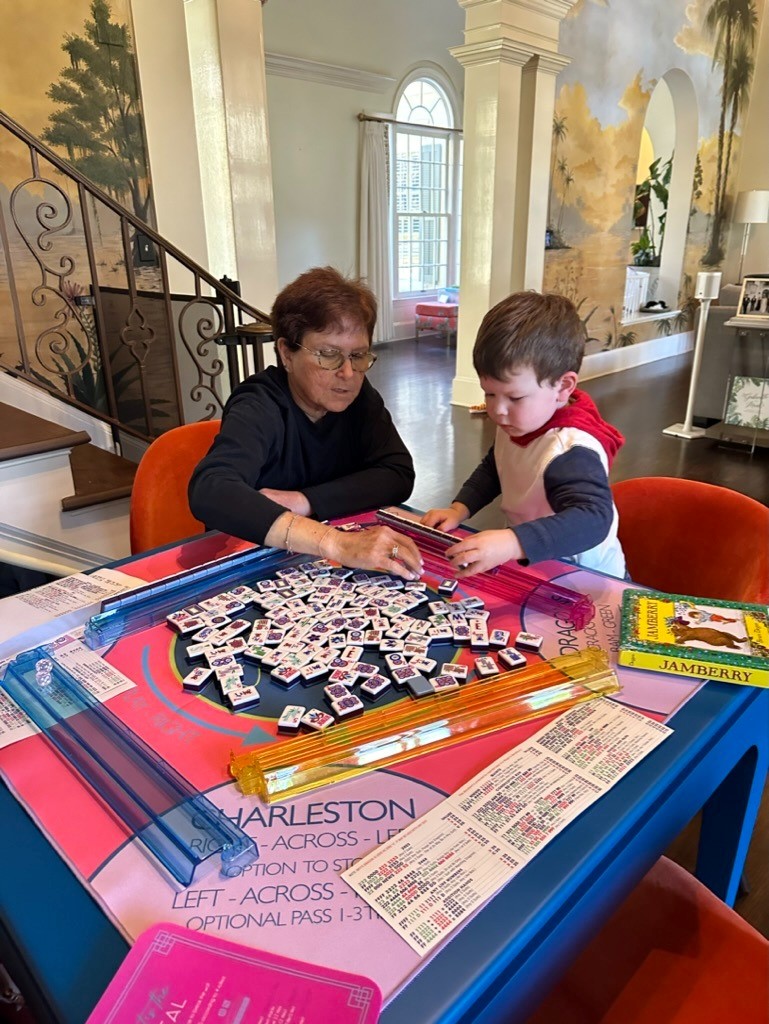
Sandy Springs parents, Gabby and Mark Spatt, released a story book about the learning, bonding, and family fun created involving kids in the popular “Jew-ishy” game of mahjong. No longer is it accurate to envision older women sitting around a table, playing with yellowed tiles, eating mixed nuts, and drinking Crystal Light.

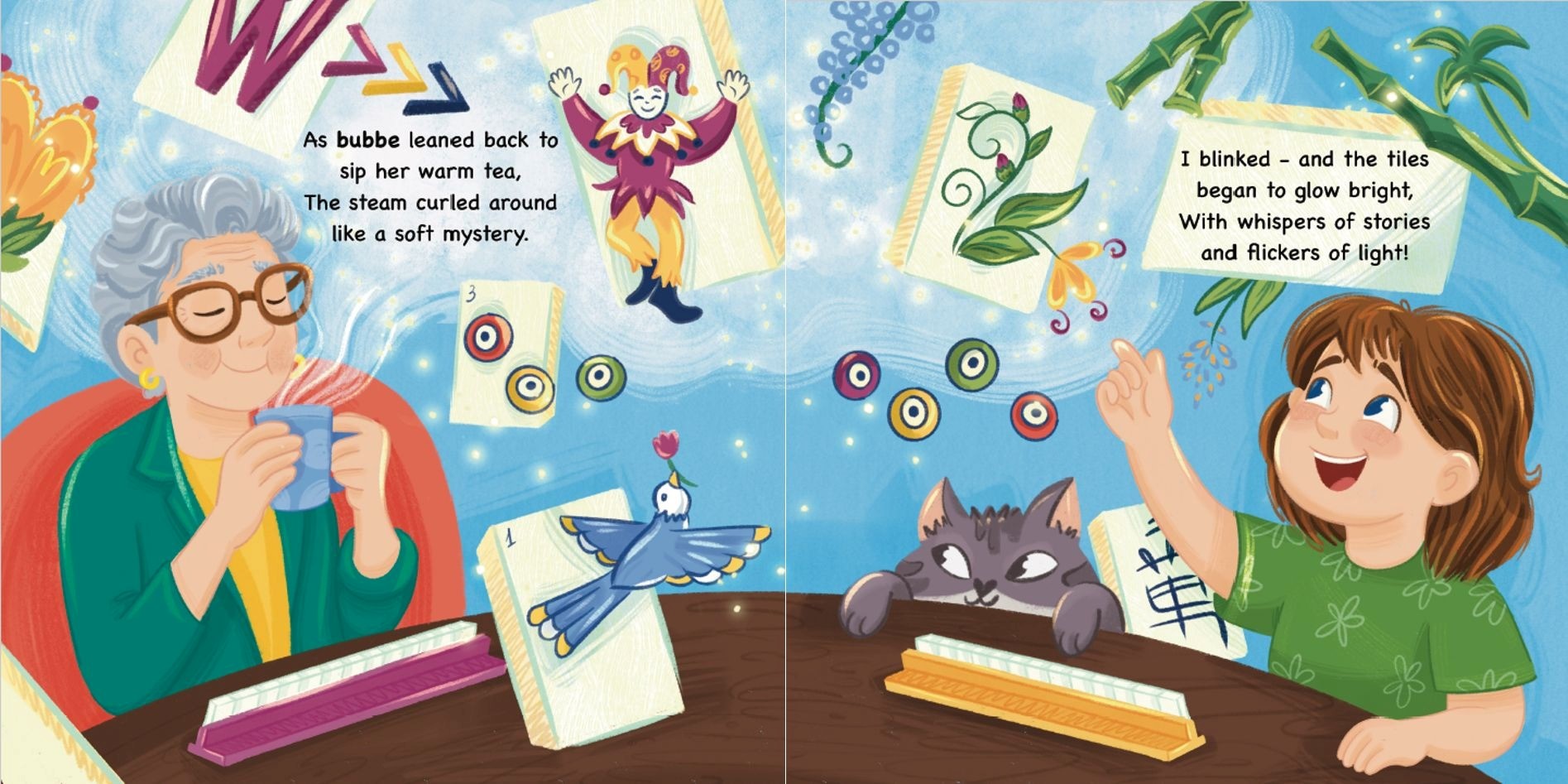
The rebooted moment today is one that’s younger, Southern, and less Jewish. Gabby and Mark Spatt agree. Their four-year-old son, who plays with tiles, inspired their new children’s book, “Bubbe and Bams,” where a mahjong-loving grandmother passes on wisdom and warmth to her granddaughter. The book, and its non-Jewish version, “Grandma Dottie’s Dots,” use mahjong to teach love, resilience, and respect across generations.
The Spatts watched their mothers and grandmothers clack tiles at the table. Gabby’s grandmother played with fellow Holocaust survivors in Florida, and Mark’s with National Council of Jewish Women volunteers in Manhattan. Gabby started playing again in earnest before COVID. She reminisces, “Coming out of a period of isolation, we were all grateful to find ways to be together for that connection.”
She plays at least weekly, and co-founded, Let’s Rack and Roll Mahjong, a mahjong enthusiasts club. As one of Gabby’s first students, Mark considers himself a “reluctant enthusiast and her a great teacher.
Though invented in China, mahjong has long been woven into American Jewish culture. Two of the greatest mahjong moments on the big screen occurred in, “Joy Luck Club,” where Asian women made fun of Jews taking over the game. In “Crazy Rich Asians,” the mahjong scene was pivotal to the denouement. Actually, a group of New York Jewish women founded the National Mah Jongg League in 1937, which standardized the game. Mahjong helped maintain friendships during World War II and was popular in the Catskills. According to Gabby, who has written about mahjong’s Jewish heritage, helped design Jewish-themed mahjong accessories and jewelry, and created the Mazel Card to raise money for Israel after Oct. 7, “it was essential to connect mahjong with that traditional Jewish heritage by having Jewish characters and language in “Bubbe and Bams.”
Mahjong’s resurgence around COVID has extended the game beyond traditional Jewish communities to younger women, especially in the South, who assigned their own touches. Women-owned companies like Dallas’ The Mahjong Line and Oh My Mahjong, and Atlanta’s own Mahjong Maven, now make tile sets that are modern and bright, with all sorts of accessories, tie dye patterns, and personalized jokers featuring the host’s name. There are mahjong social media influencers and meme accounts. When Mark and Gabby hosted a giveaway of their books in a Facebook group with more than 140,000 members, most responses were from non-Jews.

Young families are a new audience. Kids are no longer just watching from the side; they’re playing! According to Mark, mahjong teaches a host of developmental lessons. “When our son was two, we used the tiles to teach numbers and colors, asking him to find the missing tile from a pile or select among the different suits. Now it’s math problems and pattern recognition.”
“Watching adults and playing requires attention, memory, and social skills.” Gabby says. “We have several friends whose elementary school-aged children play, and we see how it helps deepen focus and strategic thinking.”
LaGrange, Ga., native, Ellen Moskowitz Fleisher, has five grandchildren (four boys and one girl) ranging from 10 to 19 who are avid players. She said, “Even though some are well over six feet, when we are together, the first thing one says is, ‘Who wants to play mahjong?’ I taught all of them at a very early age, and they are now pretty well skilled in information technology and math, too.”
A 2022 Japanese study found that teaching children mahjong significantly improved IQ levels. (Higashijima, “Effect of Mahjong on Children’s Intelligence Quotient.” Frontiers in Psychology. September 2022)
“Bubbe and Bams” encourages story sharing. “Our families are incredibly important to us, and we hope our book brings generations together. The concept of L’dor v’dor is behind so much that we love here in the Atlanta Jewish community. Iit’s the last two words in the book: ‘This game isn’t just tiles – it’s stories, it’s lore/It’s love passed along, L’dor v’dor.”
“Bubbe and Bams” is available on Amazon and themissingline.com.
comments