



Chief Uganda Rabbi Visits Atlanta-Area Synagogues
Rabbi Gershom Sizomu, chief rabbi of Uganda, appeared at Congregations B’nai Torah, Ahavath Achim, Shearith Israel, and Etz Chaim.

Rabbi Gershom Sizomu, Chief Rabbi of Uganda, recently visited several synagogues around Atlanta. The trip, sponsored by Masorti Olami, the global organization for conservative Judaism, had him visiting Congregations B’nai Torah, Ahavath Achim, Shearith Israel, and Etz Chaim, sharing his story, songs, and unique perspective on Torah and Talmud.

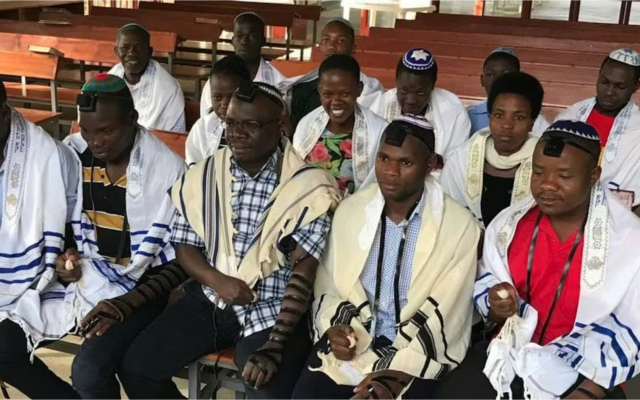
At each synagogue, he explained the history of the Abayudaya, the Jewish community in Uganda and Kenya, although the word, meaning “People of Judah,” is also the Ugandan term for anyone Jewish.
He spoke briefly of how a man named Semei Kakungulu founded their community after rejecting Christian missionaries, supposedly taking the New Testament part off of a Christian Bible and handing it back to them, while keeping the rest. Rabbi Sizomu discussed the Biblical-focused form of Judaism the community practiced until they received a visit from some Israelis in the 1960s, who were shocked to see them making the paschal sacrifice during Pesach.
“We didn’t think they were Jewish, they didn’t think we were Jewish,” Rabbi Sizomu joked.
He shared how the community converted to Rabbinic Judaism after this, and how he himself became the first rabbi in his community to receive ordination in the U.S., studying at the Ziegler School of Rabbinic Studies in Los Angeles, where he graduated in the same class as Ahavath Achim’s Rabbi Laurence Rosenthal.
“Gershom is incredibly sweet and really quite a scholar of Judaism and Jewish text, and of liturgy, and it was really wonderful to learn from him and with him,” said Rosenthal. “Being in such an unusual situation, he was getting flown all over the country. It was always so interesting getting a phone call from him asking to let the teacher know he wasn’t going to be in class because – and this was a real situation that happened – he said ‘the secret service is here to take me to see the president, so please let professor so-and-so know that I can’t come into class today.’”

That was a meeting with President George W. Bush, who had been meeting with representatives of persecuted Jewish communities. Rabbi Sizomu grew up during the reign of Idi Amin and discussed the difficulties of that time – including having to practice completely in secret, only in his home, and of a man who got drunk and started singing prayers on the way home and was then killed by a mob.
He recalled the excitement he and his family felt when they heard about Operation Entebbe – the Israeli operation which saved a hundred men and women kidnapped to Uganda on a highjacked flight – and the absolute elation on the night of April 11, 1979, which happened to be the first night of Pesach, when Idi Amin was finally removed from power.
“We drank a lot more than four cups of wine that night,” Rabbi Sizomu said, laughing.
Rabbi Sizomu gave D’var Torah and led discussions at each place he visited. He spoke about Parshat Toldos at B’nai Torah and Shearith Israel, explaining through the story of Jacob and Esau that while we often see having different relationships with different children as a bad thing, to love them all fully doesn’t mean to love them all the same way. He also shared his favorite Talmudic story at a brotherhood meeting at Ahavath Achim, in which Bruriah, wife of Rabbi Meir, chastises him for cursing misbehaving children, telling him instead to condemn their behaviors, not the children themselves.
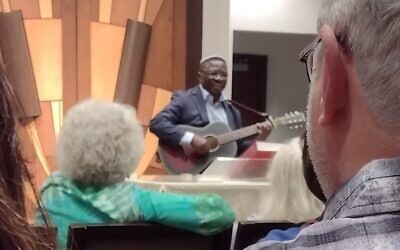
Rabbi Sizomu also shared several songs in his “Ugandan nusach,” although some congregants at Shearith Israel were already familiar with them, from an album of music called, “Abayudaya: Music from the Jewish People of Uganda.”
“So, they knew his music, of the Abuyadaya, from the CD, which actually was nominated for a Grammy,” said Rabbi Ari Kaiman, who also went to Ziegler around the same time as Rabbi Sizomu. “He said ‘what’s a Grammy?’ He had no idea.”
In addition to his religious work, Rabbi Sizomu is involved in Ugandan politics, and holds a seat in Ugandan parliament, working to represent the needs of a diverse region of Jews, Muslims, Christians, and others. He mentioned using the parliamentary stipend intended for buying new personal transport to instead purchase an ambulance for the region, which previously did not have one.
“Gershom is really trying to do incredible work over there,” said Rabbi Rosenthal. “He’s building bridges of peace with the Muslim and Christian communities of Uganda, and it’s an incredible example of how we in the Jewish community could, through our living Jewishly, really make incredible bridges.”
As his visit ended, Rabbi Sizomu shared the hope that, someday, members of the congregations he visited might make a trip out to visit him.
- Robert Garber
- Local
- Rabbi Gershom Sizomu
- Masorti Olami
- Uganda
- Congregations B’nai Torah
- Ahavath Achim Synagogue
- Congregation Shearith Israel
- congregation etz chaim
- Abayudaya
- Semei Kakungulu
- Ziegler School of Rabbinic Studies
- Rabbi Laurence Rosenthal
- George W. Bush
- Idi Amin
- Operation Entebbe
- Parshat Toldos
- Bruriah
- Rabbi Meir
- Rabbi Ari Kaiman
comments