



Eizenstat Lecture Details Israel’s New Military Doctrine
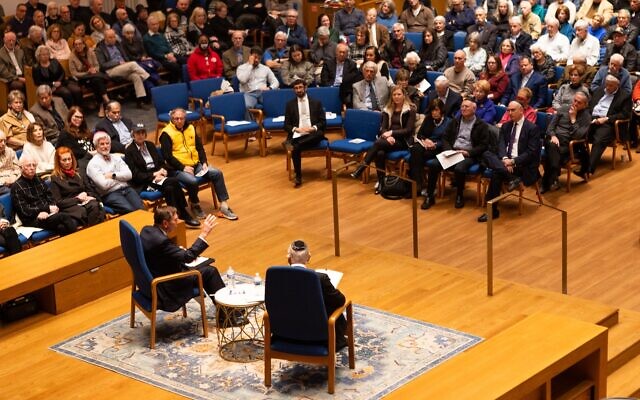
Former Gen. David Petraeus acknowledged Israel’s recent successes and failures during his appearance at Ahavath Achim Synagogue.

The distinguished retired Gen. David Petraeus led his audience at this year’s Eizenstat Lecture through a master class in the past, present, and future of warfare and strategic military thinking.

It was another brilliant program for a series that, for the past 36 years, has brought some of America’s most important leaders to Ahavath Achim Synagogue. This year’s program was skillfully led by Ambassador Stuart Eizenstat, who has served almost continuously at the highest levels of government since the presidency of Jimmy Carter.
Among the subjects he tackled was the changes brought about in the Middle East since Oct. 7, 2023.
Petraeus is a former commander of U.S. forces in Iraq and Afghanistan. He’s a former director of the Central Intelligence Agency and teaches at Yale University.
Among his many interests is being a partner of the New York investment firm of Kohlberg Kravis and Roberts where he is the lead of their Middle East practice. He believes that Israel has made a fundamental shift in its national security strategy. As a result of its experience in the past two years, Israel has a new military doctrine against its foes.
“They will never again allow a force to build up, not just on their borders,” Petraeus says, “but in the region again in the way that they have. And, if they see it happening, where Lebanese armed forces are unable to disarm Hezbollah, the Israelis are insisting they’ll just continue to keep them degraded.”

As a result of that policy, Israel recently killed Hezbollah’s chief of staff, Haitham al-Tabtabai, in an air strike on an apartment building in a suburb of Beirut, Lebanon’s capital. The attack came despite a ceasefire worked out by the United States and France between Israel and the Lebanese terrorist group. Israel has accused the group of trying to rearm itself with smuggled weapons and a renewed attempt to rebuild its force of explosive drones.
Israel’s Prime Minister, Benjamin Netanyahu, in a statement after last month’s attack said the renewed threat of military force will not be tolerated.
Petraeus described Israel’s plan to decimate Hezbollah operatives though the simultaneous explosion of pagers and walkie talkie in Lebanon was described as “sheer genius.”
“That episode,” Petraeus maintained, “started Hezbollah down the road to enormous degradation, the greatest intelligence supply chain operation in history, greater than the Trojan horse.”
That operation and the elimination of 18 of Hezbollah’s top leaders not only took a human toll on the group but made it impossible for them to use the estimated 150,000 missiles and drones that had amassed against Israel.
Petraeus was equally impressed by Israel’s campaign against Iran and its nuclear capabilities. He believes Israel and the United States will not allow the Iranians to attempt to rebuild that capability.
“If Israel sees Iran reassembling certain threatening capabilities, particularly the missiles, they’ll go after them again. Certainly, if they try to enrich uranium they will go after that as well.”

In contrast to what happened in Iran and in Lebanon, Petraeus called the failure to predict the success of Hamas’ Oct. 7 attack, “the worst intelligence failure in Israel’s history.” Israel mid-level intelligence analysts failed to believe warnings that Hamas was preparing to destroy Israel’s electronic monitoring system along the border with Gaza before sweeping into the country from the south, with little resistance from the IDF.
“They made a terrible assessment that this was not possible, but it was also worse than that, really. It was also a terrible military readiness failure.”
Despite all these successes and failures in Israel, Petraeus believes that what is happening in Ukraine is rewriting the battle plans of the future. On the front lines between the Ukrainians and the Russians, traditional combined arms warfare there is a thing of the past. In this deadly no man’s land, conventional manned weapons such as tanks and artillery are useless against much cheaper, and smarter weapons such as unmanned drones.
Petraeus has made seven trips to the battlefield there. The latest was in September, to visit a battle zone where the Ukrainians are using up to 9,000 of the drones each day. They are expected to manufacture 3.5 million of them in the coming year and they will be smarter than ever, controlled not by individuals on the ground but by artificial intelligence in a computer program.
“I think within a year, you will start to see a transition from remotely piloted air assets to algorithmically piloted ones, and that is the future of warfare.”
He envisions swarms of drones on the attack, no longer limited by the need for individual control that can respond to algorithms without human intervention.
comments