



JCRC Renews Commitment to Fighting Hunger
Jewish Community Relations Council of Atlanta supports strengthening efforts to combat food insecurity throughout Georgia.

Alarmed by the possibility of deep cuts to the Supplemental Nutrition Assistance Program (SNAP), the Jewish Community Relations Council of Atlanta (JCRC) ended 2025 with a resolution that supports strengthening efforts to fight hunger throughout Georgia in 2026.

A large group of dedicated leaders, including Harold Kirtz, Abbie Fuksman, Howard Zandman, Sherri Wildstein, Michael Jacobs, and Rabbi Ari Kaiman, gathered recently at the final JCRC quarterly meeting for 2025, held at Congregation Shearith Israel, to discuss steps to address food insecurity in 2026. In opening the meeting, Rabbi Kaiman told participants, “By taking care of one another, we are a blessing and the world becomes a little closer.”
According to Jacobs, president of JCRC, the organization will focus on hunger and food insecurity throughout 2026.
SNAP is the country’s most significant anti-hunger program and provides food assistance to approximately 1.4 million Georgians. The program has reduced food insecurity by 30 percent, according to the most recent figures released. The federal government is currently placing more of the SNAP costs on individual states, and Georgia’s new expenses are expected to far exceed half a billion dollars each year just to maintain current support.
Fortunately, Georgia has a current budget surplus of $14.6 billion, including a rainy-day fund of $5.6 billion, according to figures shared by JCRC, which is urging its partners within and beyond the Jewish community to join their fight to end food insecurity and hunger throughout the state.
The action steps proposed and accepted at the meeting include:

* Meet with Georgia legislators before and during the General Assembly session about the necessity of including a fully funded SNAP line item in the state budget;
* Engage with synagogues, other Jewish organizations and Jewish individuals fighting hunger to enhance cooperation and strengthen the combined efforts;
* Provide resources and connections to faith-based and secular organizations committed to this work, expanding the organization’s communal power and reach through interfaith partnership;
* Gather for Hunger Seder on March 29, 2025, to share progress, resources and interfaith community.
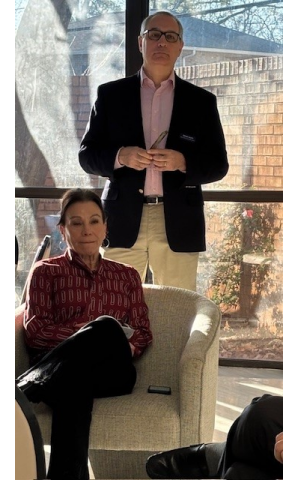
Eliza Lieberman, vice president of public affairs at MAZON, flew in from Washington, D.C. to speak to attendees about the importance of continued giving and the impact MAZON, JCRC, and the Jewish community has made on food insecurity and hunger. She pointed out that members of the military, veterans, college students, indigenous communities, single mothers, and members of the LGBTQ community have been hit especially hard in recent years.
“Jewish values from Torah are baked into our communities. In fact, the Atlanta community is famous for its yearly Hunger Seder, sponsored by JCRC,” she said. “Hunger is not always begging on the street. Often, it’s a parent skipping meals so they can feed their kids, or it’s someone who just lost a job and has no money for food. Pantry lines are too long, and there is a clear role for the government to do more, not less,” she added.
JCRC of Atlanta works to unite Jewish organizations, agencies, synagogues, and individuals into a community of conscience and action and to engage with interfaith partners in the general community around issues of concern.
MAZON: A Jewish Response to Hunger is a national organization fighting to end hunger among people of all faiths and backgrounds in the U.S. and Israel. For more than 40 years, MAZON has been committed to ensuring that vulnerable people have access to the resources they need to put food on the table.
comments