



Jewish Film Festivals Seen as Important for Messaging
Albi, a relatively new organization set to change the relationship between Palestinians and Jewish Israelis, was an active participant in the recent Atlanta Jewish Film Festival.

America’s Jewish film festivals have an important role in influencing not just Jewish history but the Jewish future, behind a recent effort by a former longtime executive of the New Israel Fund (NIF), Libby Lenkinski, who for 14 years was the vice president for public engagement at the left leaning social and political advocacy group.

Lenkinski, who was responsible for the organization’s communications and its community partnerships, has started an organization called Albi. It’s described as establishing “paradigm-shifting narratives by and about Palestinians and Jews.”
The recently completed Atlanta Jewish Film Festival (AJFF), one of the nation’s largest and most ambitious screening events for productions with a Jewish theme, was seen by Lenkinski as an important opportunity for promoting what she hails as some of her organization’s most important goals.
“We’ve been sold some pretty unhealthy and untrue bills of goods,” she observes. “One is that war is the only inevitable present and future in Israel. Another is that endless division is somehow going to help us. And so, I’m looking for stories that break through in some way.”
She and the New Israel Fund found in the 49 films that were shown during the recent festival at least six that reflected the kinds of story that can change existing attitudes.
In support of at least one of those films, “Holding Liat,” she visited the festival for three days in February. The film, which had its Atlanta premiere at the AJFF, was scheduled for two screenings at the Tara Theatre and The Springs Cinema. It was among the films nominated for the festival’s Building Bridges Jury Award.

The production had its world premiere at the prestigious Berlin International Film Festival last year and won its top Berlinale Documentary Award. The prominent American filmmaker Darren Aronofsky is listed as the producer.
“Holding Liat” chronicles the anguish of the family of Liat Beinin Atzili, who was taken hostage during the attack by Hamas terrorists on the kibbutz of Nir Oz in southern Israel on Oct. 7, 2023. During the attack, her husband was killed, although his fate was not immediately known.
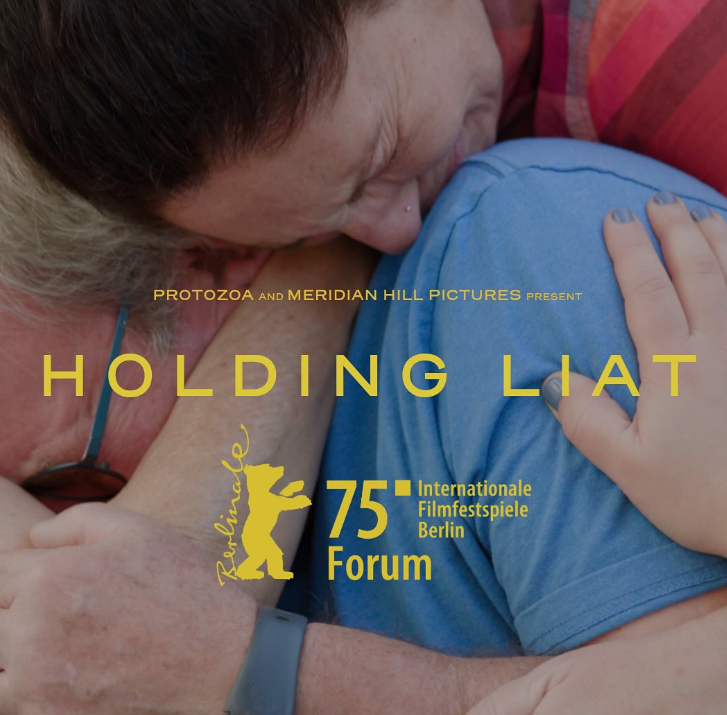
The documentary follows Liat’s parents, Yehuda and Chaya Beinin, New Jersey natives who live in Israel as they search for help in a vigorous public campaign to try to win her release. Lenkinski became involved, she says, early in the production process and continued to provide guidance to the filmmakers as they shaped the film messaging and their point of view.
“They were still documenting, when we got in touch and stepped in to both advise and help in understanding the different political layers to what was unfolding as they were trying to tell the story authentically. And then, when the film was about to release, we basically planned the entire positioning of the film, together with the film team and their PR. And, as an impact partner, we did some deep work with the team to understand … what they wanted to be different in the world as a result of this film having been made.”
The film was made by Lance and Brandon Kramer, who were at this year’s AJFF to discuss the documentary. The two filmmakers are distant relative of the Liat family and the relationship gave them a unique and intimate access from the first hours of the process to gain Liat’s release. Then, after her 54 days in captivity, they followed her through her process of readjusting to her life in Israel and the loss of her husband.
During that period, she came to believe that despite all that she had been through that revenge was not something she could muster. She spoke about that belief in a reconciliation between Israelis and Palestinians both in the film and later during the American premiere at the Tribeca Film Festival in New York.
During Lenkinski’s visit during the AJFF, she attended both screenings of the film, held a gathering for potential funders for her organization, and attended a reception by the New Israel Fund that was planned. She also helped to create a third screening of the film on March 8 that NIF planned at the Tara Theatre.
The events of Oct. 7 and its aftermath have given Lenkinski and her supporters in the New Israel Fund a renewed sense of mission and a belief, as she describes it that positive change can still be accomplished.
“After Oct. 7, the attention is clearly there and hasn’t really waned,” she said, “even for a day, and our goal is to engage that attention in positive directions that can lead to better futures and not more polarization.”
comments