



Train, Light Rail Stations Double as Bomb Shelters
In the Big Orange and neighboring cities of Ramat Gan and Bnei Brak, nine underground stops on the Red Line of the Light Rail are open 24/7 as public bomb shelters.
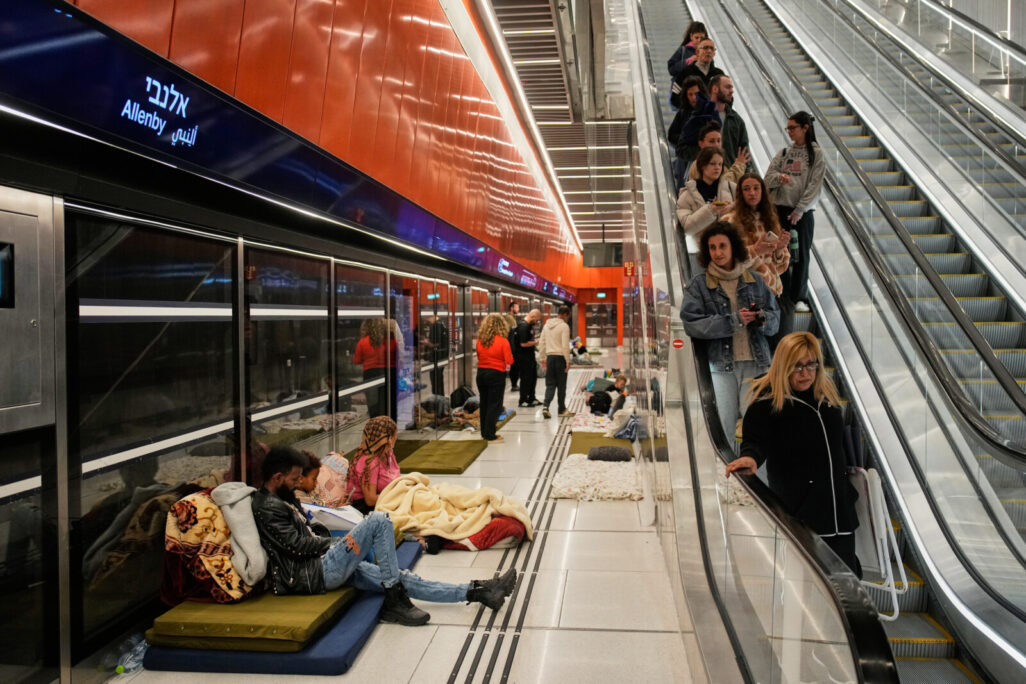
Those who think history doesn’t repeat itself may wish to WhatsApp this writer’s 97-year-old mother, Joyce Raymond, to discuss how millions of Londoners like herself sheltered in the British capital’s Tube stations during the Blitz and World War II. The Luftwaffe bombings traumatized her and her two younger sisters, Anita and Renee White. Today the rain of terror from the skies is being repeated across Tel Aviv and Jerusalem.

In the Big Orange and neighboring cities of Ramat Gan and Bnei Brak, nine underground stops on the Red Line of the Light Rail are open 24/7 as public bomb shelters, including on the Sabbath when there is no transportation service. Some denizens of greater Tel Aviv have taken to sleeping on the station platforms overnight rather than returning home after each all-clear alert.
At the time of writing, the Red Line is not operating. Commuters from Jerusalem to Central Israel have been temporarily required to change trains at Ben-Gurion Airport before continuing to Tel Aviv.
Not surprisingly in a country where kvetching is the national sport, some people have complained not all the underground stations have been opened to serve as protected spaces. The Ministry of Transportation has published its list of stations deemed safe which the frantic hordes may freely enter when the missile alert screams.
The Carlebach station, named after Esriel Gotthelf Carlebach (1908-1956), the Leipzig, Germany-born pioneering journalist, founding editor of the daily Maariv, and cousin of Berlin-born troubadour, Rabbi Shlomo Carlebach, has not been opened as it is not deemed suitable as a secure shelter for engineering reasons.
Similarly, in the Eternal Capital of the Jewish people, Yerushalmis are taking cover underground. While all the stops on Jerusalem’s single tram line are on the surface, the Navon Train Station – which is 90 meters below street level and was designed to function as a nuclear bomb shelter – is now serving its secondary purpose apart from transportation.

Home Front Command and Ministry of Defense officials have praised the Israeli public for its resilience in quickly reaching a safe place to shelter when the siren blares.
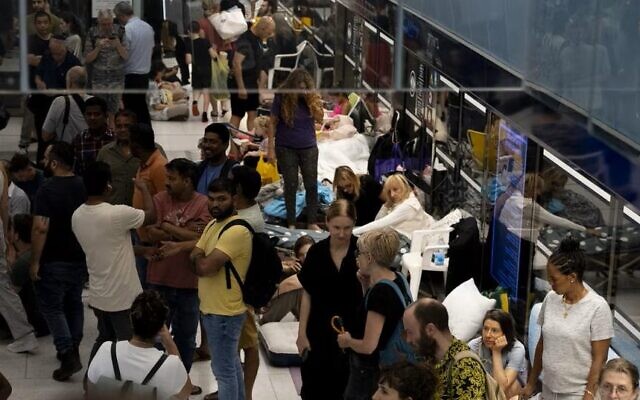
Israel updated its national building code in 1992 following the Gulf War the previous year when Saddam Hussein rained Scud missiles down on Tel Aviv and Haifa from Iraq. Previously, zoning laws had required condominium apartment buildings to incorporate a basement bomb shelter. But the threat of heavier-than-air poison gas attacks made those shelters potential death traps. Thus, gas masks were distributed, and every apartment in new residential buildings is now required to have a reinforced and sealed security room, called a mamad in Hebrew. Typically, these are a bedroom protected with extra thick concrete and equipped with a steel door and heavy shutters. A wet towel placed by the door makes for a reasonably airtight seal. Some newer buildings have been designed so that the area around the elevator shaft and stairs serves as a protected miklat for the entire floor.
It’s a uniquely Israeli way of getting to know one’s neighbors.
The number of fatalities has been miraculously low in the night-and-day barrages from Iran and Lebanon since the current war broke out on Feb. 28. At the time of this writing, 21 people – all noncombatants – have been killed in the hundreds of missile and drone attacks targeting civilian regions in the Jewish state. More than 300 ballistic missiles have been launched, including 170 on the war’s first day. No information has been released on the number of drones fired.
Nine Israelis were killed in Beit Shemesh on March 1 when an Iranian ballistic missile scored a direct hit on a residential neighborhood, destroying a synagogue and collapsing the adjoining bomb shelter.
This was the deadliest single strike on Israel since the Iran war began, with more than 40 additional injuries reported. The shelter was in an older pre-1991 building that had been retrofitted.
A Thai agricultural worker in central Israel and four Palestinian women in a beauty salon in the village of Beit Awwa, southwest of Hebron, were killed March 18 by debris from an Iranian ballistic missile. Barrages employing cluster munitions have hit multiple locations across the region – including near this writer’s home in downtown Jerusalem.
Train service has been interrupted at Tel Aviv’s Savidor station and in Holon, where several buses were damaged. Military censorship prohibits publishing the addresses of hits.
On March 15, Israel Railways reopened the train stations in Hod HaSharon–Sokolov, Bnei Brak, Rishon LeZion HaRishonim and Dimona which were shut down when the war erupted.
Full service resumed on the lines from Herzliya to Ofakim, and Herzliya to Jerusalem. While the latter stops at Ben-Gurion Airport, service at the international air hub remains greatly reduced. Some travelers are choosing to take a bus to Amman, Jordan, or Sharm esh-Sheikh, Egypt, in order to fly abroad.
The situation remains fluid.
For this writer and family, four overseas guests at Pesach seder have had to say, “Next Year in Jerusalem,” because their flights have been cancelled. This writer lives in a charming stone building in the city center built in 1886 that has neither a miklat nor a mamad. When the siren blares, the family heads to the Herbert Samuel Hotel across the street. There, the synagogue two floors below ground level doubles as the reinforced space. Last Friday, as the Sabbath approached and the air raid alert sounded, a guest was playing the violin, serenading those present with the strains of “Shalom Alechem.”
Gil Zohar is a journalist and licensed tour guide based in Jerusalem.
comments