



CIE Brings Middle East Expert’s Insights to Atlanta
Michael Eisenstadt leads the Washington Institute’s Military and Security Studies Program.

Washington Institute for Near East Policy Senior Fellow Michael Eisenstadt shared deep expertise on Iran and the U.S.-Israel relationship during a whirlwind visit to Atlanta on March 22 and 23.
Brought to town by the Center for Israel Education, Eisenstadt spoke to students online and in person at Emory Hillel, addressed Congregation Or Hadash members and others, then made a presentation to the community at The Dupree. In all, he met with more than 100 people.
Eisenstadt leads the Washington Institute’s Military and Security Studies Program, had multiple postings in the Middle East during 26 years in the U.S. Army Reserve, served as a U.S. government military analyst, and has written extensively about Iran.
His Emory Hillel and Dupree sessions focused on the history and future of the special U.S.-Israel relationship, which for the first time involves fighting a war together. The Or Hadash presentation, which was the annual Tillie and Max Stein Israel Lecture, examined the regional effects of the U.S.-Israel war against Iran, the Gaza war and the Israel-Hezbollah fighting in Lebanon.
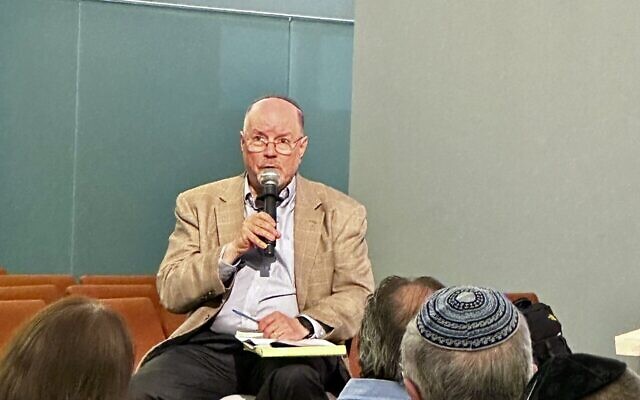
Iran, which after its 1979 Islamic revolution had no superpower backer and only one regional ally, Syria, created its own regional Axis of Resistance “through patience, through perseverance, through tremendous resources invested,” Eisenstadt said at Or Hadash. “And just since Oct. 7, within just a couple of years, much of it has been destroyed.”
CIE President Ken Stein, a scholar who has spent more than half a century studying the modern Middle East, contributed his own analysis and expertise to each of the Eisenstadt appearances as they conversed with attendees.

Before Oct. 7, 2023, “ there was a sense that the U.S. was withdrawing from the Middle East. We were pivoting to Asia. There was a sense that American Jews were definitely distancing from Israel, and perhaps it was irreversible,” Stein told the Or Hadash crowd. “I think antisemitism, like anti-Zionism and anti-Israelism, has thrown American Jews back to one another, even if they don’t particularly like each other’s respective political parties, good, bad, indifferent.”
At The Dupree and for the student audience, Eisenstadt laid out the history of the U.S.-Israel relationship, which has broadly grown closer since the June 1967 Middle East war. The two countries’ cooperation has never been deeper than now. Eisenstadt showed that the military, intelligence, and economic value flows both ways.
But he and Stein warned that things could change if the current war goes badly, with potential effects on elections in Israel and the United States this fall.
“Wars always involve crapshoots and risks,” Eisenstadt said.
Eisenstadt’s Atlanta programs were free, thanks to CIE and the center’s supporters.
CIE is an Atlanta nonprofit with an international reach. The center is dedicated to educating a wide range of learners about modern Israel and its inherent role in Jewish peoplehood. Some of its resources are available through israeled.org; CIE+ members have full access to the site’s growing collection of more than 3,000 posts, as well as special webinars and other benefits.
comments