


Elvis’s Jewish Guru was a Hollywood Hairdresser
Larry Geller developed a deep bond in the mid-1960s, based on their shared interest in the big questions in life.
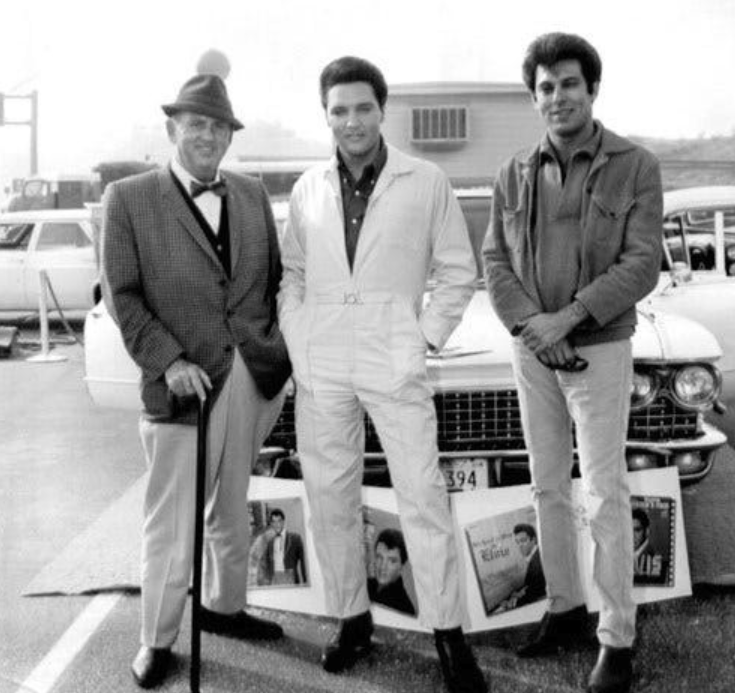
Elvis Presley’s life, who had rocketed to fame after he cut his first recordings in Memphis in 1954, would be irreparably changed by a chance meeting a decade later.

On Thursday, April 30, 1965, he was in Hollywood and needed a haircut. He had an assistant call Larry Geller, a 24-year-old hairdresser who had developed a following of famous names, working for several years in Jay Sebring’s famous salon. Their fateful meeting and its impact on the King of Rock’n’roll take up a full chapter in Peter Guralnick’s recent book, “The Colonel and The King.”
That April afternoon, almost 60 years ago, Geller drove to Presley’s home on Perugia Way in the Bel-Air section of Los Angeles where he spent a pleasant and largely routine 45 minutes washing and cutting the star’s hair. But he was taken aback by a question, suddenly posed.
“Larry, let me ask you something, I mean, you’re a great hair stylist and all,” Elvis said, “but what are you really all about? What are you really into?”
The answer Geller gave Presley that day transformed the relationship the two men had, helped make made Geller, who had been born into an Orthodox Jewish family, one of the star’s closest confidants.
“My main interest, which is really the most important part of my life, is my search for truth, for G-d, and for a greater understanding of myself.”

That answer touched off a three-hour conversation that began with the books on religion and the spiritual life that Geller had grown up with. He touched on the ideas inherent in the study of Kabbalah, the medieval Jewish mystical practice that was enjoying a resurgence of interest in the 1960.
Kabbalah’s emphasis on the Ein Sof, G-d’s infinite presence, and the psychological structure of the sefirot that are present in each individual soul was finding new adherents in Jews and Gentiles, alike. The turn from the materialism inherent in everyday life in America had brought about a new interest in spirituality and the journey of the soul through life.
The decade-long climb that Elvis had experienced since his days as a young truck driver who dreamed one day of becoming a star had happened all too quickly and had left Presley bewildered and searching for answers that fame had not provided.

“Why me, Larry?” Geller quotes him as saying in their first meeting. “Why was I picked out of all the millions of people to be Elvis Presley?”
Geller was about to leave when Presley paused for a moment then asked him to quit his job with Sebring and work for him.
“Larry, I sure don’t believe in coincidences. You came here for a reason more than just doing my hair. Just meet me at Paramount Studios tomorrow morning at eight o’clock. And Larry … don’t forget, you gotta bring me a few of those books you’ve been talking about.”
For the next three years, Geller and Elvis were inseparable. He gradually put together a library of hundreds of books with a heavy emphasis on Eastern and Western spirituality. He also introduced Presley to the leader of the Self Realization Fellowship, which had been founded by an Indian mystic, Parmahansa Yogananda, that was headquartered in Los Angeles.
But he also provided many the classics of American spiritualism that flowered in late 19th century America and continued to be a major force in American life for the next hundred years.
Presley eventually began wearing a pendant around his neck with the Hebrew letters chet and yud, spelling out chai, the word for “life.” It was in part a tribute to the Jewish hairdresser, who in a few short years had become a kind of spiritual guru who travelled everywhere with the singer and the two trunks that contained part of the library of well-worn books Elvis read regularly. It also may have been an acknowledgment that his great-great-grandmother was Jewish.
Guralnick is generally recognized as the leading authority on the singer’s life. He believes that the deep relationship Presley formed with Geller helped fill a deep emotional need that formed after the sudden death of the performer’s mother in 1958.
In the mid-1960s, according to Guralnick, the relationship eventually began to drive a wedge between himself and every else, except Geller. For them, Geller became as Guralnick quotes his wife, Priscilla, “a total threat to us all.”
Eventually, the Colonel would engineer a break between the two, but not before one final Presley masterpiece. In late May of 1966, he recorded the tracks that became his album “How Great Thou Art.”
Although it is strongly rooted in his religious faith, it can also be seen as a tribute to his Jewish spiritual guide, Larry Geller. It sold three million copies and won Presley the first of three Grammy Awards.
comments