



New Mindful Caregiving Book Emphasizes Self-Care
Nancy Kriseman’s new edition of her advice for caregivers teaches how to live with the demands of others.

Earlier this summer AARP, the organization for seniors, and the National Alliance for Caregiving released a study of how caregiving has changed in recent years. The study, which is conducted every five years, estimates that there are 63 million American who are now providing care for another person. That means that almost one person in five is a caregiver. According to the study that’s 50 percent more than it was 10 years ago. The Centers for Disease Control and Prevention has described caregivers the “backbone” of care that often takes place in the home.

The surging demand for assistance as our population ages was one of the reasons Nancy Kriseman wrote her book, “The Mindful Caregiver,” that first appeared just about 10 years ago. And it’s the reason she’s revised the book that’s coming out later this month.
It’s the third book that the Atlanta-based author has written about caregiving. The advice she gives often is based on personal experience. She was a social worker at The Jewish Home here for seven years and started a support group for caregivers there. Later, she provided care for her father and her mother who lived at the Jewish Home as she slowly slipped into dementia as she grew older.
For more than 35 years, Kriseman, a licensed clinical social worker, has worked with clients to overcome some of the concerns and crises they’ve confronted as caregivers. Increasingly, according to the experts who study developments in caregiving, anger and frustration are often a part of helping loved ones through issues that develop with aging and declining health.
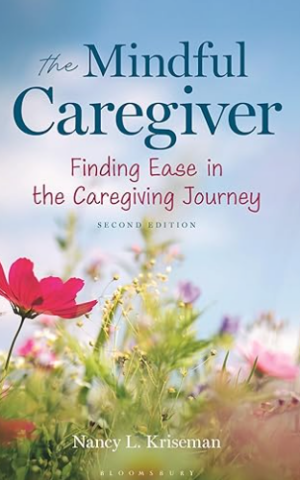
The stress of trying to keep up with the demands of an older parent or relative can have a significant impact on a caregiver’s health. That’s particularly the case if care for the elderly is coupled with the care for a spouse or a child with health care issues. It’s one of the issues that led Kriseman to write her book, initially, and now to revise it a decade later.
“I found that caregivers were not taking the time, making the time, committing to the time that it was that they needed to do to replenish themselves. They were kind of on a rat’s wheel, just circling, circling, circling, and doing all the things that they felt they needed to do to take care of their loved one, and they weren’t very good about taking care of themselves.”

About 30 percent of her book is new material. There are two new chapters in the book that are based on the work she’s done with clients who were involved in the care of loved ones. The first is about how to handle resistance when an older person declines to make the move from their home to a place like an assisted living facility where they can get better care.
Handling that move with care is particularly important if the person is beginning to develop cognitive impairment. It’s not a time to argue with the person.
“I found that a lot of families would try to convince the person with dementia that they should do what’s so necessary,” Kriseman points out. “And all that did was create more angst on both ends. Because so often when a person has dementia, their ability to understand, their impulse control, their social filter, all those sorts of things go by the way. So, it’s really important to help families understand that they can’t argue. This new chapter addresses how to take an alternative approach.”
She also added a new chapter on resilience and how to preserve your own physical and mental wellbeing for what could be a considerable number of years of care.
The latest AARP study found that caregivers can struggle to maintain themselves. One in five say their health is fair or poor and nearly 25 percent say they have difficulty taking care of themselves. Nearly two-thirds of caregivers report high emotional stress, something Kriseman had to wrestle with in the care of her mother.
“It occurred to me that the way that I was going to be the best possible caregiver I can be to my mom was to find a way to hold on to my own spirit. I might take a walk in a park or connect with friends that lift me up, that make me laugh, that fill my spirit back up.”
As the holidays approach, Kriseman counsels that caregivers should think of how to make these special times work for them as well as their loved ones.
“I think we get so caught up on feeling like we’ve got to do it the right way, But honestly, chronic disease and illness changes everything, So, don’t allow the holidays to make you feel guilty.”
comments