



Samaritans of the Bible Re-Enact Passover Exodus
The Samaritans held their paschal lamb sacrifice atop Mount Gerizim on April 10.
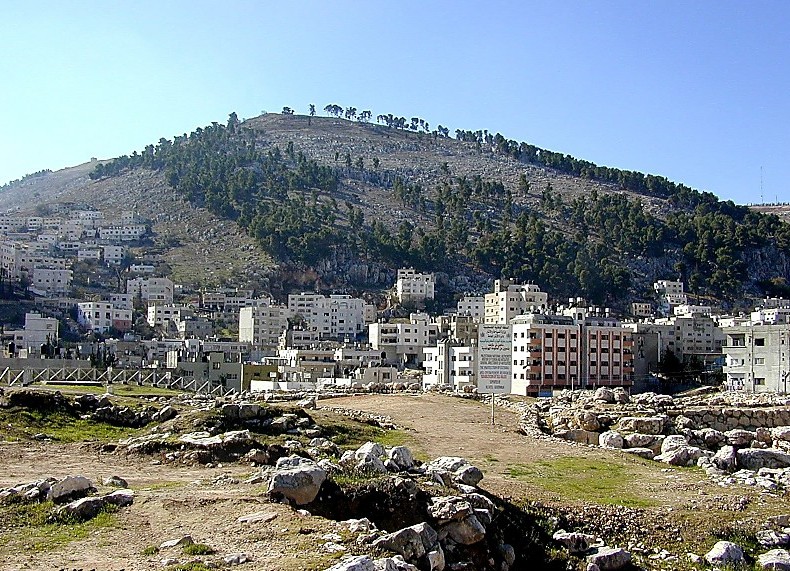
For Jews, Christians, Muslims, and Bahá’ís in Israel, President Donald Trump’s Operation Epic Fury has played havoc with their respective celebrations of Pesach, Easter, Ramadan, and Nowruz. The Samaritans are the latest faith community to have their religious holy day observance impacted by the uncertainty of the tripartite Iran-U.S.-Israel war – their paschal lamb sacrifice and re-enactment of the Exodus atop Mount Gerizim overlooking Nablus, scheduled for April 30, was advanced to April 10 to benefit from the brief ceasefire during the conflict in Iran and the Persian Gulf.

Like the world’s 16 million Jews, the world’s smallest ethnic group – numbering some 925 people – celebrates the Biblical escape from Pharaoh’s Egypt on the full moon of Nisan. While the ancient Samaritans and contemporary Jews both follow a lunar calendar with a solar correction, in some years, the Samaritans celebrate Nisan 15 a month later than Jews. That would have been the case this year. Instead, heeding IDF Home Front Commands’ orders, the Samaritans advanced their unique fête by three weeks.
The Samaritans in the world are the last remnant of the once flourishing Biblical kingdom of Israel that split off from the kingdom of Judah c.920 BCE. They trace their descent back to the tribes of Ephraim and Menasseh, the sons of Joseph of multicolored cloak fame.
After the death of King Solomon, his northern subjects gathered at Shechem (the modern Palestinian city of Nablus) to secede, rejecting his arrogant heir, Rehoboam (I Kings 12:1-20). The breakaway state bolstered its political independence from rival Judah by theologically challenging the beliefs of the older kingdom.
The Samaritans maintain G-d’s chosen site for His sanctuary is Mount Gerizim, an 881-meter peak looming over Shechem from the south, rather than Mount Moriah in Jerusalem 63 kilometers to the south.
Their religion became fossilized in the centuries following the split between Israel and Judah. Very little innovation in thought, literature, or social organization has arisen over the millennia, affording a telescopic glimpse of the pristine Judaism of pre-Rabbinic times.

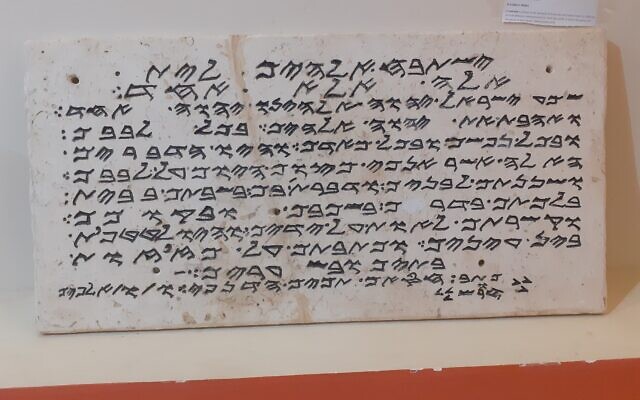
Calling themselves Shamerim, meaning “guardians of the truth,” the Samaritans hold as sacred the Five Books of Moses but have never accepted as canon the Prophets or Writings, or the Talmud (the compendium of Jewish oral law.) Their Torah, written on parchment in the ancient Hebrew alphabet, contains some 6,000 variants from the Masoretic Hebrew Bible. Most are discrepancies over spelling or pronunciation. Some, however, reflect the bitter historical and religious struggle waged 3,000 years ago between the Samaritans and the Jews.
For example, the Ten Commandments as they are known to Jew and Christian alike, are compressed into nine in the Samaritan version. A tenth teaching drawn up from passages in Deuteronomy 11 and 27 proclaims the sanctity of Mount Gerizim, the Mount of Blessing. The Samaritans observe only the Biblical Holy Days – the New Year, Day of Atonement, Tabernacles (Sukkot), Pentecost (Shavuot) and Passover (Pesach). The latter is their holiest festival.
This year, the Passover sacrifice was again led by the community’s High Priest Aabed-El ben Tsedaka ben Yitzhaq. Also known by his Arabic name, Abdullah Wassef Tawfiq, the 91-year-old is the 133rd High Priest in a series traced back to Aaron, the brother of Moses, and his grandson, Itamar.
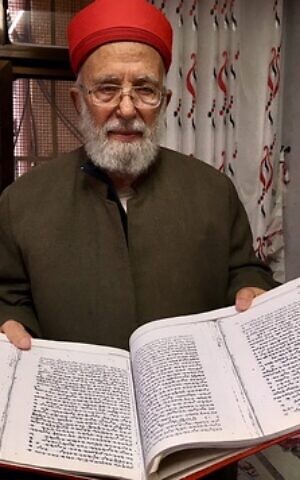
Ben Yitzhaq assumed the leadership following the death of his predecessor, Aaron Ben Hisda, 13 years ago. Prior to his appointment, Tawfiq ran the Har Bracha Tahini factory on the holy mountain. His father, Asher ben Matzliach, served as high priest from 1980 to 1982, and his grandfather, Matzliach ben Yitzhaq, held the role for a decade beginning in 1933.
The genealogy of the Samaritan high priests is well-documented, going back to the Biblical figure, Uziel, son of Kohath, son of Levi. It was the Levites who assisted the Kohanim in their priestly duties in Solomon’s Temple.
Until 1624, there had existed a chain of high priests descended from Eleazar, the son of Aaron, and the nephew of Moses.
“We are the true Israelites,” Ben Yitzhaq says of his people. His long white beard, red turban, and full-length robe bestow upon him an air of authority that belies the marginal number of Samaritans in the world.
The sacrifice of the paschal lamb takes place at dusk on the 15th of Nisan, the night of the full moon, according to the Samaritans’ 354-day lunar calendar. (In contrast to Judaism, which adds an extra month seven times in a 19-year cycle, the Samaritan elders determine leap months on an ad hoc basis.) The ritual itself has been faithfully preserved across the generations and is a literal observance of the Passover slaughter commanded in Exodus 12.
Half an hour before sunset, a crowd of chanting males carrying cleavers and wearing rubber boots escorts the high priest to the sacrificial site, a plateau 80 meters from the summit.
They are dressed in flowing white ceremonial robes or plain white shirts and pants, their heads covered either with the traditional red tarboosh or the warm Czech wool cap popular with local Arabs during the rainy winter season.
Ben Yitzhak, wrapped in a tallit, leads a semi-circle of heads of families in the rhythmic chanting of Hebrew verses from the Samaritan Pentateuch describing the Exodus from Pharaoh’s bondage. Other men and boys have readied the sheep for slaughter, binding them by the feet in an earthen altar, a shallow 2.15-meter-long trench lined with stones.
At a signal from the High Priest, the 28 sheep are slaughtered, one for each clan, evoking an ecstatic outburst of chanting and clapping by the entire assembly.
Their white robes splattered with blood, the ritual butchers raise their bloodied cleavers into the air, embrace and kiss each other’s forehead and on the cheeks of their children.
Boiling water is poured over the sheep, the carcasses stripped of their fleece, gutted, salted and impaled on spits for baking. The two ovens, deep pits dug into the earth, are covered with shrubs and wet clay. The fleece and fat are set aside as a burnt offering.
As the sacrifice slowly bakes in the fire-pits, more prayers are chanted. Then, all the community retires indoors to remove their white clothing, emerging dressed in rough garments and heavy shoes, with staff in hand and bundles on their back, ready to re-enact the Exodus.
Exactly at midnight, the earthen ovens are opened. Each extended family claims its lamb, and everyone tears a piece of meat from the sacrifice, standing while eating it quickly together with matzah and bitter herbs to symbolize the hasty departure of the Children of Israel from Egypt and the bitterness of slavery.
After everyone has hastily eaten, the pilgrims circle the sacred precinct in a procession symbolizing the 40 years of wandering in the wilderness on the way to the Promised Land.
They pass a fenced-off slab of rock purportedly the site where Abraham intended to sacrifice Isaac, and an altar of stones supposedly built by Joshua when he assembled the Tribes to hear the reading of the Torah. (Jewish tradition maintains the respective sites of these events are Mount Moriah – Gen. 22:2-14, and Mount Ebal, Mount Gerizim’s cursed sister peak – Joshua 8:30-35.)
The pilgrims then sit down to a festive ritual banquet. The ceremony is open to the public and invitations are available from the Israel Government Tourist Office. Transportation must be arranged privately. Every year, a small group of students of comparative religion and just plain curiosity seekers make their way to Mount Gerizim to watch this ancient rite of animal sacrifice, unique among the world’s monotheistic faiths.
- Gil Zohar
- Israel
- jews
- Christians
- Muslims
- Bahá’ís
- Donald Trump
- Operation Epic Fury
- Pesach
- Easter
- Ramadan
- Nowruz
- Samaritans
- Iran-U.S.-Israel war
- exodus
- Mount Gerizim
- Nablus
- Persian Gulf
- Nisan
- IDF Home Front Command
- Ephraim and Menasseh
- King Solomon
- Shechem
- Rehoboam
- Mount Moriah
- Jerusalem
- Shamerim
- Five Books of Moses
- Book of Prophets
- Book of Writings
- Talmud
- Masoretic Hebrew Bible
- Passover
- High Priest Aabed-El ben Tsedaka ben Yitzhaq
- Abdullah Wassef Tawfiq
- Aaron
- Moses
- Itamar
- Aaron Ben Hisda
- the Har Bracha Tahini factory
- Asher ben Matzliach
- Matzliach ben Yitzhaq
- Uziel
- Kohath
- Levi
- Solomon's Temple
- Israel Government Tourist Office
comments