



The History & Custom of the Wimpel
Rich dives deep into the backstory on a fairly uncommon Jewish custom.
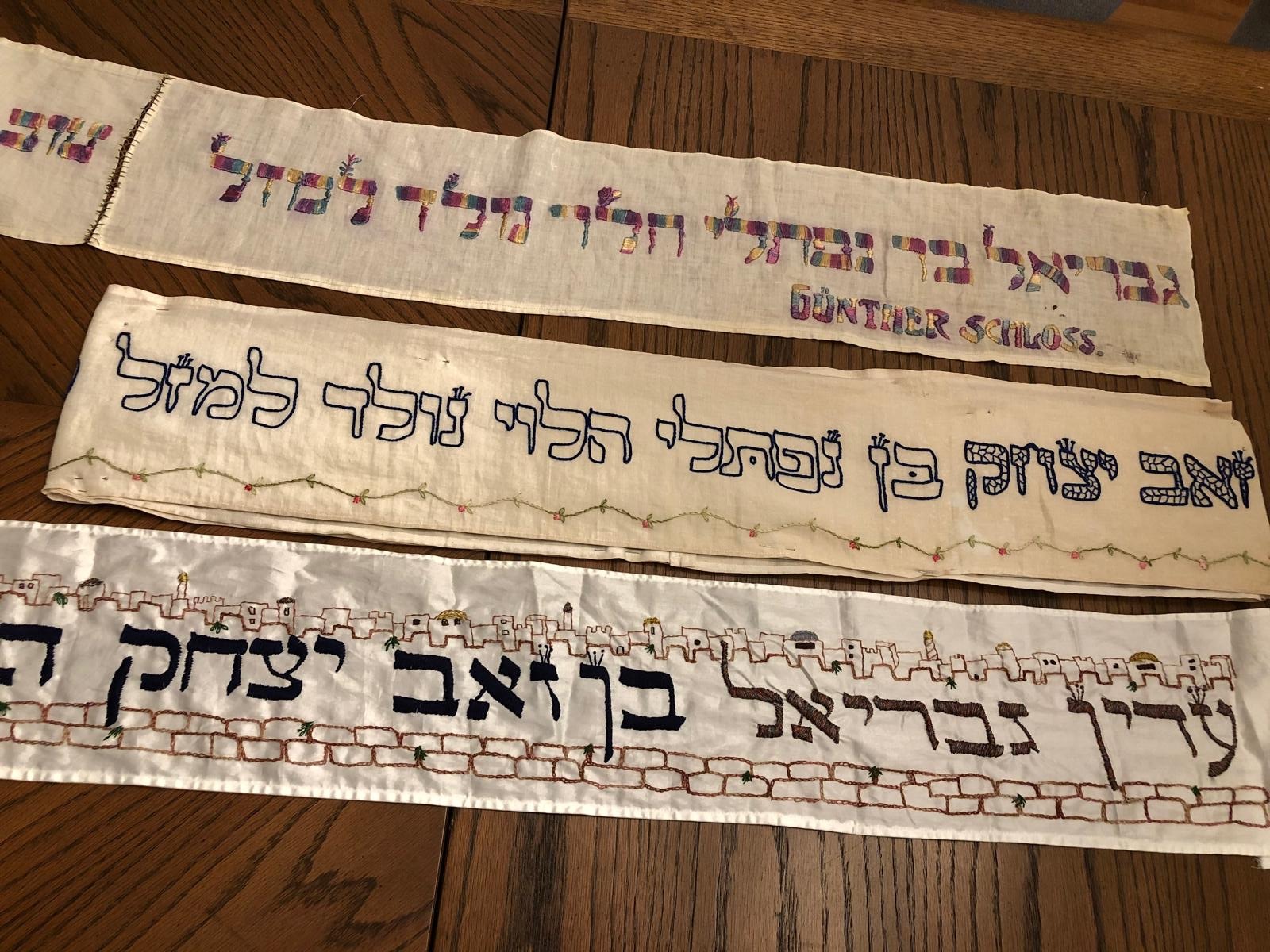
What is it about religious customs that has such an impact on us? In part, customs provide us order, a sense of identity, and a sense of community. So, it is with the wimpel that had usage in Europe’s German Jewish community and also with pockets of German Jewish communities here in the U.S. It was used to wrap an infant boy during the brit milah. After the circumcision, the cloth was washed, cut into strips, and sewn to form a long band. Customarily the boy’s mother would paint or embroider a Hebrew inscription with his name and birthdate. Later, the wimpel could be used to bind the Torah scroll at important milestones in the boy’s life – at bar mitzvah and or at his marriage. Images of the inscriptions appear later in the article.

An excellent example of this is a keepsake is held by the family of Steve and Nora Floersheim, who are members of Temple Emanu-El in Sandy Springs. Steve’s grandfather had one made for his brit milah. Nora has demonstrated it to both her congregation’s board and her Chevra Torah study group on different occasions. Fully unfurled, it extends about 12 feet laterally and is visually impressive.
Steve’s grandfather, Carl Floersheim, came to New York City in the fall of 1878 from Hamburg, Germany. Floersheim migrated westward to small towns in New Mexico and Southern Colorado. He spent time in Las Vegas and Springer, New Mexico, and the latter town was where Steve’s father, Stanley, was raised. Both communities are northeast of Albuquerque and east of Taos. His father served in the Army Airforce during World War II, met his bashert, married her, and subsequently moved to Atlanta for a job opportunity.

For many contemporary Jews, especially those from Jewish communities in Russia, Poland, or Lithuania, a wimpel is rarely seen as this custom was not part of their communal way of life.
Its appearance among Atlanta Jewry is relatively uncommon. Dr. Arthur Gumer, an obstetrician-gynecologist in Sandy Springs, also serves as a recognized mohel in Metro Atlanta. He remarked, “I have now been doing Brit for approximately 26 years. I have seen an occasional wimpel that was handed down in some families, but this is extremely rare. Maybe just a handful of times. On some of them are embroidered or stitched in the names and dates of the previous babies that had a brit with that specific wimpel. I have also seen some very new wimpels that were specifically created or bought for the specific brit that I was asked to officiate at. These are often embroidered and have some padding to them and can be quite beautiful. They would likely have the prayer that is recited at the time of the brit stitched onto the fabric.”
Rabbi Max Miller of Temple Emanu-El explained that one reason for their relative rarity is that some traditions of the old country gave way to modernity in the U.S. He also cited another tradition that is rarely seen and it involves the wedding kittel, a white garment signifying purity, worn by a groom as part of the wedding ceremony. The kittel is rarely seen in Reform weddings and is more common in Orthodox weddings.

Rabbi Adam Starr, spiritual leader of Congregation Ohr HaTorah, is himself a fifth-generation American of German Jewish forebears. He was raised in Silver Spring, Md., and recalled that his grandparents were part of a German Jewish synagogue in Baltimore. In their era, there was a separate section in cemeteries for German Jews. Two generations later, when Rabbi Starr grew up, separate cemetery sections were no longer standard. In fact, congregations that once retained their European identities (German Jewish vs. Ashkenazi Jews from Russia, Poland, Hungary, and Lithuania) had given way to Ashkenazi Orthodox shuls where a common siddur was used. Over the years, the practice of having a wimpel became far less common in these settings.
Finally, Rabbi Norm Schloss, a member of both Congregation Ohr HaTorah and Congregation Beth Jacob, recalls his upbringing in the German Jewish section of Washington Heights on Manhattan’s Upper West Side in New York City. He is a first-generation American and both of his parents were German emigres. His mother arrived in 1938 and his father in 1941. He still has the wimpel of his father who was born in 1915. His wife made wimpels for both his son and grandson. In fact, Rabbi Schloss’ son used his own wimpel to decorate his chuppah.
He noted that wimpels are rarely seen in Metro Atlanta for two reasons. First is that people who attend yeshivot tend to adopt the customs of the yeshiva they attended. The second approach is modernity taking over for customs. It could be explained as “my grandfather did it, my dad did it, and we don’t do that.”
Rabbi Schloss noted several books for those that wish to delve more deeply into the German Jewish world here in the U.S. One is “Frankfurt-on-the-Hudson,” by Steven M. Lowenstein; another is, “Jewish Life in the Villages of Southern Germany,” by Hugo Mandelbaum; and finally, there is, “Jewish Daily Life in Germany, 1618-1945,” by Marion A. Kaplan.
Rabbi Schloss mentioned that a wimpel display is in the museum at Congregation Ahavath Achim, located at 600 Peachtree Battle Ave NW, Atlanta, GA 30327. You can visit it almost any day of the week, but be sure to call ahead at (404) 355-5222 to verify that they are open. Note that they are closed on Jewish holidays.
comments