



The Miraculous Story of George Rishfeld
How a Holocaust child survivor’s life was saved.
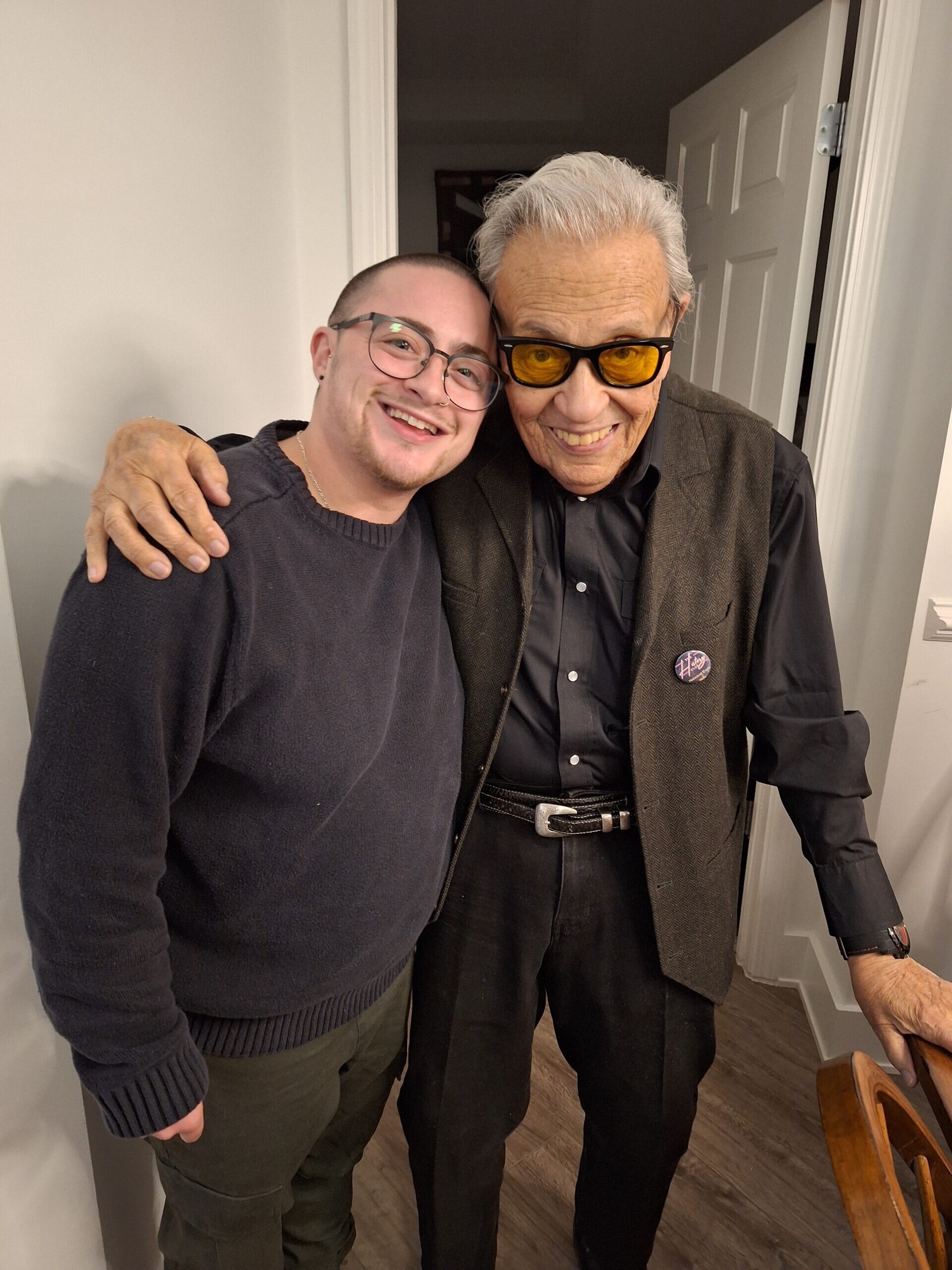
George Rishfeld, now 86, feels certain that his life at the fragile age of two was saved during the Holocaust for a deeper purpose. As a result, he has spent decades telling his story of survival and resilience and is dedicated to educating students and audiences about the Holocaust. His story has touched the hearts and minds of generations of all ages, while inspiring his own grandson to pen poetry to continue George’s mission.

Rishfeld shared, “We are losing most survivors, and I am concerned. As long as I can, I will keep talking.” Even as cancer threatened his voice, following radiation, Rishfeld has not slowed down and added, “Antisemitism has risen from a flame or flicker to a flash storm. We must tell the story. You see the phrase ‘never again’ has unfortunately turned into ‘again’ on Oct. 7.”
While Rishfeld still works, overseeing care packages for first responders, he is dedicated to educating the world, students, and sharing his story. Following this interview, he was on his way to a rural area in Georgia to speak to 600 children about the Holocaust presenting his 50-minute life story.
In 1939, Rishfeld’s beloved parents made a pact with a righteous Gentile family that no matter what happened to them, their child must be saved. Later in life, he recalled his mother telling him, “George, the only way to save you at the critical moment when we were being rounded up was to throw you over a barb wire fence to the daughter of the couple, we had made a pact with as we saw things unfolding.”
If they did not survive, this family would bring up George as their own child, in the Catholic faith. Rishfeld explained, “I’m told by my parents that I was thrown over the barbed-wire fence of the Vilna ghetto, into the arms of Helinka Franchevitz. Helinka took me home to the apartment she lived in with her parents, and they hid me for about three years. They whisked me off to their apartment in Warsaw and kept me safe as their own child.”
When the war ended, Rishfeld was five years old, and the year was 1945 when his parents’ story unfolded. He shared, “How my mother survived was because she could sew, making garments for the Nazis in a factory. The fact that my parents even reunited was a miracle. Following being liberated, she was standing on a train platform in Lithuania coming to find me, and my father showed up on the same platform wearing a Russian uniform he had stolen, as he had escaped from the ghetto in 1943. Ninety-five percent of the people were murdered, and my father had escaped and lived in a cave for 2 ½ years as part of a partisan group. They thought the other was dead and as their eyes locked, in sheer disbelief, they ran towards each other, embraced and were reunited. They came and got me, and the rest is history.”

We are losing most survivors, and I am concerned. As long as I can, I will keep talking.
Fast forward to 2007. Rishfeld moved to Atlanta from California and, upon arrival here, he went to the Breman Museum and volunteered as a speaker. He said, “I’ve been speaking all over the Southeast ever since, including the Georgia Commission on the Holocaust, sponsored by the State of Georgia, and to numerous schools, colleges, churches, and private events, and the homes of both Jewish and non-Jewish community members.”
Rishfeld’s resilience has continued throughout his life, and explained, “It’s all about my mantra: ‘Better and better every day, in every way.’ I’ve stayed positive my whole life because I’m a survivor. It’s for my own well-being and the people around me. It’s that simple. My parents were very positive people. They were destined to survive, and they fought for that.”
Rishfeld added, “Most students are hungry for knowledge. They’re not getting the right perspective. They’re taught hatred by their peers, when they should be learning tolerance and positivity. I want them to be taught the meaning of tolerance, and then I want them to become it. We must know that what happened between 1933 to 1945 happened. It is not a myth, it’s not a legend, and it’s certainly not a fairy tale. More than 11 million innocent people were systematically murdered. History cannot repeat itself. Unfortunately, I’m watching it repeat today. Fortunately, the future isn’t written yet.”
Recently, Rishfeld’s grandson, Max Greyson, inspired by his grandfather, wrote a poem that he hopes will continue to share George’s story. Greyson said, “I’m honored to share my poetry. Since my early childhood, I’ve listened to the remarkable and heartbreaking stories of my grandfather and great-grandparents. They continue to both astonish and move me. I am a social worker, therapist, child forensic interviewer, and a passionate Jew. I am the eldest grandchild and great-grandchild to survivors of the Holocaust.”
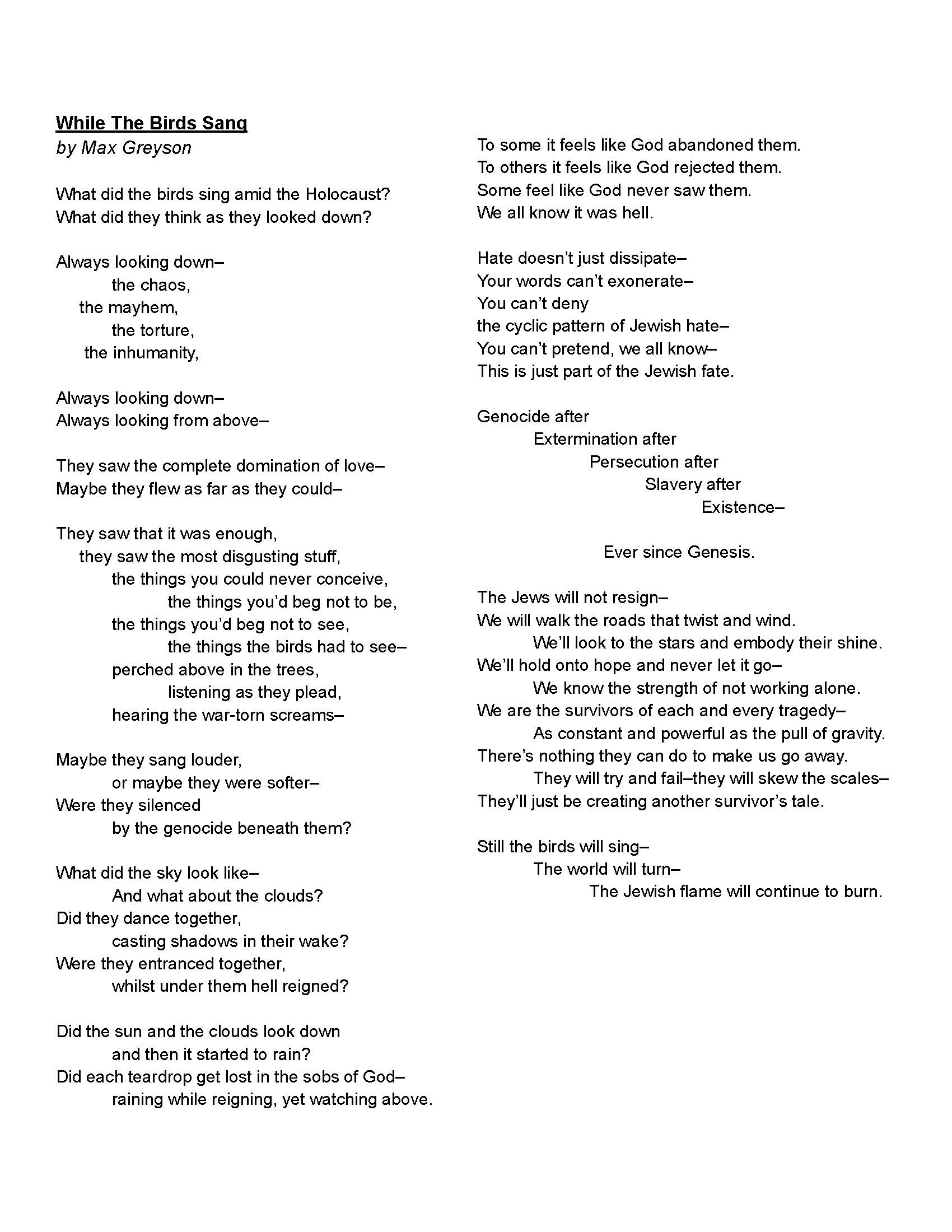
Max shared how his grandfather inspired him to write the poem, “On a beautiful sunny day in May, I was sitting on my back porch, soaking in the sun, listening to the birds — observing nature. Nothing makes me feel more connected to G-d than when I’m with nature. But then a different thought popped into my head: during the Holocaust, while some of humanity’s darkest tales were being written, the birds must have still been singing. I considered how the birds sounded; how they might have hit the ear differently. What would it be like to hear a bird’s song in the torture of a concentration camp? Would it be soothing or depressing? I wondered if the birds sang in a sadder tune — after all, there was nothing they could do but watch. It wasn’t until my grandfather read my poem that my perspective shifted. He challenged me to reconsider this truth: Even during a horrific tragedy like the Holocaust, there were — and always will be — beautiful sunny days. Sunny days where you can look around, feel warmth on your skin, and listen to the birds. Days of gratitude, growth, and hope. You just must look and listen.”
Greyson added, “I hope we all find the courage to imagine life beyond our own experience; to see through someone else’s eyes and walk in their shoes. I hope people linger there long enough to feel not just the weight of each person’s story, but also the hope within it. I hope they will think critically, with an open mind and a compassionate heart.
“My grandfather came to share his story to my class in every level of my schooling from fifth grade to college and my Master of social work program. He brought the most amazing woman into my life — my Bubbie, my grandmother, his beloved Pamela. He teaches me important things about living life to the fullest. To say I’m grateful to him would be an understatement, I couldn’t ever say enough to express my awe for him. When I witness injustice, I don’t remain silent, a proud Jewish man, born from a legacy of perseverance and unbreakable spirit.”
Max’s poem personifies George’s belief that, “Life is not easy to start with, and you must have open ears and eyes because history has a chance to repeat itself. You can’t avoid knowing, hearing, reading, watching and seeing what’s going on in the world. Keep your mind, your eyes, and your ears open. It’s part of a love story and how my parents reunited. It was serendipitous looking for me. Both sides saved me.”
Even with life’s ongoing challenges, Rishfeld continues, “I just lost my beloved wife, Pamela, and living in grief after 54 years. She was the love of my life, my soulmate. I still say stay positive; the glass is half full. I don’t look at the negative as it takes the same amount of energy to be positive vs. negative. The sun shines between your ears. Peace and kindness must exist to have a future and a good future. Righteous Gentiles saved me because it was the right thing to do. I feel the same way now as I educate others.”
Rishfeld added, “Last but not least, believe in something better. Without that, there’s no hope. We still must forge ahead working towards never again.”
comments