



Featured Speaker Warns Politics is Killing Community
Yehuda Kurtzer tells J Street gathering that partisan attacks can destroy the fabric of the Jewish community.
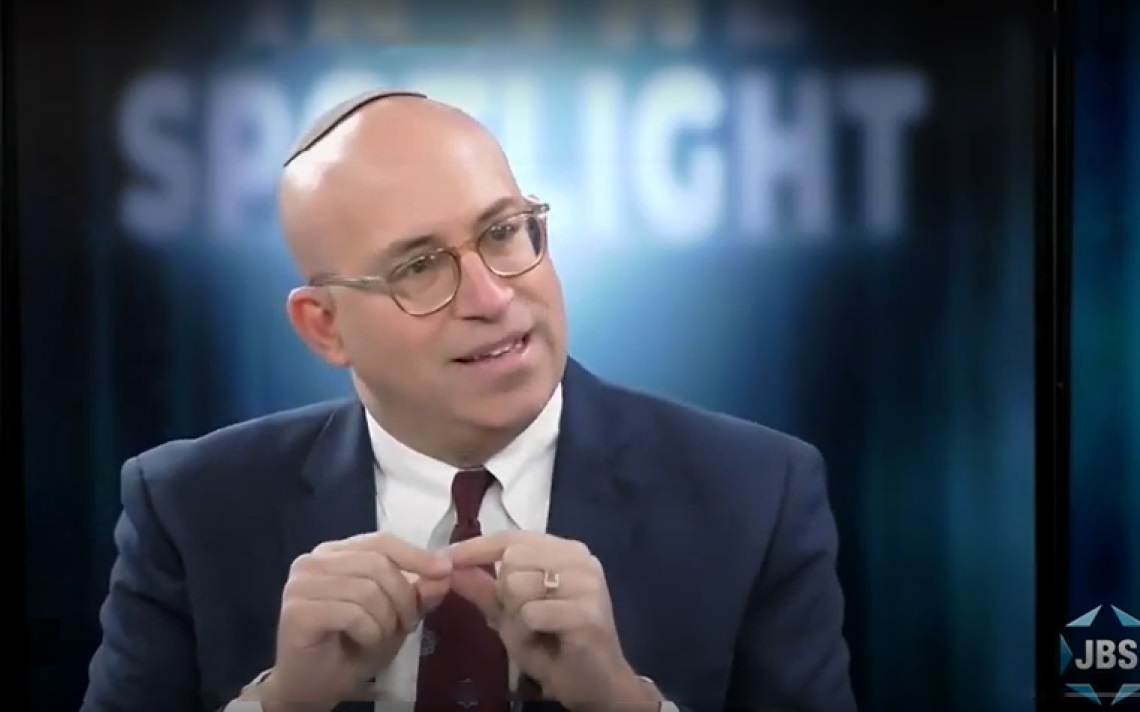
One of America’s most prominent public observers of contemporary Jewish life says it’s time to call a truce between Jews on the left and Jews on the right in this country. Yehuda Kurtzer has been a firm advocate in recent years of lowering the temperature of public discussion about a subject that animates many public discussions among Jews, the rise of antisemitism in the world.

He told the annual meeting of J Street Georgia, the local branch of the liberal Zionist lobby in Washington, that the American Jewish community has succumbed to what he described as America’s “culture of polarization.”
But, unlike previous eras when Americans were divided politically, there is little opportunity for Jews to unite around a higher ideal. In the 1930s, Jews could rally around the cause of opposition to fascism. In the 1950s, it was in opposition to the tactics of McCarthyism and the political leaders of the “Red Scare.”
But today, Kurtzer believes that Jews are unable to come together around a common cause because we often see each other not as allies, but as enemies. Issues of common concern, like antisemitism, are often seen merely as an opportunity to score points in partisan political battles.
“Jews who vote Democrat are inclined to focus on the antisemitism of the right. Jews who vote for the Republican party are inclined to focus exclusively on the antisemitism that they see on the left,” Kurtzer says. “And what that means is we as Americans are not really fighting antisemitism as a collective concern. We’re trying to win elections.”

While he notes that, in the short term, that may lead to a few converts to one side or the other, in the end the result is the erosion of a common collective stand for the good of all Jews.

“We just can’t allow that difference to erode some notion of a collective consciousness. We should think more about what’s in our collective shared interest than we think of what is in our short-term partisan interests.”
For Kurtzer, who is co-president of the Shalom Hartman Institute in Israel and in North America, the idea of developing a more productive dialogue among American Jews is not new. Taking the high road is an important goal of the Institute he heads, which promotes study and learning across the denominational divide. Its Atlanta programs are offered through the Marcus Jewish Community Center.
The Institute has among its goals, “to enrich and elevate the conversation in Jewish life around Jewish ideas, learning, and text beyond the crises we talk about all the time and the politics of the institutions we inhabit.”
Kurtzer wrote in an op-ed in The Times of Israel four years ago that “Jewish support for Israel depends on some notion of Jewish community. Without it, we are vulnerable on both sides of the political spectrum: the narrower your sub-community, the less effective it will be in the long run at mobilizing wider support for its position, and the more dependent it becomes on building unwieldy coalitions.”
Much the same idea is echoed in a book that was written by his co-president at the Institute, Rabbi Donniel Hartman. That work, which was published two years ago, less than a month after the events of Oct. 7, asks the question in its title, “Who Are The Jews and Who Can We Become?”
It was a finalist in 2023 for a National Jewish Book Award. Hartman inquires into how we can speak better to one another to address so many of the issues that divide us.
We just can’t allow that difference to erode some notion of a collective consciousness. We should think more about what’s in our collective shared interest than we think of what is in our short-term partisan interests.
“When I claim that Jewish people can have a shared story,” Rabbi Hartman says, “it is founded on the belief that all those differences do not undermine the shared story. And like a big family, there are times when some members of that big Jewish family are going to aggravate you, but you don’t walk away from them.”
For Kurtzer, the failure of American Jews to come together does not bode well for the future. He believes that the continued attacks by Jews on each other could endanger our continued safety as a community. As a community, he believes, we are moving from a place where we feel threatened not just by those outside.
We must not, he cautions, allow ourselves to undermine our sense of community by seeing other Jews as mortal enemies because they don’t believe as you do. We must not let our partisan difference erode our moral responsibility for each other.
“What we need to do as leaders and as communities,” Kurtzer advises, “is to try to refocus conversations across differences back to the moral commitments that we try to hold in common. That’s what we have to try to do.”
comments