



Rosh Hashanah Poll: Mixed Outlook on the New Year
Heading into the Jewish New Year, Israelis express a poor national mood, though are less pessimistic about the year ahead as they were at this point last year.
Sasha Heller is the Web Editor and Copy Editor for the Atlanta Jewish Times
A recent survey conducted by the Viterbi Family Center for Public Opinion and Policy Research at the Israel Democracy Institute garnered mixed results regarding the public’s outlook on Israel heading into the Jewish new year.

The survey, conducted between Aug. 24-28, was based on a representative sample of the Israeli population aged 18 and older, with 600 Jewish and 150 Arab interviewees taking part.
According to the survey, approximately 71 percent believe that the current Israeli national mood is fairly poor or very poor. The survey found 73 percent of Jews interviewed felt this way with 58 percent of Arabs sharing the same sentiment. The survey found that political affiliation was not a factor with the following results – Left, 93 percent; Center, 89 percent; and Right, 61 percent.
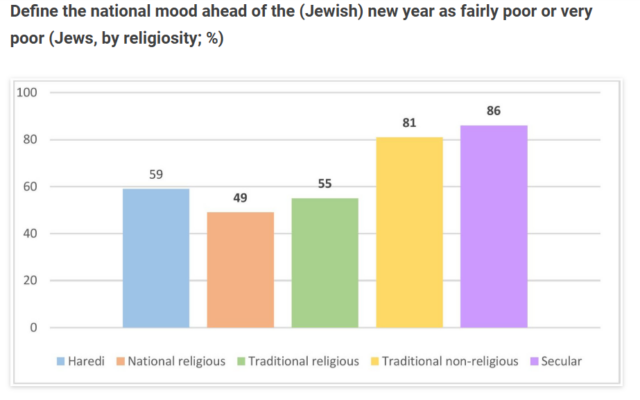
The results for personal mood were much more favorable than the national mood – for the Jewish participants, 48 percent as fairly poor or very poor, and 49.5 percent as fairly good or very good. Among Arab interviewees, the results were 39 percent as fairly poor or very poor, and 52 percent as fairly good or very good.
Breaking down for political affiliations regarding personal mood heading into the new year, the Right registered 35 percent as fairly poor or very poor, Left as 69 percent, and Center as 61 percent.
The survey notes, “We cross-tabulated the responses to both questions in the entire sample and found that among those who rate the national mood as fairly poor or very poor, the majority (62 percent) give the same assessment of their personal mood. By contrast, among those who rate the national mood as fairly good or very good, an even larger majority (89 percent) also define their personal mood positively. In other words, assessments at one level influence assessments at the other.”

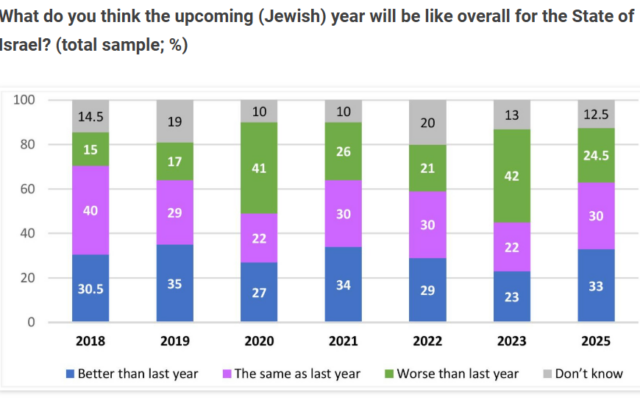
The survey continues, “Our findings show a significant decline in the total sample in the share of respondents who expect the upcoming Jewish year to be worse than the year now ending — from 42 percent last year to just 24.5 percent this year. Concurrently, we found a rise in the share of those who expect next year to be better (from 23 percent to 33 percent) and those who expect it to be similar to last year (from 22 percent to 30 percent).
“Breaking down responses in the Jewish sample by political orientation reveals that on the Left, the largest share of respondents expects the upcoming year to be worse than last year. Those in the Center are more or less evenly divided among the three possibilities, while on the Right, the largest share expects next year to be better than last.”
The survey was conducted via the Internet and by telephone (to include groups that are under-represented on the Internet) with 600 men and women interviewed in Hebrew and 150 in Arabic, constituting a nationally representative sample of the adult population in Israel aged 18 and over. The maximum sampling error was ±3.58 percent at a confidence level of 95 percent. Field work was carried out by Shiluv I2R. The full data file can be found at: https://dataisrael.idi.org.il.
comments